OpenAI has developed an autonomous vulnerability research pipeline designed to systematically identify and remediate security flaws in the Linux kernel. The project represents a shift from traditional, manual security investigations—which often require sustained human effort for each individual finding—to a scalable, automated process. By utilizing frontier AI models, the pipeline can navigate the vast complexity of the Linux kernel, a codebase exceeding 40 million lines that underpins everything from Android devices to cloud infrastructure.
The pipeline operates through five distinct stages: discovery, dynamic validation, exploitability assessment, patch generation, and human review. In the discovery phase, 'Scout' agents identify high-value audit targets based on reachability by low-privileged users, while 'Analyst' agents scan these targets for potential flaws. Validated findings are then tested in isolated virtual machines to produce crashing proof-of-concepts. The system then assesses whether these flaws could lead to local privilege escalation (LPE) or information leaks, eventually generating candidate patches. In a single run in mid-October 2026, this process identified 2,308 candidate findings, successfully reproduced 1,724 vulnerabilities, and generated 948 working LPE exploits.
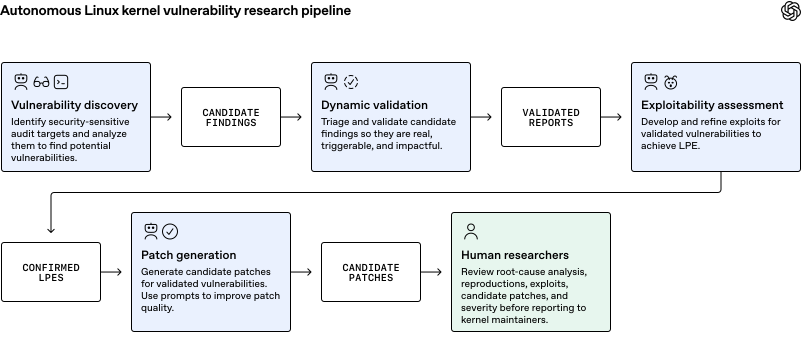
The pipeline operates through five distinct stages: discovery, dynamic validation, exploitability assessment, patch generation, and human review.
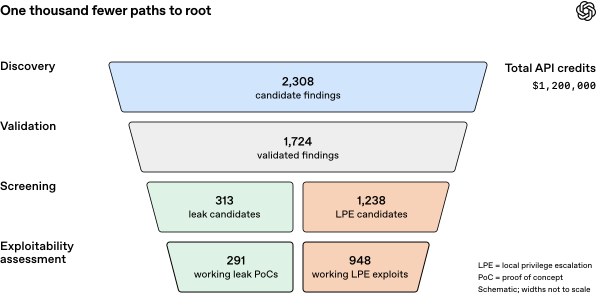
In a single run in mid-October 2026, this process identified 2,308 candidate findings, successfully reproduced 1,724 vulnerabilities, and generated 948 working LPE exploits.
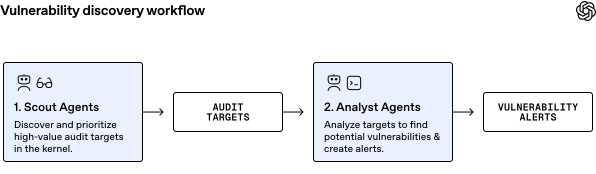
In the discovery phase, 'Scout' agents identify high-value audit targets based on reachability by low-privileged users, while 'Analyst' agents scan these targets for potential flaws.
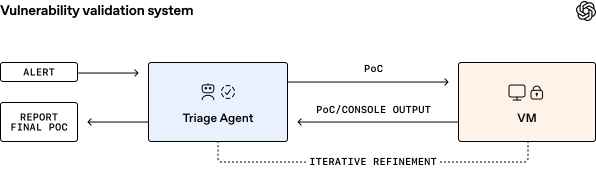
Validated findings are then tested in isolated virtual machines to produce crashing proof-of-concepts.
The economic implications of this automation are significant. The pipeline's run cost approximately $1.2 million in API credits, resulting in an average cost of roughly $1,279 per LPE exploit. OpenAI notes that this is a fraction of the cost of traditional bug bounties; for example, historical bounties for Linux kernel LPE exploits have ranged from $20,000 to $70,000, suggesting a hypothetical valuation of $18.9 million to $66.3 million for the exploits discovered. However, OpenAI emphasizes that human expert review remains a critical final step to ensure patches are functionally correct and aligned with existing coding styles before they are reported to maintainers. While the pipeline can discover novel exploitation techniques at scale, the researchers suggest that complex software may still require multiple iterative rounds of scanning to 'bottom out' latent bugs. For the near term, OpenAI suggests that for well-resourced actors, having low-privileged access to an unpatched system may become functionally equivalent to having root access, highlighting the need for high-assurance software and defense-in-depth strategies like sandboxing.