Kairos is an open-source risk and fraud decisioning platform designed to evaluate financial behaviors, such as sign-ups, logins, and payments, in real time. It serves as an alternative to commercial fraud detection services by providing a system that returns immediate actions—approve, step up, review, or block—along with the specific risk scores and signals behind each choice. The platform tracks the history of subjects, including shared devices, cards, and addresses, to provide context for every decision.
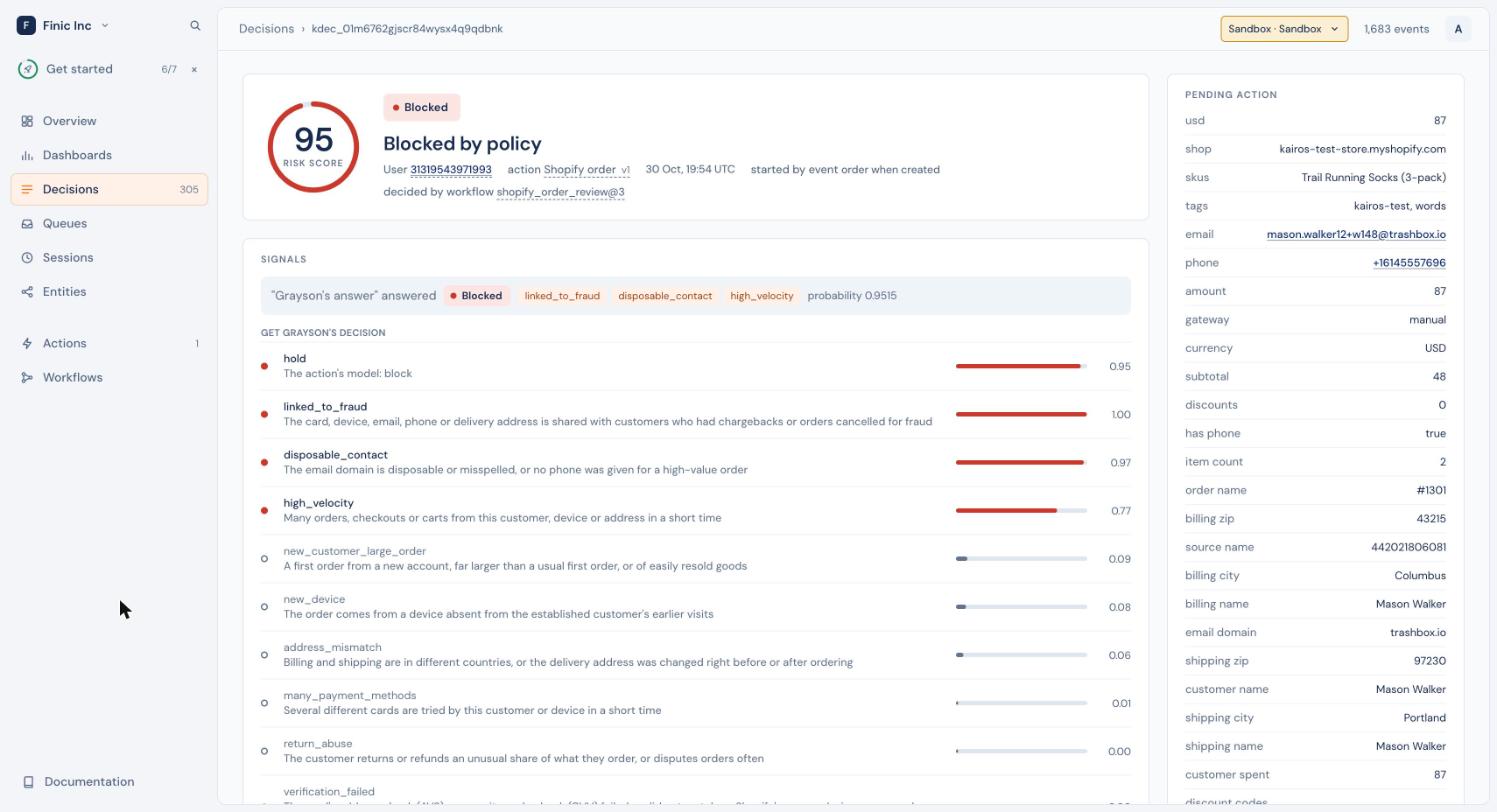
This image illustrates the platform's ability to return immediate actions along with specific risk scores and signals.
The core mechanism of Kairos relies on a hybrid approach between 'decision models' and traditional machine learning. At its center is Grayson, a decision model that can process unstructured data like emails, names, and item titles to answer plain-language questions (e.g., "Is this email throwaway?") with calibrated probabilities. While these decision models excel in scenarios with few labels or complex text, Kairos also supports traditional models like logistic regression and gradient-boosted trees (XGBoost-compatible). By combining Grayson’s qualitative answers with quantitative data from traditional models, the platform allows users to balance high-reasoning capabilities with the low-cost, high-precision scoring required for high-volume transactions.
A primary differentiator for Kairos is its "agent-first" design, which utilizes a Model Context Protocol (MCP) server. This allows AI coding agents, such as Claude Code, Cursor, or Codex, to interact directly with the platform to perform the work of a fraud ML engineer. These agents can build workflows, propose model variants, and run experiments. Kairos then trains these variants on labeled data, tests them on new data, and reports performance metrics like ROC-AUC and precision-recall. The agent can then explain its choice and automatically publish the winning model as the new version of the workflow. While this automation streamlines the development of fraud defenses, the platform's effectiveness remains dependent on the quality of the labels provided by the user's historical data and the specific questions posed to the Grayson model.