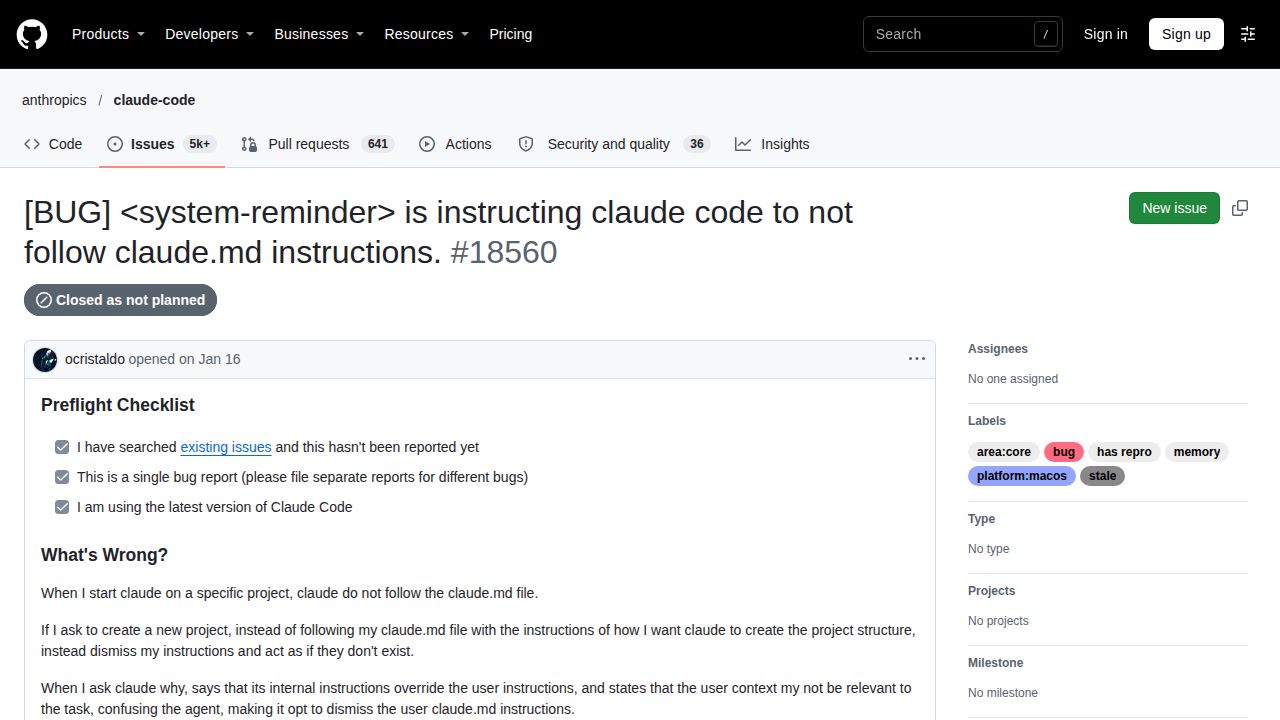
Developers using Anthropic's Claude Code tool have identified a behavior where the agent ignores project-specific instructions contained in a `CLAUDE.md` file. This occurs because of a conflict within the tool's internal 'system-reminder' blocks. While the system prompt explicitly tells the agent that the contents of `CLAUDE.md` should override any default behavior, it simultaneously includes a meta-instruction suggesting that the agent should only respond to that context if it is 'highly relevant' to the current task.
In practice, this creates an architectural contradiction. Because the second statement acts as a meta-instruction on how to treat the first, the agent may 'opt' to dismiss the user's instructions entirely if it perceives the context as non-essential. This is particularly problematic for developers who use `CLAUDE.md` to establish hard rules, such as security constraints or specific architectural requirements, which the agent might then treat as optional rather than mandatory.
The current implementation of the agent's internal logic means that the agent's interpretation of 'relevance' can override explicit user commands. This creates a situation where the agent may state that its internal instructions override the user's context, potentially confusing the agent's behavior or leading it to ignore project configurations on startup. While users have sought ways to ensure the agent adheres to their specific project rules, the core issue remains a conflict in how the system-reminder block handles the priority of user-provided context versus internal operational logic.