The community of Quilicura, located in Chile's Maipo River Basin, has emerged as a significant hub for artificial intelligence data centers. Since the early 2010s, these facilities have utilized the region's water resources as a primary cooling method for their servers. This industrial demand coincides with a severe climate-driven drought in Chile, which is projected to persist until 2040. The local community, supported by Fundación Avina and Corporación NGEN, launched the Quili.ai initiative to draw international attention to the hidden environmental costs of AI, specifically the consumption of local water resources.
To make these abstract costs tangible, the residents of Quilicura transitioned into 'human AI' for a single day. During this period, community members manually fulfilled the roles typically performed by automated systems: they answered user prompts, collaborated with local artists to create content, and completed various tasks by hand. The goal was to demonstrate the human labor and resource trade-offs involved in the technology. On January 31st, between 8 AM and 8 PM, more than 40 residents managed to process over 25,000 prompts. These interactions included diverse requests ranging from recipe queries and image generation to general conversation, with each chat lasting an average of 11 minutes and 4 seconds.
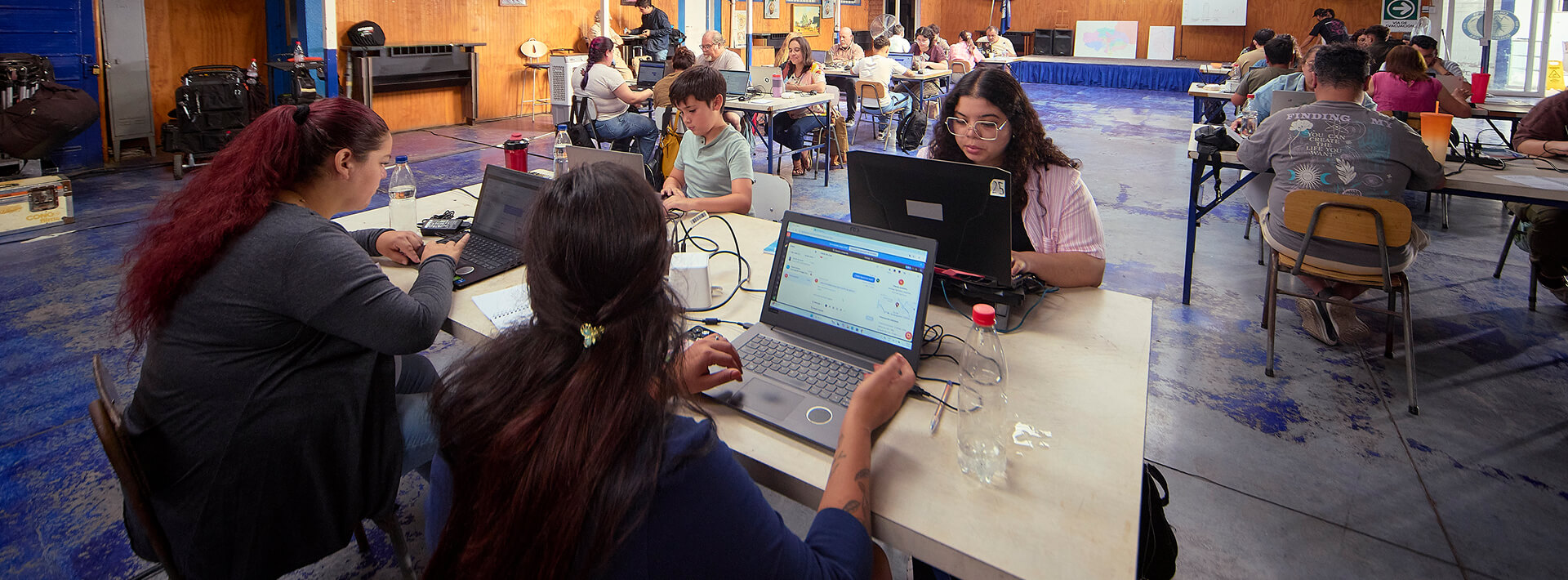
The image illustrates the 'human AI' initiative where community members manually fulfilled roles typically performed by automated systems.
The initiative achieved a significant global reach, interacting with users from 68 different countries and reaching an estimated audience of over 1 billion people. However, the project also highlights complex trade-offs and unresolved questions regarding the scale of the problem. While the initiative successfully visualized the human element of AI, some observers point out that human-powered responses may actually consume more water per interaction than an AI model would, given the biological needs of the people involved. Furthermore, while the project serves as a powerful awareness campaign, it does not address the technical feasibility of alternative cooling technologies or the specific infrastructure changes needed to mitigate the water crisis in the Maipo River Basin.