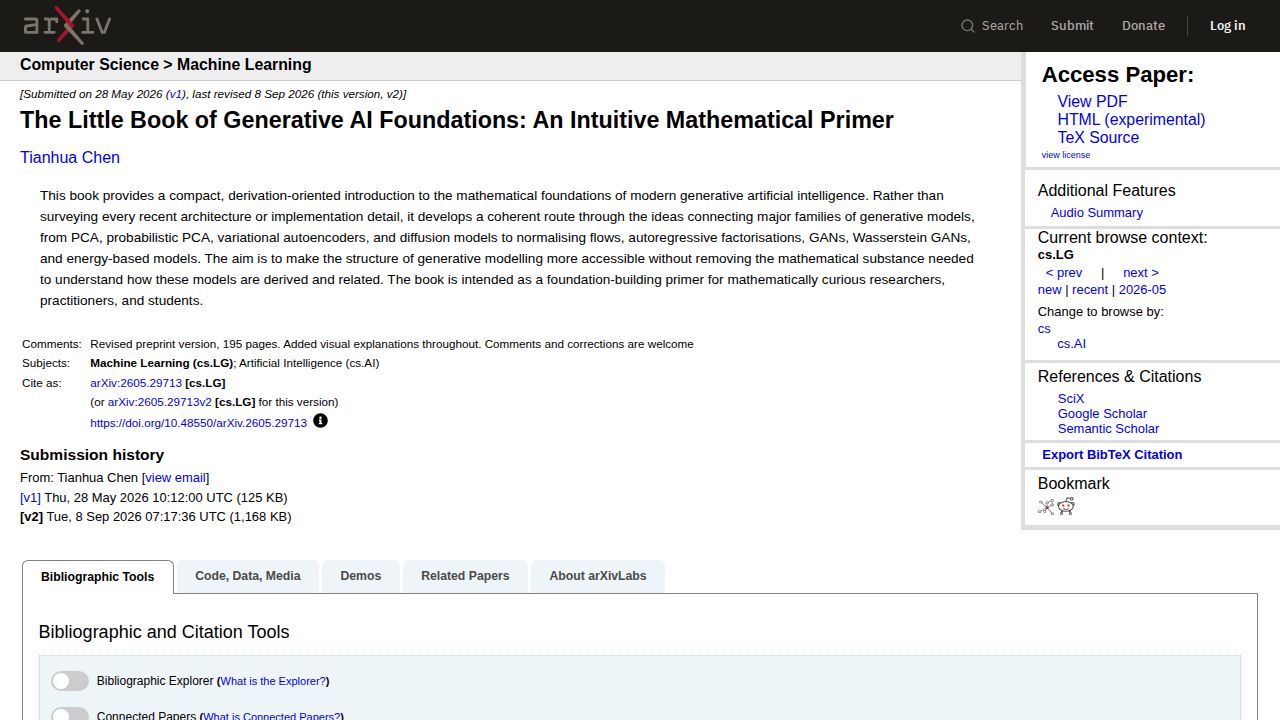
The field of generative artificial intelligence is often presented as a collection of disparate, state-of-the-art architectures. However, a new primer titled 'The Little Book of Generative AI Foundations: An Intuitive Mathematical Primer' by Tianhua Chen argues that these models share a deep, interconnected mathematical lineage. Rather than focusing on the specific implementation details of every new model, the work seeks to establish a coherent route through the core ideas that define the field. This approach is designed to help researchers and students understand how different families of generative models are derived from and related to one another.
The mathematical progression described in the primer begins with foundational techniques like Principal Component Analysis (PCA) and probabilistic PCA. From these roots, the text develops a path toward more complex structures, including Variational Autoencoders (VAEs), diffusion models, and normalizing flows. By focusing on the underlying derivations, the primer aims to provide a foundation-building framework that explains how these models function as variations of the same fundamental principles. This includes the inclusion of Generative Adversarial Networks (GANs), Wasserstein GANs, and energy-based models, positioning them as part of a unified mathematical structure rather than isolated breakthroughs.
One of the primary challenges in such a work is balancing 'intuitive' accessibility with the rigorous mathematical substance required to understand how these models are actually derived. While the primer is intended to be a compact, derivation-oriented introduction, the complexity of the math remains a significant hurdle for many practitioners. Because the book covers a wide range of models—from the linear transformations of PCA to the complex stochastic processes of diffusion—the 'intuitive' nature of the material is a subjective trade-off. The goal is to make the structure of generative modeling more accessible without stripping away the technical depth necessary for serious research, a balance that remains a central theme for those attempting to master the foundations of the field.