Namespace, a platform for running macOS instances, has adopted an unconventional hardware strategy: deploying MacBook Pros in data center racks. This decision stems from the specific requirements of their customers, who need macOS environments to build and test iOS applications. Because Apple requires the use of recent Xcode versions and the iOS Simulator only runs on Mac hardware, the company must provide a scalable way to run these environments. While Mac Minis are generally more suitable for data centers, Namespace encountered significant supply chain delays—waiting months for specific CPU models—which led them to pivot toward MacBook Pro units to ensure their customers receive the newest hardware available.
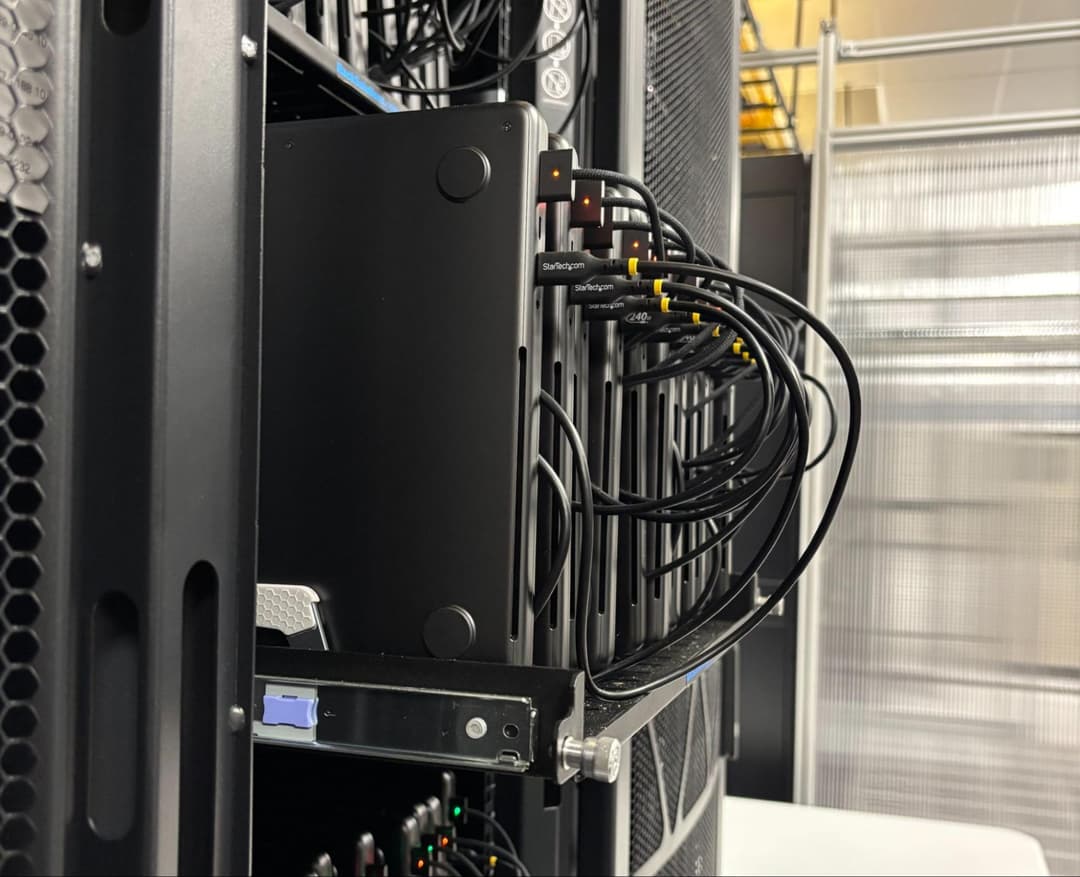
The image illustrates the unconventional hardware strategy of deploying laptops in server racks to overcome supply chain constraints.
Managing laptops in a server environment presents unique engineering hurdles that Namespace addresses through custom hardware and software workarounds. Every MacBook in their racks is connected to an IP KVM for remote management, as laptop firmware often requires GUI interactions for maintenance. To handle the physical environment, the team uses custom-made holders designed to wick heat away from hotspots and specialized cables to ensure reliability. On the software side, Namespace utilizes Apple's Virtualization framework to run macOS instances. However, this framework imposes a hard limit of only two guest VMs per physical Mac, regardless of the host's core count or memory. This constraint forces Namespace to slice resources into specific configurations, such as 6 or 12 cores on Mac Minis or 8/16 cores on MacBook Pro units.
To ensure security and performance for untrusted code, Namespace implements a userspace TCP/IP stack based on Google's gVisor project. This allows them to enforce granular network policies by processing every packet in software before it reaches the host OS. While this architecture introduces an IPC (Inter-Process Communication) roundtrip between the VM process and the host, it enables a respectable 4 Gbps upstream bandwidth. Additionally, to manage the massive size of macOS VM images—which can exceed 2 TB due to large iOS runtime packages—Namespace developed a custom storage format. This format preserves the 'sparse-ness' of the images and uses a layered approach to share common base blocks, allowing them to distribute and update images across their fleet efficiently without wasting storage on redundant data.