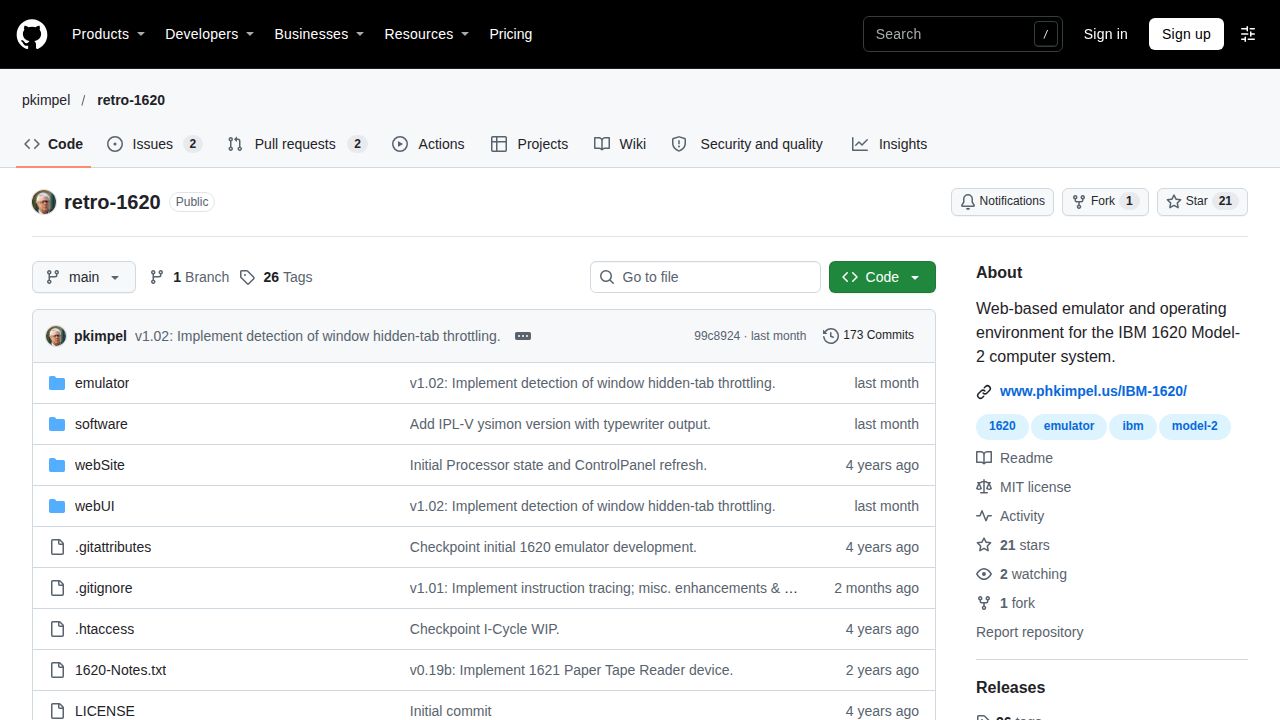
The IBM 1620 was a transistorized, decimal-based computer system designed in the late 1950s and early 1960s as an affordable solution for scientific and engineering applications. Unlike modern binary-centric systems, the 1620 utilized a memory-to-memory architecture where all arithmetic and data movement were performed digit-sequentially. Its memory structure consisted of 20,000 to 60,000 digits, each containing a four-bit binary-coded decimal value, a flag bit for signs and delimiters, and a parity check bit. Because it lacked software-accessible registers, instructions were fixed at 12 digits, combining operation codes with 'P' and 'Q' addresses or literal values.
The project focuses on the Model 2 variant, released in 1962, which offered significant hardware improvements over the original Model 1. The Model 2 doubled the memory cycle speed to 10µs per two digits and introduced standard features such as hardware division and indirect addressing. While it still relied on memory-based lookup tables for multiplication, these enhancements made it a more capable tool for complex engineering tasks. The emulator aims to recreate this specific environment, providing a web-based interface that allows users to interact with the system's unique architecture without needing the original physical hardware, which was typically housed in closed machine rooms.
A significant milestone of this emulator is its ability to run IPL-V, a 1963 compiler and runtime from the University of Oregon. IPL-V is historically notable as a primary inspiration for the Lisp programming language, containing the foundational logic for many modern programming paradigms. While the original 1620 experience often involved physical punch cards and manual coding forms, the web-based emulator translates these historical constraints into a browser-accessible format. However, the project's scope is currently limited to the Model 2 variant and the recovery of available historical software, leaving the full breadth of the 1620's vast software library still to be fully integrated into the web environment.