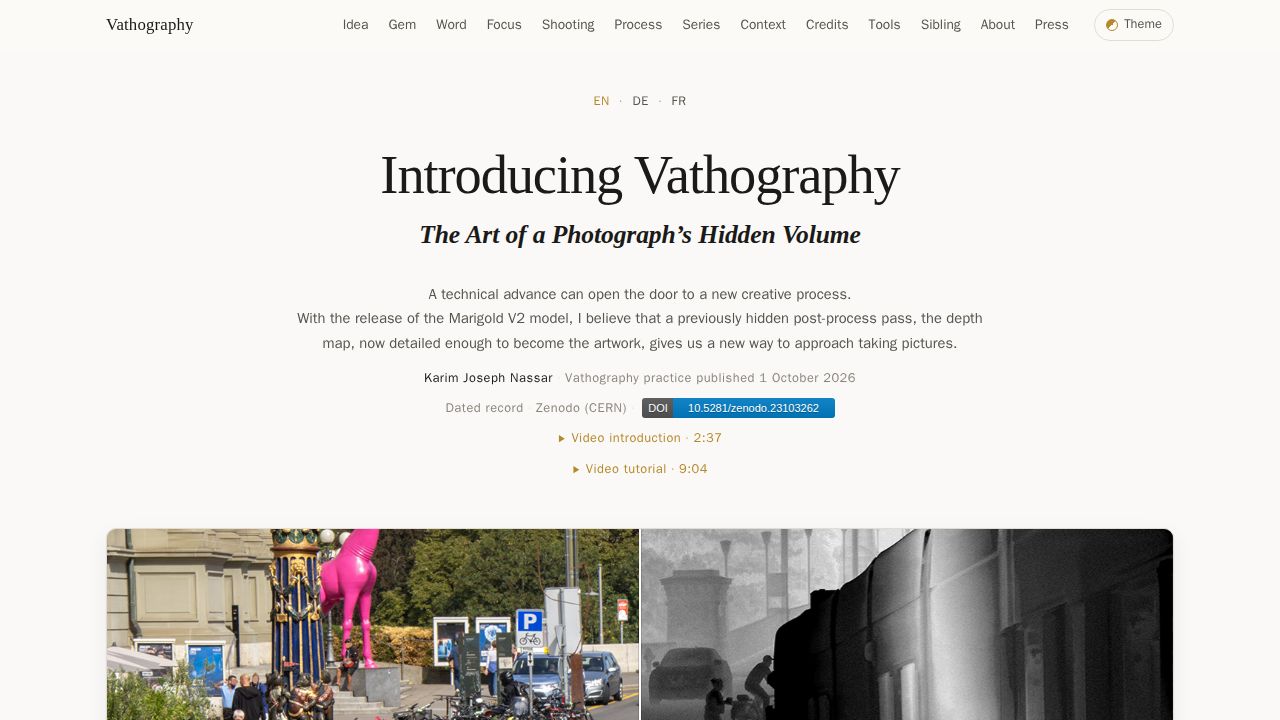
Vathographs are a creative art form that utilizes photographic depth maps as a primary medium for expression. Rather than capturing a scene through traditional optics, this process takes a standard photograph and converts it into a stylized, black-and-white representation of depth. This shift moves the focus of the work from the documentation of a physical moment to the creation of a permanent, interpreted piece of art. By isolating subjects through depth, the medium highlights the silhouette and spatial relationship of the scene rather than its color or texture.
The technical mechanism behind Vathographs relies on machine learning to infer depth from a single (monocular) image. This differs significantly from deterministic methods like LiDAR, Time-of-Flight (ToF) sensors, or stereo camera arrays, which measure physical distances using light or parallax. Because the data for depth is not physically present in a single flat image, the resulting maps are described by some observers as 'hallucinated' by a model. While these models can interpolate values for featureless or textureless planes—areas where traditional sensors often struggle—they lack the scientific calibration of hardware-based depth capture. This non-deterministic approach means the depth map is a generative interpretation of the original photo rather than a precise measurement of the environment.
This artistic choice involves a specific trade-off between scientific precision and aesthetic utility. While the depth maps may not be accurate enough for engineering or navigation, they are highly effective for subject isolation and artistic composition. However, this process introduces unique considerations, such as privacy; for instance, a depth map might reveal a face that was obscured or blocked in the original color photograph. Ultimately, Vathographs function as a bridge between photography and generative art, turning a transient visual moment into a stylized study of form and space, even if the underlying depth data is an algorithmic estimation rather than a physical fact.