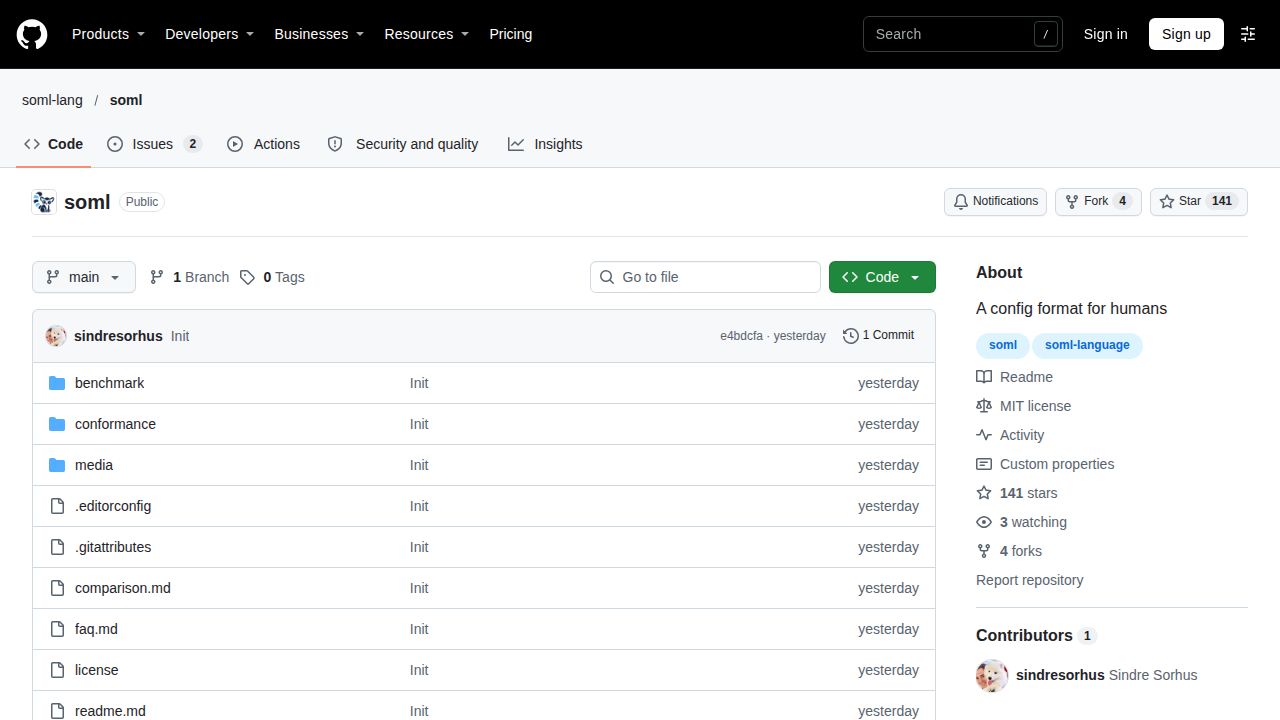
SOML, short for Sindre's Objectively Marvelous Language, is a configuration format designed to be pleasant to write while maintaining strict parsing rules. Its core philosophy is that a value's type must come from its syntax, never from its content. This design choice addresses a common frustration in YAML, where a value like `country: no` might be incorrectly interpreted as a boolean `false` because the parser guesses the type based on the text. In SOML, a string must always have quotes; without them, a value must be a number, date, instant, duration, keyword, or the file will result in an error.
SOML distinguishes itself from both JSON and YAML by removing specific 'noises' and 'comforts' it deems problematic. It removes the braces, quotes, and commas required by JSON, and allows comments to be placed almost anywhere. However, it retains JSON's strictness by forbidding duplicate keys and ensuring that types like integers and floats remain distinct (e.g., `3` and `3.0` are different types). Unlike YAML, which can be unpredictable across different parsers, SOML uses a single syntax for lists and maps and provides native support for dates, instants, and durations. For example, a duration like `30s` is treated as a real value, removing the need for a reader to guess the unit of a raw number.
Compared to TOML, SOML introduces features like top-level arrays and block comments while addressing TOML's 'hidden scope' issues. In TOML, a key's meaning can depend on what came before it, and dotted paths can behave differently depending on the parser. SOML uses braces to make object boundaries explicit, ensuring that a key always belongs to the braces surrounding it. Additionally, SOML provides a canonical form where equal values result in equal bytes, which is essential for hashing and signing. While the project is currently in a draft specification phase, it includes a conformance suite of nearly 1,000 cases to ensure that every implementation reads a file in the exact same way. However, because it is a draft, there is currently no information regarding a production ecosystem of language-specific libraries or tools beyond the conformance suite.