For nearly a century, the study of magnetism was dominated by a dichotomy between two primary types: ferromagnetism and antiferromagnetism. Ferromagnets, such as those used in traditional magnets, have electronic spins that point in the same direction, creating an observable magnetic field. Antiferromagnets have alternating spins that cancel each other out, resulting in no net magnetic effect. While both have been well-understood for decades, researchers recently identified a 'wily' class of materials that seemed to exhibit features of both, leading to the proposal of 'altermagnetism' in 2022.
Altermagnets are distinguished by a specific geometric configuration in their crystal lattice. While they maintain an alternating spin pattern (up-down-up-down) similar to antiferromagnets, the crystal structure surrounding the 'up' spins is rotated relative to the structure surrounding the 'down' spins. This symmetry break allows altermagnets to possess a unique property: the ability to generate spin-polarized currents, a characteristic typically reserved for ferromagnets. By combining the zero net magnetization of an antiferromagnet with the functional utility of a ferromagnet, altermagnets offer a potential middle ground for next-generation electronics.
To provide conclusive proof, a team led by Daniel Jost at SLAC and the Stanford Institute for Materials and Energy Sciences investigated manganese telluride (MnTe). The researchers sought to identify 'chirality'—a sense of 'handedness' in the material's structure that conventional antiferromagnets lack. Using circularly polarized X-rays at the European Synchrotron Radiation Facility, the team observed that the material scattered left-handed and right-handed beams differently. This chiral signature confirmed that MnTe is an altermagnet, providing a robust experimental foundation for this new magnetic phase. These materials could eventually be used to create spintronic devices that are more stable than ferromagnets and more readable than antiferromagnets, potentially leading to faster, lower-power computing and data center technologies.
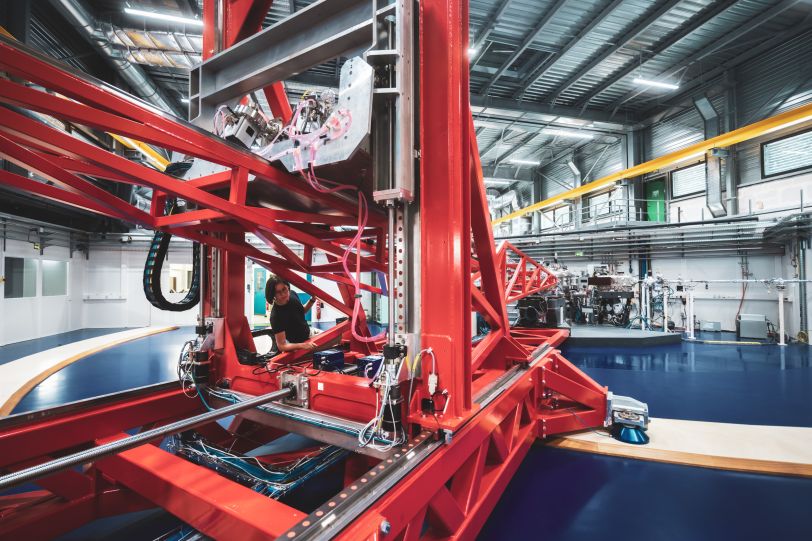
The researchers used circularly polarized X-rays at the European Synchrotron Radiation Facility to observe the material's chiral signature.