Large language model (LLM) agents often struggle with reliable analytics because they lack a structured understanding of an organization's data landscape. While agents can retrieve documents or query databases, they frequently lack the context to know where specific data lives, what its definitions mean, or how it relates to other entities. NVIDIA's Auto Ontology addresses this by providing a semantic layer that sits between the raw data and the AI agent. This layer acts as a knowledge graph that reconciles inconsistent definitions across different systems, ensuring that an agent's reasoning is grounded in certified business logic rather than just raw, potentially ambiguous, data points.
The framework operates as a multi-component stack using a FastAPI backend, a Next.js frontend, and a Postgres database equipped with pgvector for vector storage. It allows developers to discover and generate enterprise ontologies from existing metadata, providing a way to 'ground' agents in trusted relationships. A key technical feature is its ability to translate natural-language questions into SQL queries that are validated against certified definitions and lineage. This process ensures that the resulting answers include provenance, making the AI's output more explainable. The system also supports Model Triplets—specific configurations for reasoning, entity extraction, and embeddings—which can be hosted via NVIDIA NIM endpoints or self-hosted instances.
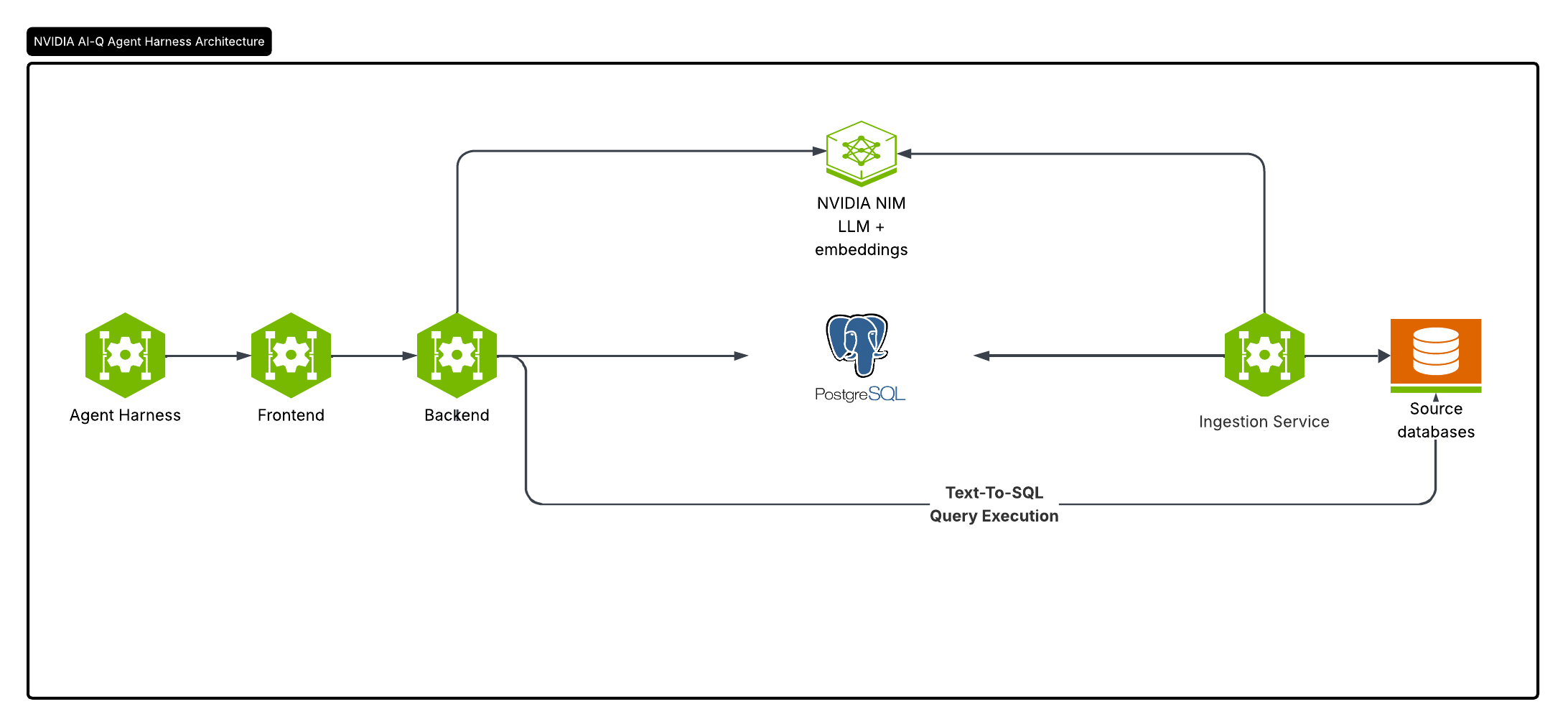
The framework operates as a multi-component stack using a FastAPI backend, a Next.js frontend, and a Postgres database equipped with pgvector for vector storage.
Despite its focus on reliability, the framework introduces specific operational requirements and limitations. Users must manually configure connection strings for source databases like Snowflake, Databricks, or DuckDB, and manage model triplets via environment variables. While the system provides a web UI for chat and data cataloging, it currently does not accept external contributions, meaning its growth depends on NVIDIA's internal development. Furthermore, while the framework aims to solve the 'unreliable' nature of agentic analytics, the specific logic used to automatically reconcile conflicting definitions across disparate systems remains an internal implementation detail not fully detailed in the public repository. The system is designed to be extensible through the Model Context Protocol (MCP), allowing it to integrate with popular agent harnesses like Claude Desktop or Cursor.
Evidence: 1. The primary source (GitHub - NVIDIA/auto-ontology) establishes that the framework enables 'deterministic query generation' and 'better context retrieval' by building a reasoning layer from enterprise metadata. 2. The primary source also details the technical stack, including the use of FastAPI for the backend, Next.js for the frontend, and the integration with NVIDIA NIM for inference. 3. The primary source specifies that the framework allows for 'validating' generated queries against certified definitions and returning provenance with every answer.
Editorial: - evidence_sufficient: true - source_limited: true - submission_only: false - discussion_digest: false - editorial_angle_research: - Question 1: How does Auto Ontology specifically handle conflicting metadata definitions between two different source databases? - Answer 1: The source states it 'reconciles definitions across systems' to provide a 'trusted business meaning,' but the specific algorithmic logic for this reconciliation is not detailed in the provided documentation. - Question 2: What are the specific performance benchmarks for Auto Ontology's text-to-SQL generation compared to standard RAG? - Answer 2: The source mentions a text-to-SQL benchmark (BIRD) and provides a link to an evaluation repository, but does not list specific comparative scores within the primary documentation.