As coding agents accelerate the speed of software development, the primary bottleneck has shifted from writing code to verifying that the new code functions correctly in a live environment. Momentic, a Y Combinator-backed startup, addresses this by providing an agentic quality platform where users can describe user flows in plain English. The platform then runs these tests against the application to verify critical paths and identify regressions before they reach production.
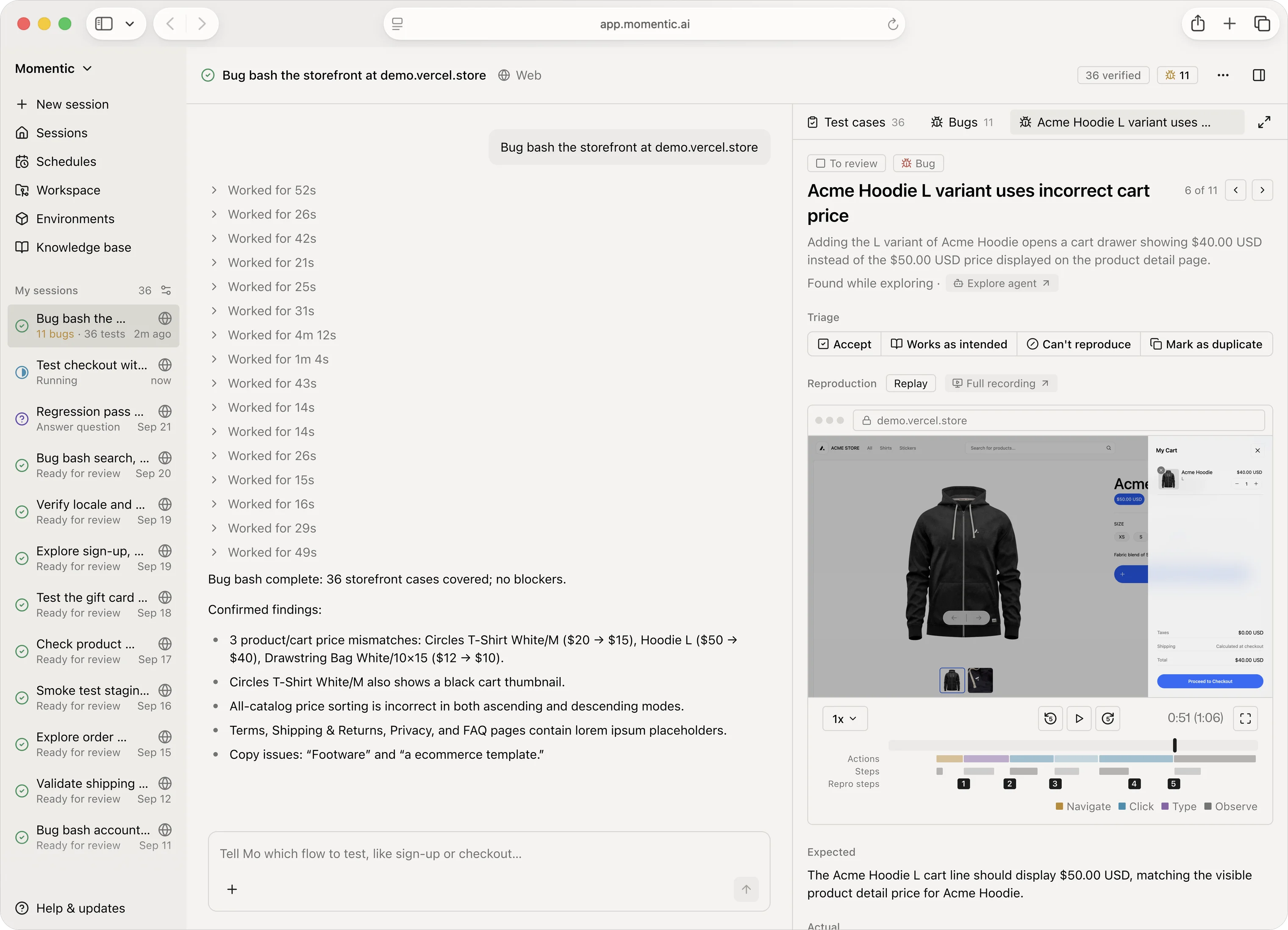
This image illustrates the agentic quality platform where users can describe flows and the platform identifies regressions.
To evaluate its performance, Momentic established a first-party benchmark called 'QA Bench.' This test pitted Mo against other well-known agents—including Codex, Claude Code, and Devin—against 1,396 human-labeled bugs across four popular open-source applications: Gitea, Metabase, Twenty, and Saleor. During the benchmark, agents were restricted from accessing the application's source code or the internet, forcing them to rely on interacting with the live UI. In a 60-minute pass through the suite, Mo matched 269.3 reference bugs, significantly outperforming the next best configuration, Codex (86.3), and the best Claude Code configuration (59.0).
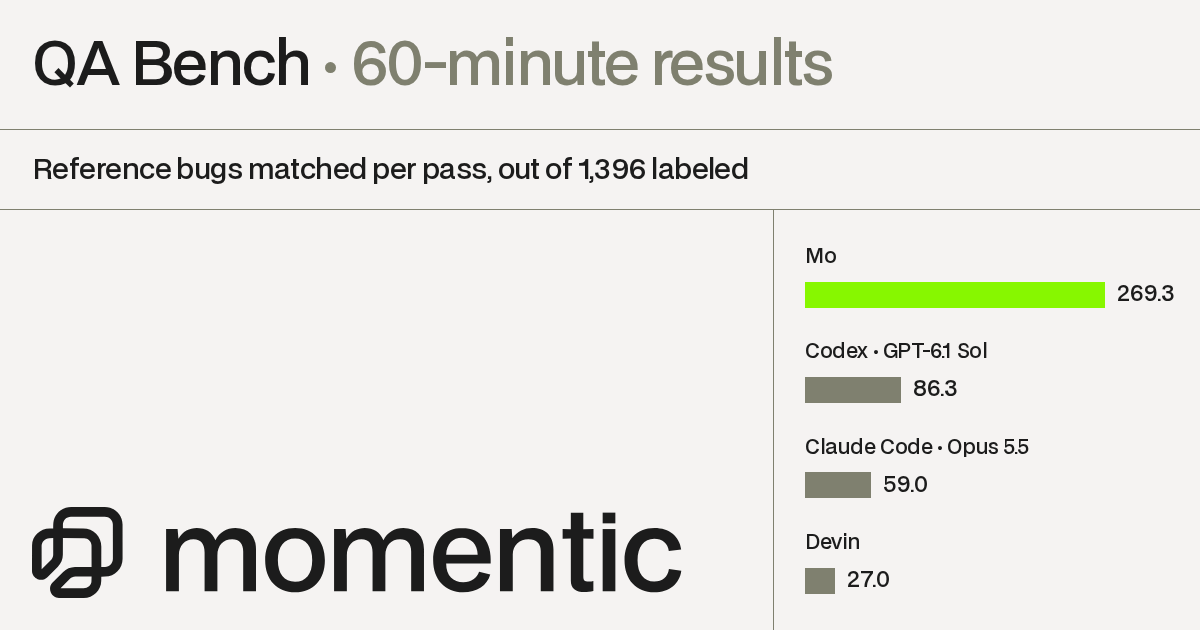
The chart provides a visual comparison of the bug recall performance across different coding agents during the 60-minute benchmark.
Mo's performance advantage stems from its specialized architecture. Unlike general-purpose coding agents, Mo utilizes a 'Knowledge base' where developers can define product-specific terminology, business rules, and expected behaviors. This context allows the agent to make more informed decisions during test runs. Additionally, the platform features 'Auto-heal,' which identifies when a UI change breaks a test and proposes a repair to the test file. While Mo achieved the highest recall in the benchmark (19.3%), it carries a higher cost per matched bug ($2.67) than the most precise Codex configuration ($0.80), though it remains cheaper than the Claude Code Opus configuration ($4.09).
Because the QA Bench is a first-party evaluation conducted by Momentic, the results are subject to the limitations of the platform's own grading system. The benchmark uses an LLM judge to match agent reports against the reference set, which may introduce bias compared to independent third-party testing. Furthermore, while Mo demonstrates high recall, a single pass still leaves the majority of labeled bugs unfound, suggesting that the agent is currently best suited for identifying high-priority regressions rather than exhaustive bug hunting.