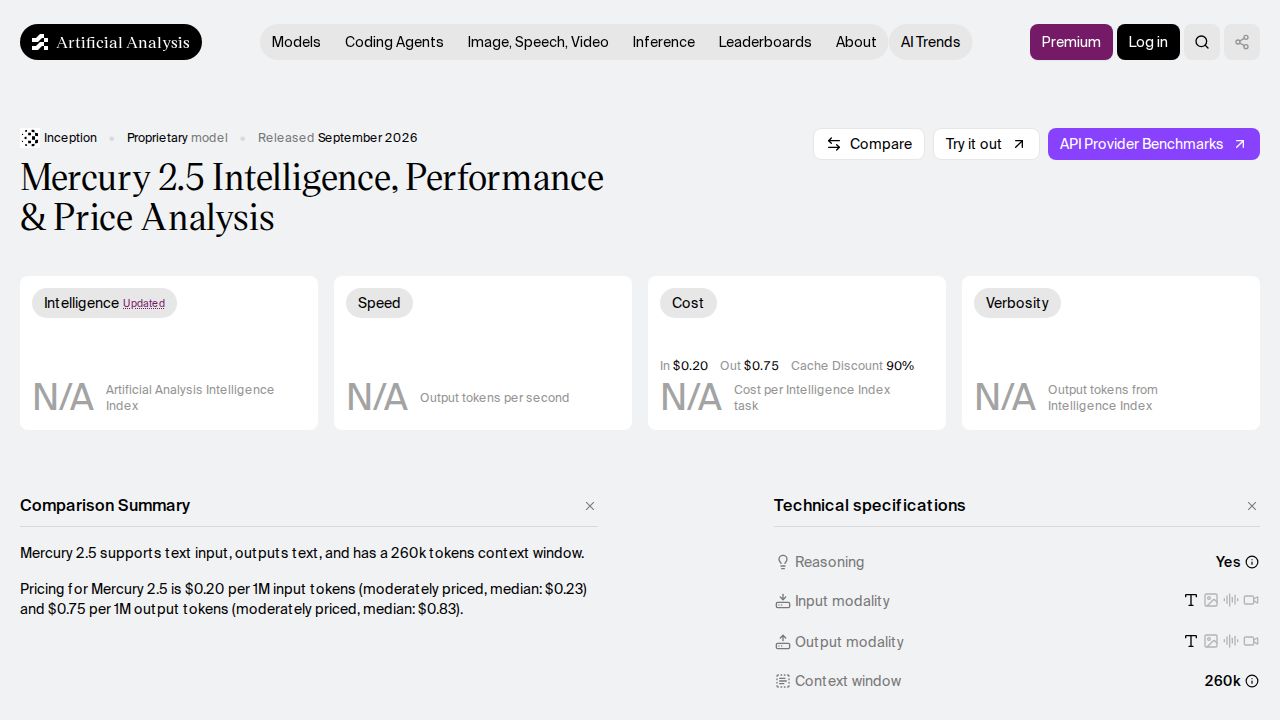
Mercury 2.5 has gained attention for its significant inference speed, reaching a benchmark of 770 tokens per second. This performance positions it as a high-velocity option in the large language model (LLM) landscape, where rapid token generation is a key metric for real-time applications. However, the model's primary appeal—its speed—comes with a notable trade-off in cognitive performance. According to the source data, Mercury 2.5 is characterized as being 'below average' in intelligence, often performing worse than smaller, more capable models such as GPT-OSS-20B or various 14B-parameter models.
Users and observers have raised questions regarding the practical application of a model that prioritizes speed over accuracy. One commenter noted that the model's intelligence is significantly lower than frontier AI offerings, suggesting that high speed may not compensate for a lack of reasoning capability. Specific technical limitations were also highlighted, such as the model's struggle with complex tasks like tool calling. Furthermore, some users expressed skepticism regarding the 'diffusion LLM' approach used by the model, suggesting it may not represent a viable 'Pareto frontier'—a state where no further improvement in speed can be made without sacrificing intelligence.
When compared to other high-speed alternatives, Mercury 2.5 faces stiff competition. For instance, the Cerebras gpt-oss-120b model reportedly reaches speeds of 1400 tokens per second, though it has been criticized for being 'broken' in tool calling and having high operational costs. Additionally, some users pointed out that Mercury 2.5's pricing ($0.25 to $0.75) may be less competitive than other open-weight models like DeepSeek v4 Flash or Qwen 3.8-flash-next, which can be served more cheaply while maintaining higher intelligence. These factors leave an open question as to whether Mercury 2.5 serves a unique niche or if its speed is overshadowed by its performance limitations.