Industrial computing systems are traditionally built on x86 or Arm architectures, both of which are owned and licensed by single corporations. For industrial applications—where machines are expected to remain operational for 10 to 15 years—this creates a dependency on a single company's roadmap or a specific government's decisions. The European RISC-V Industrial Computing Initiative (ERICI) seeks to address this by leveraging RISC-V, an open instruction set architecture (ISA) governed by a non-profit. While RISC-V silicon has recently reached a level of maturity suitable for industrial use, ERICI notes that a significant gap remains: the hardware exists, but the production-ready industrial computers—capable of surviving control cabinets and maintaining high availability for over a decade—are not yet standardized.
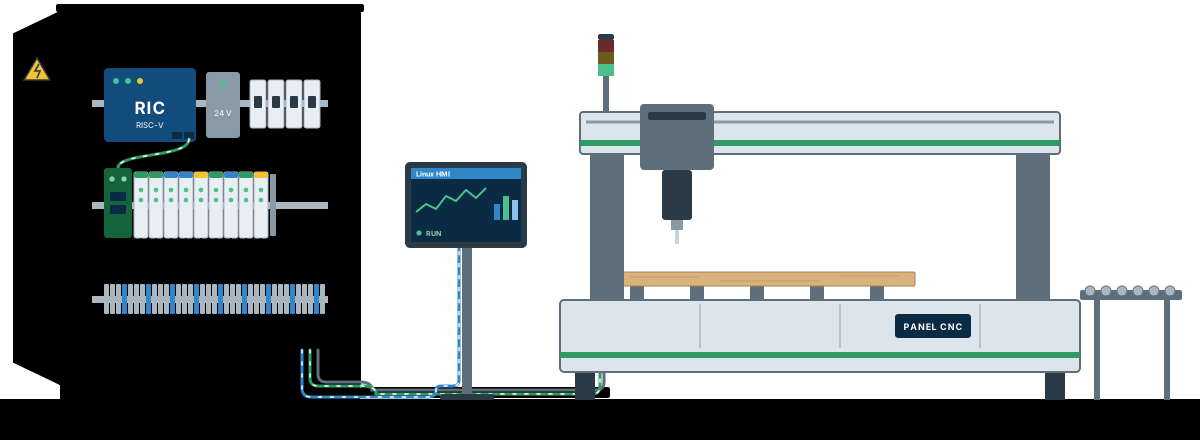
This image illustrates the industrial computing environment where ERICI's standardized hardware and software stack are intended to be deployed.
To bridge this gap, ERICI coordinates a 'reference stack' of verified software layers designed to run on RVA23-compliant hardware. The RVA23 profile, ratified in late 2024, makes hypervisor and vector extensions mandatory, providing a stable baseline for software developers. The ERICI stack consists of several layers: HFI BIOS for firmware and boot control, mr-bml as a menu-driven boot loader, and gRouvr as a resource-partitioning hypervisor. A key mechanism of this stack is its ability to run a real-time control system (QSOE) and a general-purpose Linux operating system side-by-side on a single SoC. By using the gRouvr hypervisor, the two systems remain isolated from each other, ensuring that the time-critical control loops are not interrupted by the operator's Linux-based GUI or networking tasks.
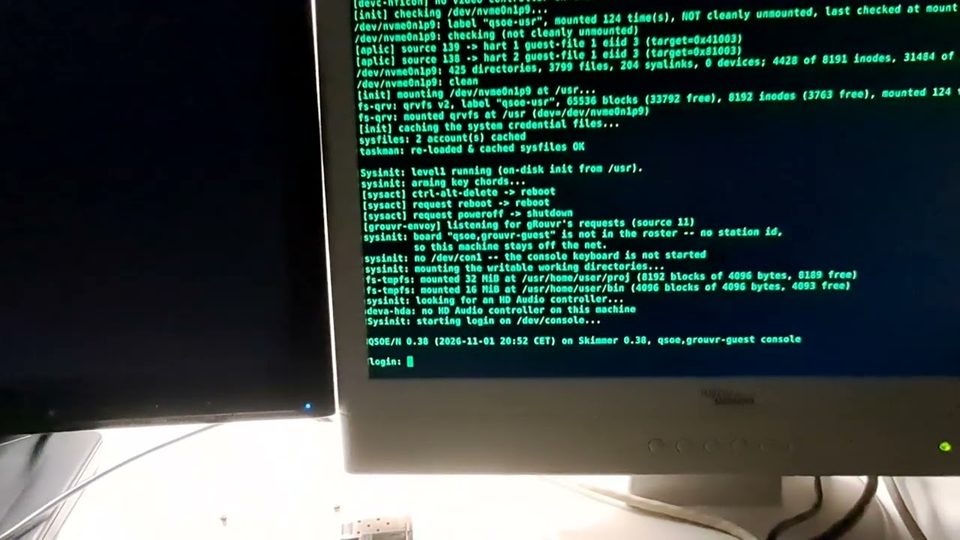
This visual demonstrates the core mechanism of the ERICI stack: running a real-time control system (QSOE) side-by-side with a Linux OS.
While the initiative provides the software framework, it also highlights the specific hardware requirements that current RISC-V boards often lack. For example, while boards like the SpacemiT K3 provide the necessary RVA23 cores and IOMMU, they may not yet meet industrial standards for wide voltage inputs (e.g., 24 V DC), extended temperature ratings (e.g., -40 to 85 °C), or fieldbus support like EtherCAT and CAN-FD. ERICI addresses these limitations by inviting industrial hardware makers and silicon vendors to join the initiative. By focusing on open interfaces like UEFI and devicetree, the project ensures that the resulting industrial computers are not tied to a single chip vendor or developer, allowing for long-term maintainability and hardware independence."