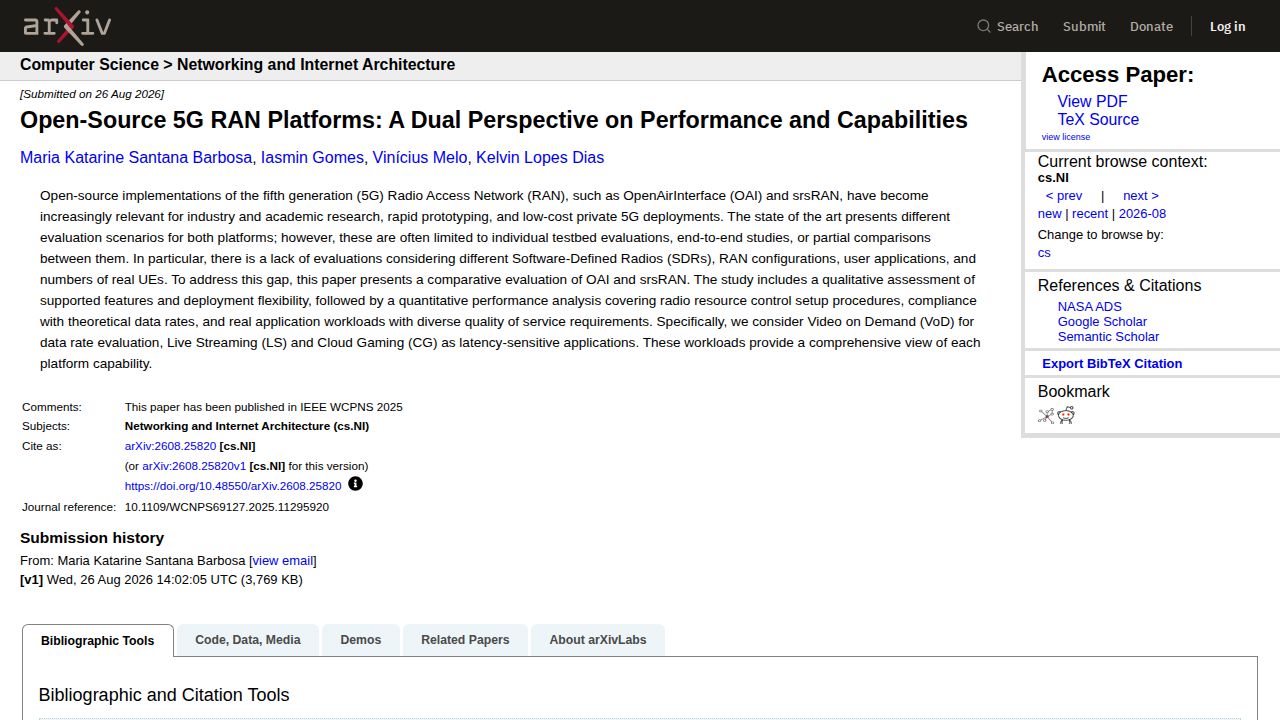
Open-source implementations of the fifth-generation (5G) Radio Access Network (RAN) have emerged as critical tools for academic research, rapid prototyping, and the deployment of low-cost private 5G networks. Two of the most prominent platforms in this space are OpenAirInterface (OAI) and srsRAN. These projects provide developers and researchers with a way to build and test 5G infrastructure without the high costs associated with proprietary hardware and software. However, while both platforms are widely used, there is a lack of comprehensive evaluations that compare their performance across diverse Software-Defined Radios (SDRs), specific RAN configurations, and varying numbers of real User Equipment (UE) units.
The research evaluates these platforms through a dual lens: qualitative assessment and quantitative performance. Qualitatively, the study examines the supported features and the flexibility each platform offers for different deployment types. Quantitatively, the analysis focuses on radio resource control setup procedures and how closely each platform complies with theoretical data rates. By testing these systems under real-world application workloads, the study provides a clearer picture of how these open-source tools handle different Quality of Service (QoS) requirements. Specifically, the evaluation uses Video on Demand (VoD) to measure raw data rates, while Live Streaming (LS) and Cloud Gaming (CG) serve as benchmarks for latency-sensitive performance.
While both OAI and srsRAN offer viable paths for 5G development, the study highlights specific trade-offs in their capabilities. The performance of these platforms can vary significantly depending on the specific RAN configuration and the type of application being hosted. For instance, a platform might excel at high-throughput tasks like VoD but struggle with the strict timing requirements of Cloud Gaming. Furthermore, the study notes that current evaluations are often limited to individual testbeds or partial comparisons. Because the research does not cover a vast array of different SDRs or a high volume of real UEs, the results provide a foundational comparison of the platforms' core capabilities rather than an exhaustive performance profile for every possible hardware combination.