In 1996, IBM's Deep Blue famously defeated reigning world champion Garry Kasparov. To achieve this, IBM invested millions into a specialized supercomputer featuring 30 P2SC processors and 480 custom VLSI chess co-processors capable of analyzing over 200 million positions per second. This victory led many to believe that massive, bespoke hardware was a prerequisite for defeating a human grandmaster. However, recent experiments suggest that the gap between human and machine performance is bridged more by software sophistication than by the sheer number of calculations performed.
Chess AI strength is generally derived from three factors: the quantity of moves analyzed, the quality of those moves, and the depth of the analysis. While modern engines dominate the first factor by processing millions of positions per second, the most significant progress in the last 30 years has mirrored human improvement: refining how engines select and evaluate the most critical moves. In a controlled test, a modern Stockfish engine was ported to run on a 200 MHz Intel Pentium Pro with 64MB of RAM—a standard desktop configuration from 1995. Despite the hardware limitations, the engine achieved an estimated Elo of 3300 at classical time controls, far surpassing Kasparov's rating of just under 2800.
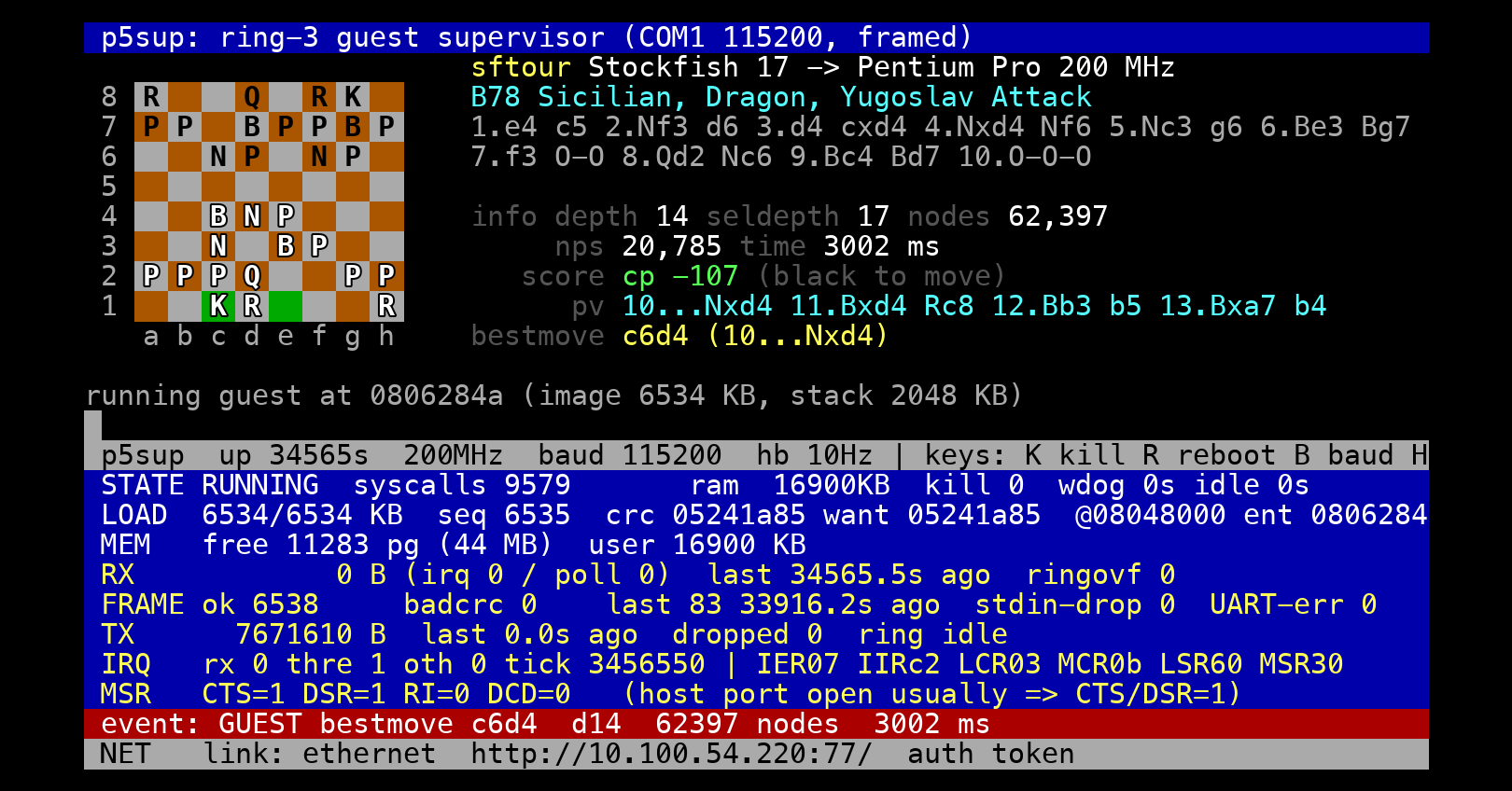
The image illustrates the experiment of running a modern chess engine on a 200 MHz Intel Pentium Pro with 64MB of RAM.
The disparity between modern and 1996-era engines is largely explained by algorithmic evolution. When a 1996-era engine called 'Crafty' was updated with modern techniques—such as fail-soft pruning, late-move reduction, and Neural Network Evaluation (NNUE)—its Elo jumped significantly even when restricted to the same vintage hardware. Conversely, a naive port of today's Stockfish to the Pentium Pro yielded a high Elo (roughly 2496 at 1 second per move) simply by utilizing modern logic. By further tuning these algorithms for the Pentium's 32-bit architecture, the engine's performance reached 3180 at 30 seconds per move. These results indicate that the majority of chess AI gains over the last three decades are attributable to better programming rather than faster silicon.
However, running modern engines on vintage hardware involves significant technical trade-offs. Because the Pentium Pro lacks modern SIMD instructions and 64-bit registers, the code must be heavily rewritten to use 32-bit arithmetic and fit within a 64MB memory ceiling. This requires replacing large lookup tables and shrinking the NNUE models to ensure the engine remains functional. While these optimizations allow a modern engine to dominate 1996-era software, the Elo estimates for the Pentium Pro are extrapolated from shorter time controls to classical games, which may involve diminishing returns that are not fully captured by linear scaling.