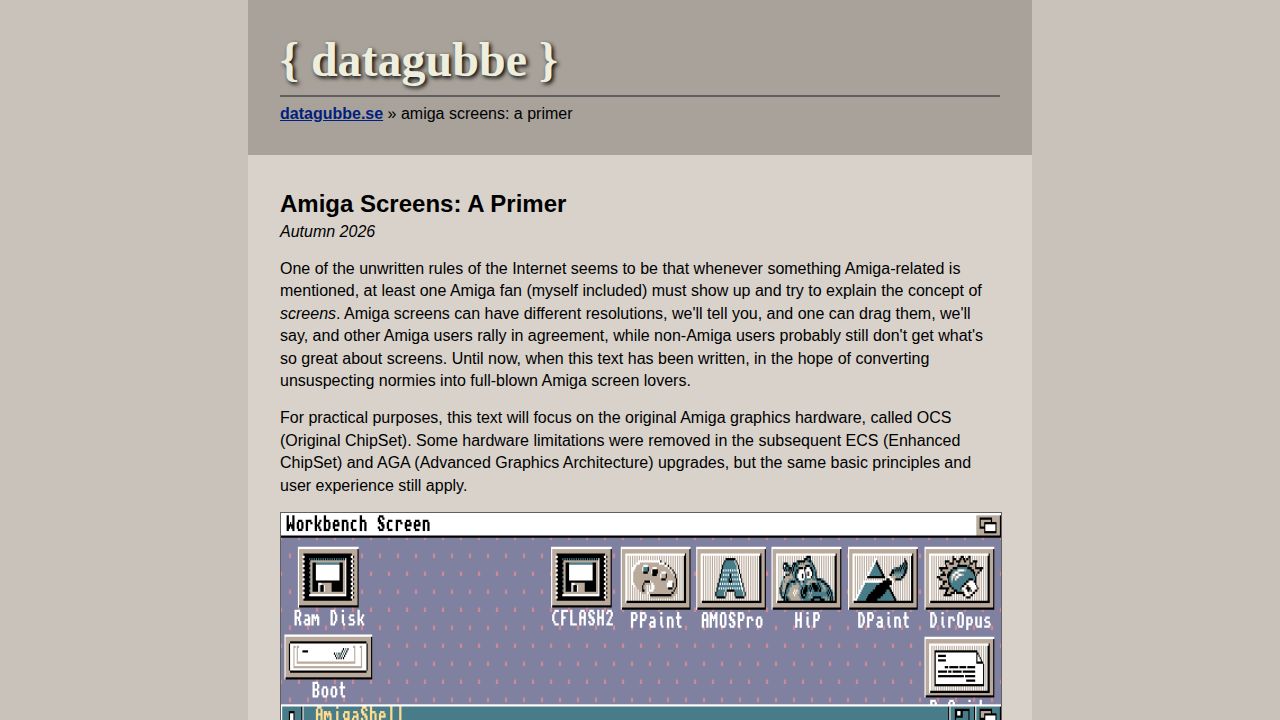
On the original Amiga systems—specifically those utilizing the Original ChipSet (OCS), Enhanced ChipSet (ECS), and Advanced Graphics Architecture (AGA)—a "screen" is defined as an area onto which graphics are drawn rather than a window within a single desktop environment. Unlike contemporary operating systems where the entire physical monitor typically shares a uniform resolution and color depth, the Amiga hardware allows multiple screens with entirely different specifications to exist simultaneously. For example, a user could run a text editor on a low-resolution, two-color screen while running a high-graphics application on a separate thirty-two-color screen at a higher resolution.
The underlying mechanism for this flexibility is known as planar graphics. In this system, a pixel's color is determined by its position in several individual memory layers called bitplanes. To increase a screen's color depth, more bitplanes are added; a one-bitplane screen provides two colors, while five bitplanes provide up to 32 colors. Because only the bits required for a specific screen’s color depth need to be stored, this approach offered significant memory efficiency during an era when RAM was expensive and shared between CPU, video, and audio tasks. Furthermore, because these screens can be arbitrarily dimensioned and positioned, they do not have to occupy the full display area, allowing programs to save even more memory by avoiding unnecessary pixels.
Hardware features like the copper co-processor further enhanced this experience by enabling instant repositioning and scrolling of any given screen. The copper works in lockstep with the video rendering hardware to change values—such as palette indices or sprites—on every horizontal line. This allows for "copper gradients" where background colors shift smoothly across the screen without taxing the main CPU. Additionally, the Amiga supports dual playfields: a feature where overlapping screens can interact such that certain color indices on the frontmost screen become transparent, revealing the content beneath it. While modern users primarily rely on stacking windows for multitasking, the Amiga's ability to drag entire full-screen environments over others provided a distinct form of context switching that prioritized high-performance graphics handling at every layer.