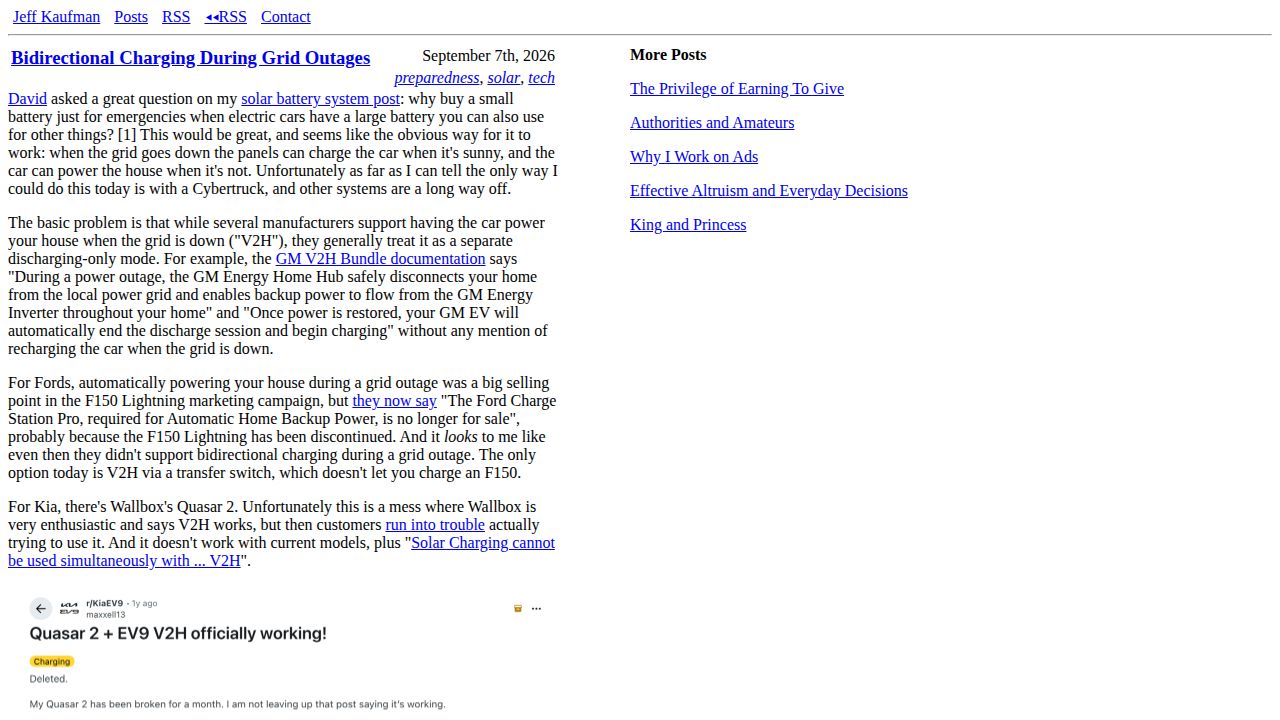
Many homeowners consider using an electric vehicle (EV) as a primary backup power source during grid outages, assuming a seamless loop where solar panels charge the car during the day and the car powers the home at night. However, current manufacturer implementations often treat Vehicle-to-Home (V2H) as a one-way discharge mode. For instance, GM's V2H documentation describes a system that disconnects the home from the grid and enables backup power from an inverter, but it does not mention recharging the vehicle during that outage period. Similarly, Ford's dedicated hardware for automatic home backup is no longer available, and other options like the Kia Quasar 2 have faced reported issues where solar charging cannot be used simultaneously with V2H functionality.
Currently, one of the few documented ways to achieve true bidirectional charging during an outage is through the Tesla Powershare system paired with a Cybertruck. This configuration allows a UL 1741-listed solar system to recharge the vehicle even while the grid is down, provided there is sufficient capacity in the backup panel. While other manufacturers are moving toward this capability, such as Enphase's plans to ship a bidirectional charger in late 2026, these solutions remain heavily dependent on automaker software enablement and specific vehicle compatibility, which may delay widespread availability.
Beyond technical limitations, practical and economic trade-offs remain significant. For many users, the high cost of a vehicle capable of bidirectional charging may exceed the cost of installing a dedicated, smaller emergency battery. Furthermore, there are ongoing questions regarding the long-term impact of frequent charge and discharge cycles on a vehicle's battery health compared to standard driving use. For high-demand loads like large HVAC systems, the sheer amount of storage required—potentially hundreds of kilowatt-hours—makes current EV-centric solutions less economically feasible for long-term infrastructure recovery than for short-term emergency bridging.