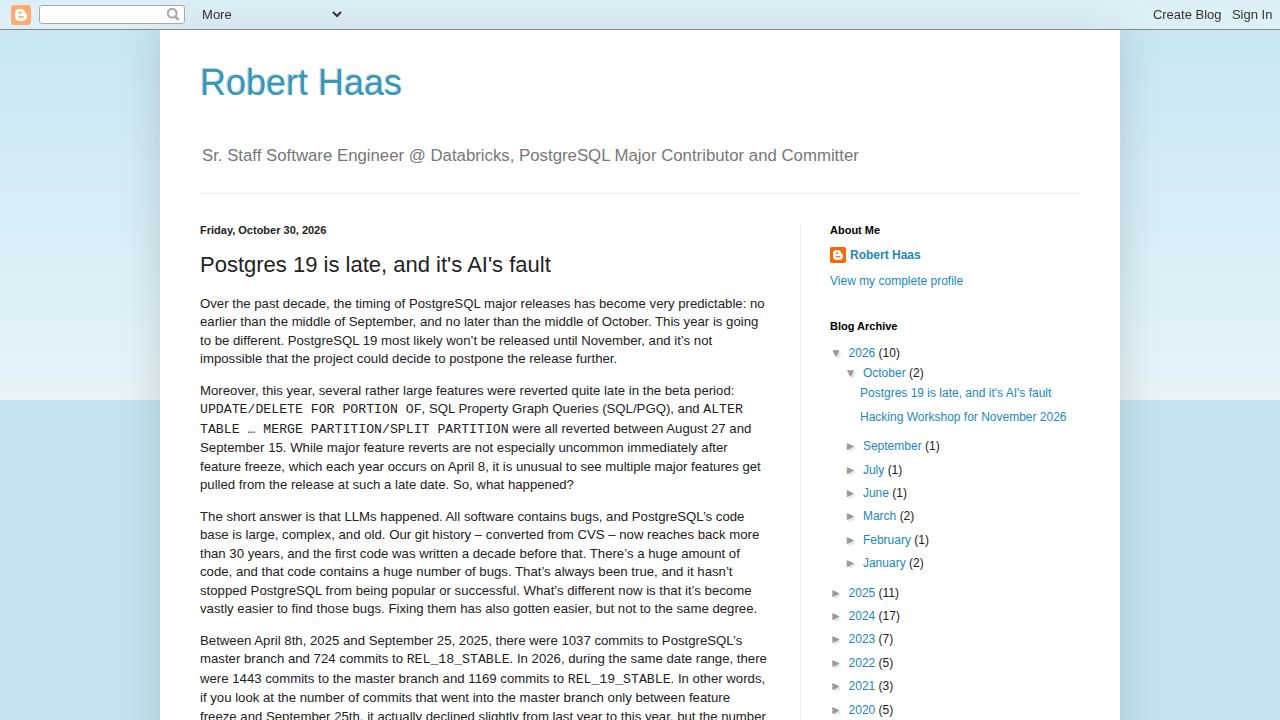
The release of PostgreSQL 19 is facing delays primarily due to a heightened quality bar and a surge in bug discoveries that have disrupted the project's traditional release cadence. While the project has historically moved at a steady pace, the recent influx of reports has forced maintainers to prioritize hardening the existing codebase over the development of new features. This shift is described by some observers as a necessary trade-off to ensure a more secure and stable product, even if it means pausing innovation in the short term to address issues that have persisted for years.
Large Language Models (LLMs) are cited as a primary catalyst for this change, specifically by improving 'read-only' search tasks. These models have made it significantly easier to identify complex technical issues, such as serialization anomalies, foreign key integrity problems, and planner correctness bugs. One contributor reported finding hundreds of potential candidates for bugs—including CVE-worthy vulnerabilities—using AI-assisted methods. This capability allows for the discovery of flaws that might have remained hidden in the 30-year-old codebase, but it also creates a massive volume of data that the project must now process.
However, this surge in discovery presents a significant scaling challenge for the PostgreSQL maintainers. While AI has removed the bottleneck of finding bugs, the project still faces a bottleneck in verification. A small group of maintainers must manually triage, validate, and review the fixes for the hundreds of reports generated by automated and AI-assisted tools. This creates a tension between the desire to harden the software and the practical limits of human review. The long-term impact remains a subject of debate: while the current focus on burning down the bug count may temporarily slow down innovation, it aims to produce a more robust foundation for future development.