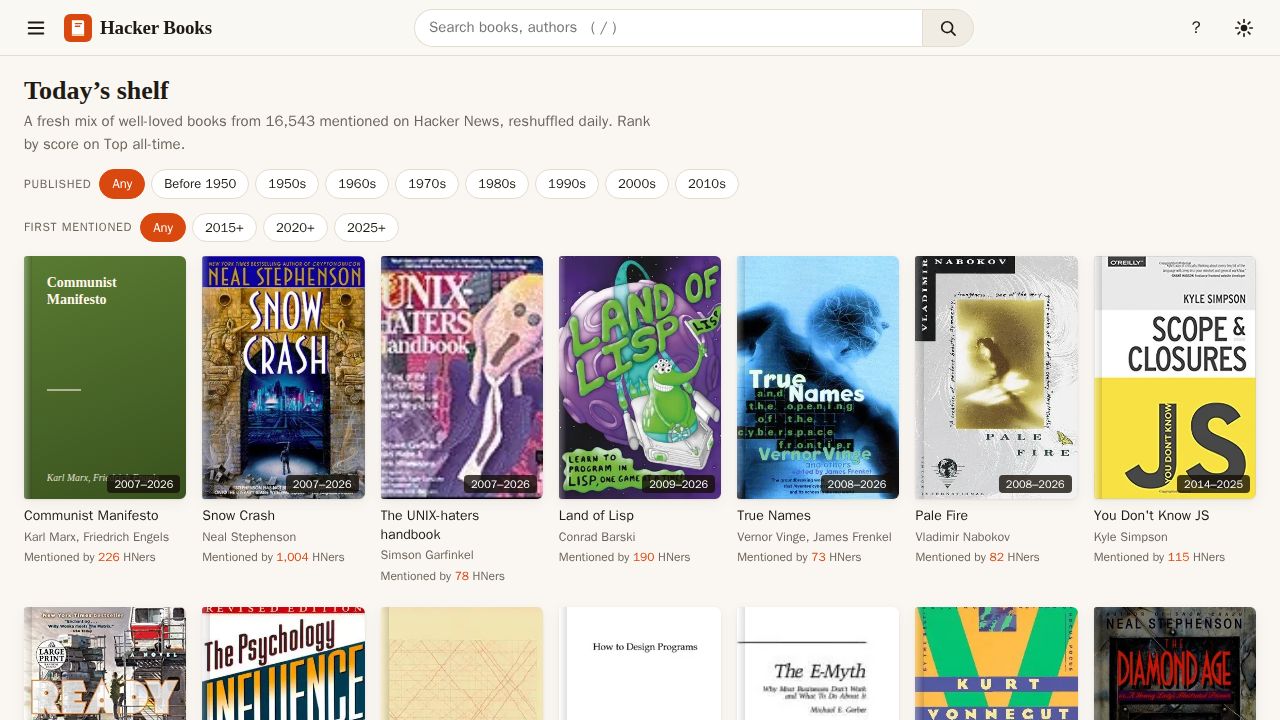
HackerBooks is a new platform designed to serve as a book-centric version of 'HackerTube,' a project that aggregates content from the Hacker News community. The site identifies and ranks approximately 16,500 books that have been mentioned by at least two different commenters in Hacker News threads dating back to 2007. The project was largely developed using Claude (Opus 5.5), which the creator used to build the data pipeline and the website's structure under human steering. Each book entry on the site includes a link back to the specific comments where it was mentioned, allowing users to see the context of the community's interest.
The core mechanism of the site relies on a mention-count system to determine a book's popularity or relevance within the community. However, this system currently treats all mentions equally; a book's score is influenced by both praise and criticism, as the system does not yet distinguish between a positive recommendation and a negative review. To ensure performance, the site utilizes a fast user interface supported by HTTP/3 and Cloudflare. While the site provides a high-level overview of what the community is reading, it faces technical challenges in precision, such as distinguishing between different publications with identical names or identifying the correct author when multiple works share a title.
Community feedback has highlighted several areas for refinement regarding the site's functionality and data accuracy. Users have noted that the 'For You' recommendation algorithm can sometimes suggest unrelated titles, and some entries may be skewed by mentions of magazines rather than books. Additionally, because many Hacker News comments contain lists of multiple books, some users have suggested improving the UI to expand these comments, making it easier to see which specific explanation belongs to which book. While the site successfully surfaces niche interests and high-frequency recommendations, it remains a work in progress as the developer addresses these nuances in data mapping and user experience.