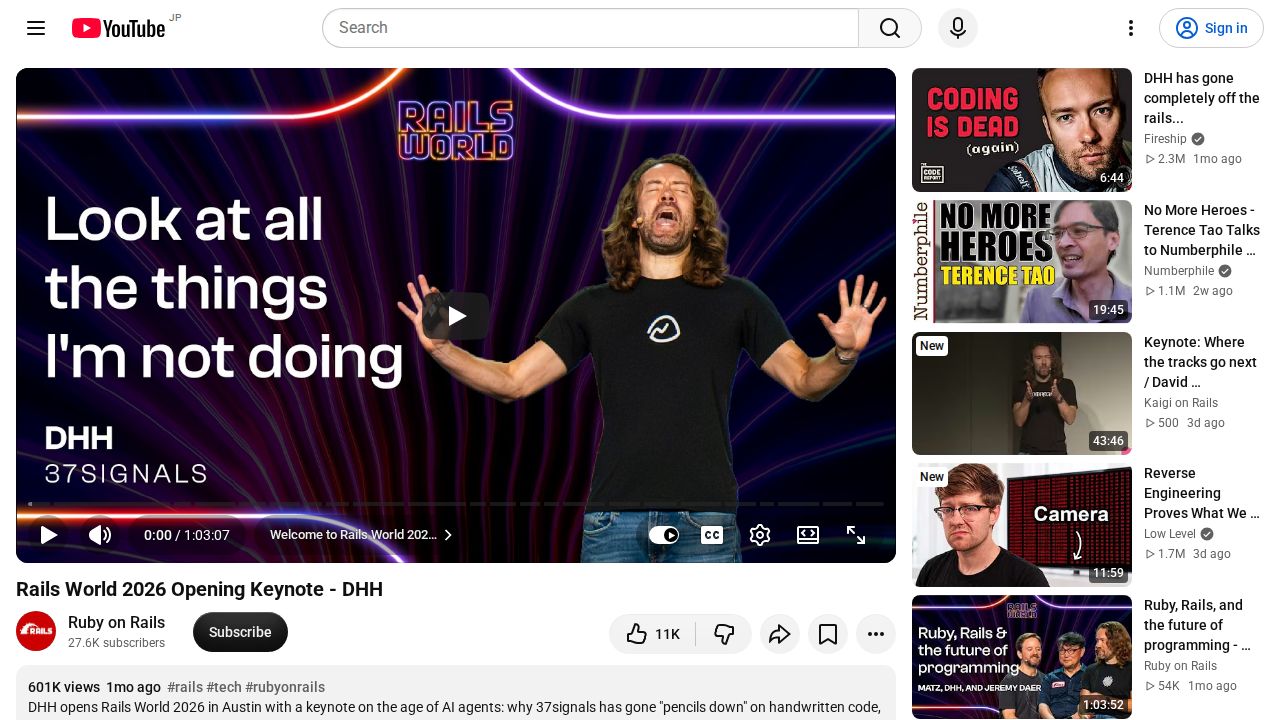
In his Rails World 2026 keynote, David Heinemeier Hansson (DHH) outlines a fundamental shift in the software development lifecycle driven by 'agentic coding.' This approach involves using AI agents to write the majority of a codebase, effectively moving the human developer's primary responsibility from manual coding to high-level 'making.' DHH suggests that this transition allows developers to focus on architecture, specifications, and the 'mending' of complex systems rather than the granular construction of every line of code. This shift is framed as a move toward a new status quo where the speed of implementation is no longer the primary bottleneck for innovation.
To illustrate this transition, DHH highlights the backend of 'Hey,' an email and calendar platform owned by 37Signals. By leveraging agentic coding to rewrite the backend in Rust, the company was able to drastically reduce its infrastructure requirements, cutting the number of servers needed from 110 down to 10. This move was facilitated by the fact that agents can now handle the heavy lifting of migrating to faster, more memory-efficient languages. Furthermore, DHH argues that agentic coding solves a long-standing business problem: the high cost of maintaining multiple native mobile applications. Previously, the overhead of supporting several different native apps was often prohibitive, leading many to settle for hybrid web-native solutions. With agents handling the implementation, businesses can now feasibly maintain a suite of native apps while keeping the backend simple and high-performing.
However, this shift toward agentic development and Rust-based backends has sparked significant debate within the developer community. Some observers express concern over the loss of 'flow state'—the deep focus achieved through manual programming—and worry that a 'cheap outsource' culture could lead to a decline in code reliability and maintainability. There is also a notable tension regarding the future of the Ruby on Rails framework itself; if the framework's creator is pivoting toward Rust and agentic workflows to solve core business problems, some question how Rails will remain relevant for new projects. While the move offers clear advantages in server costs and native app reach, it introduces unresolved questions about the long-term quality of AI-generated code and the evolving role of the human developer in a world where the 'blank canvas' is increasingly filled by agents.