A new method for building a 433 MHz radio scanner simplifies the process by removing the need for a microcontroller or soldering. By using a CC1101 radio module and a CJMCU-232H board (which houses an FT232H chip), users can connect the radio directly to a laptop's USB port. This configuration allows a Python script to communicate with the radio chip via the Serial Peripheral Interface (SPI) protocol. Unlike standard USB-serial sticks, which only support serial communication, the FT232H chip is capable of driving the SPI interface, enabling direct interaction between the laptop's software and the radio hardware.
The system functions by configuring the CC1101 as an On-Off Keying (OOK) receiver. A Python script manages the radio's settings, such as the 650 kHz filter, and monitors the signal strength (RSSI) across different frequency bands. The scanner provides a Terminal User Interface (TUI) that displays a 'waterfall' of past signal sweeps and a 'listen' screen. The listen screen captures and demodulates data from specific protocols, such as the EV1527 codes used by many simple remote controls. For example, during testing with a copy remote, the scanner successfully decoded 24-bit codes, identifying specific button presses and their corresponding bit patterns.
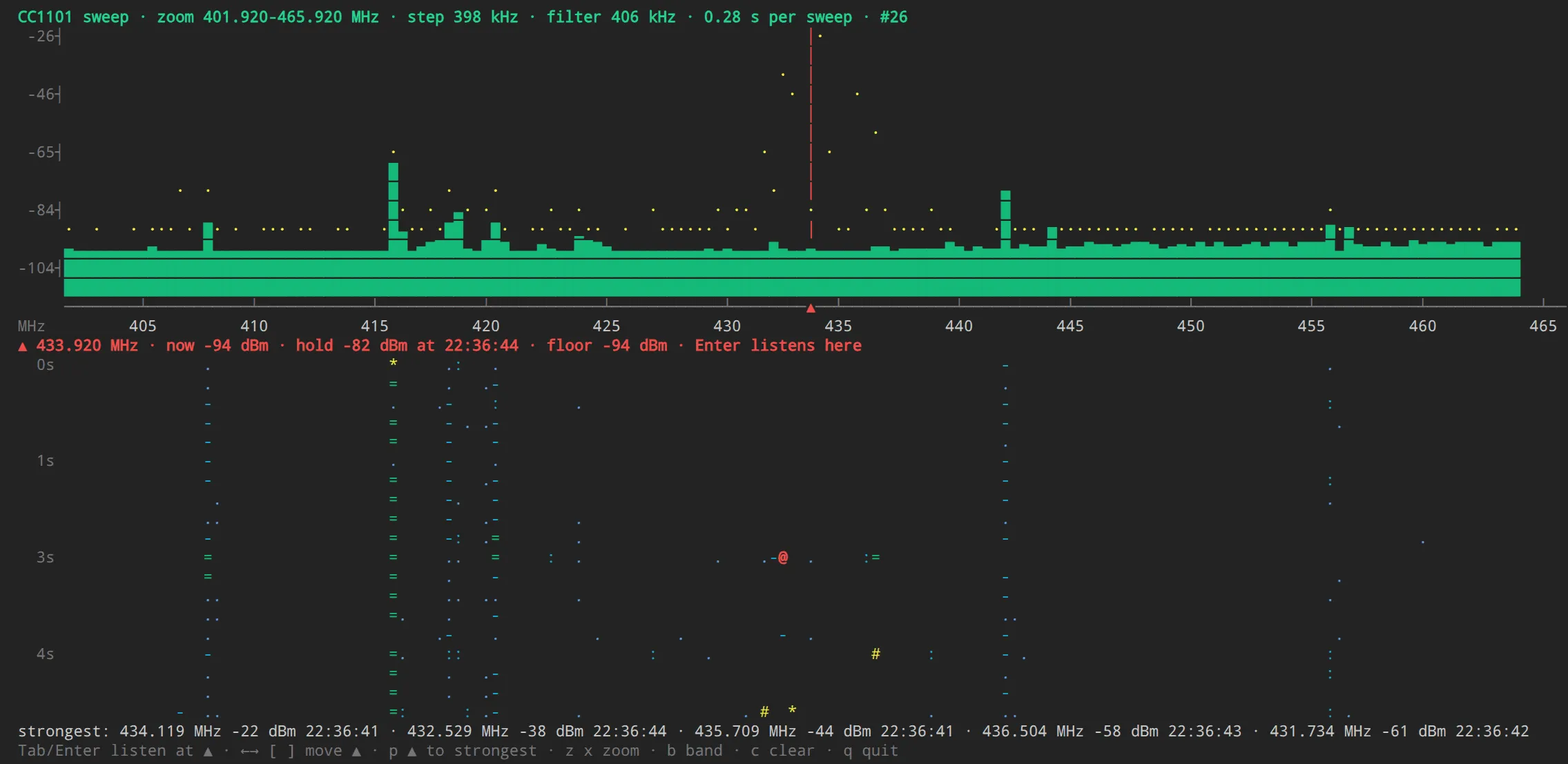
The scanner provides a Terminal User Interface (TUI) that displays a 'waterfall' of past signal sweeps and a 'listen' screen.
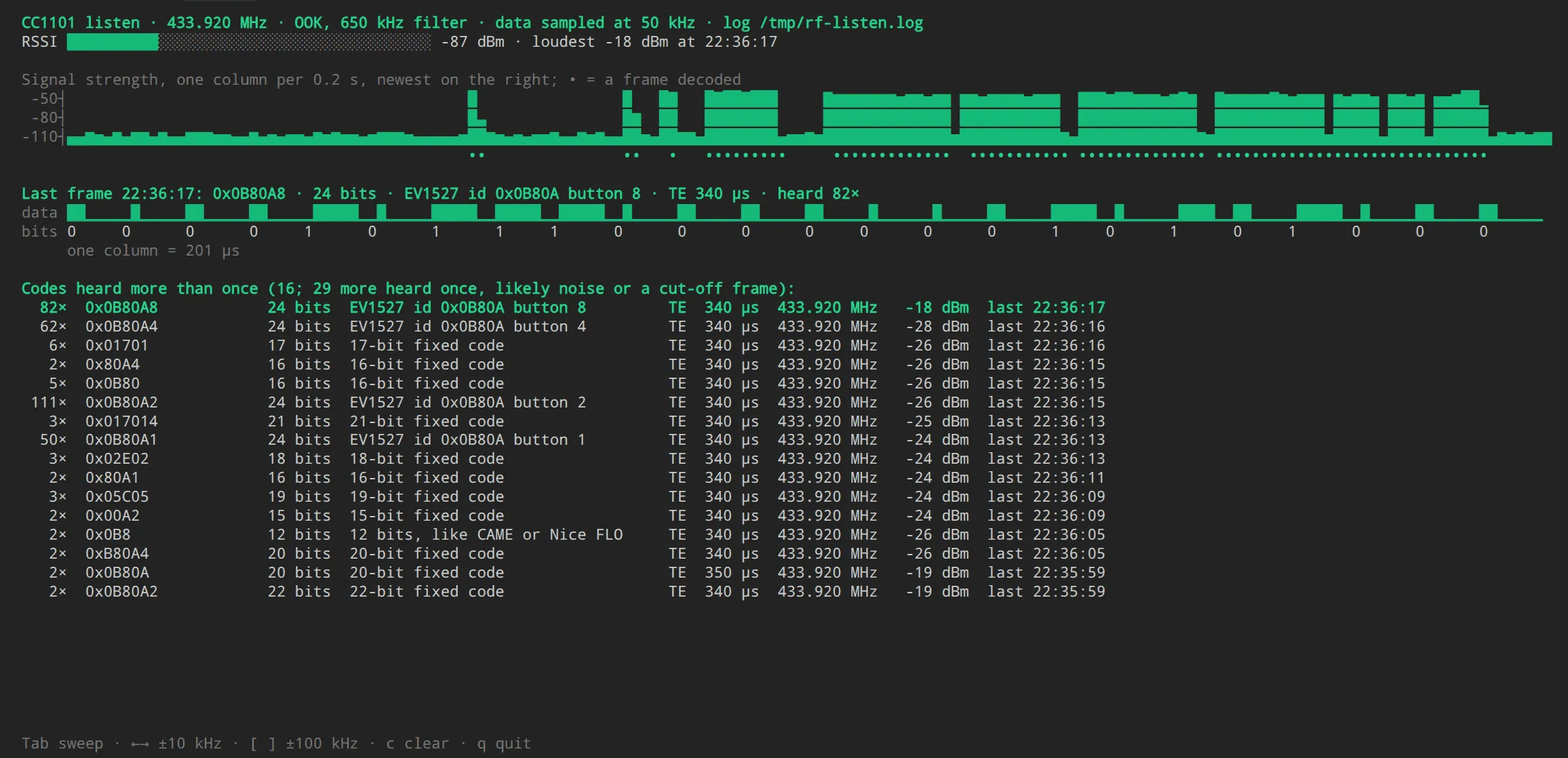
The listen screen captures and demodulates data from specific protocols, such as the EV1527 codes used by many simple remote controls.
Despite its simplicity, the setup has specific hardware and functional constraints. Because the CC1101 module operates on a low voltage (1.8V to 3.6V), it must be wired specifically to the 3.3V pin on the FT232H board; connecting it to the 5V pin can damage the module. Additionally, the current implementation is a receive-only system. While it can visualize and decode signals from simple remotes, it cannot transmit signals or interact with more complex rolling-code systems, such as those using the KeeLoq protocol, which require encrypted counters to function.
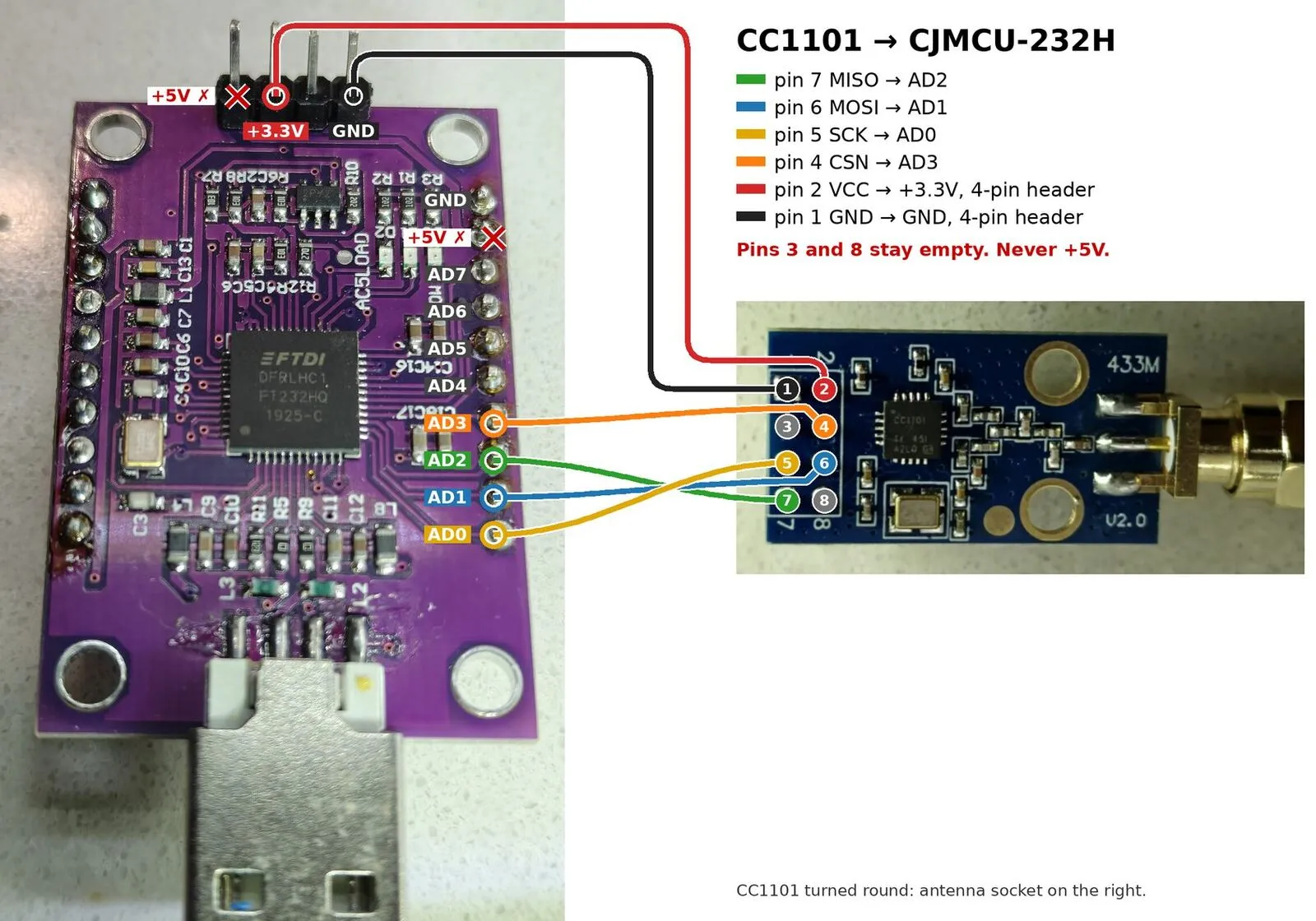
The setup requires specific wiring to the 3.3V pin of the FT232H board to power the CC1101 module safely.