Researchers from MIT CSAIL and other institutions have identified a new paradigm they call 'Weight-Space Programming.' Traditionally, optimizing a neural network involves using symbolic algorithms like Adam or Muon to iteratively update weights based on gradients. In contrast, Weight-Space Programming involves a general-purpose LLM reasoning about the raw numerical weights of a network to identify specific behaviors, failures, or traits, and then manually editing those weights to achieve a desired natural-language goal.
In a series of experiments, the researchers demonstrated that GPT-6 Astra could perform these tasks with surprising accuracy. For instance, Astra was able to identify which computer game a small neural network was trained to play (such as Breakout or Pong) simply by reading its 17,253 raw weights as text. It also successfully identified 'copying heads'—specific components in transformer blocks that allow a model to repeat previous text—within the middle layers of a language model. These capabilities were demonstrated without allowing the model to run a forward pass or use external tools, suggesting that Astra is reading the underlying geometry and structure of the weights rather than just calculating outputs.

This visual represents the experiment where Astra identified the specific game a small network was trained to play.
The most significant application of this technique involves 'one-shot' fixes for model failures. When tasked with improving the math performance of Qwen3.5-0.8B, Astra identified a specific weight issue causing reasoning loops and edited only 0.016% of the model's weights. This manual correction raised the model's score on the MATH-500 benchmark from 7.9% to 48.1% and tripled its instruction-following performance. Similarly, in a physical control task where a car was stuck on a ramp due to a local-minimum policy, Astra edited 3.5% of the weights to add a separate path through the network units, allowing the car to successfully back up and clear the obstacle. While these results are promising, the current research focuses on small-to-medium models, leaving it uncertain whether this weight-space reasoning scales linearly to massive frontier models or remains a specialized capability for smaller architectures. (primary) and (primary).
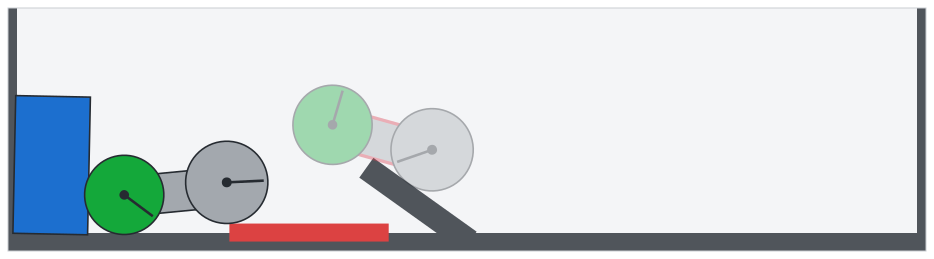
The image illustrates the physical control task where Astra edited weights to allow a car to clear a local-minimum obstacle.