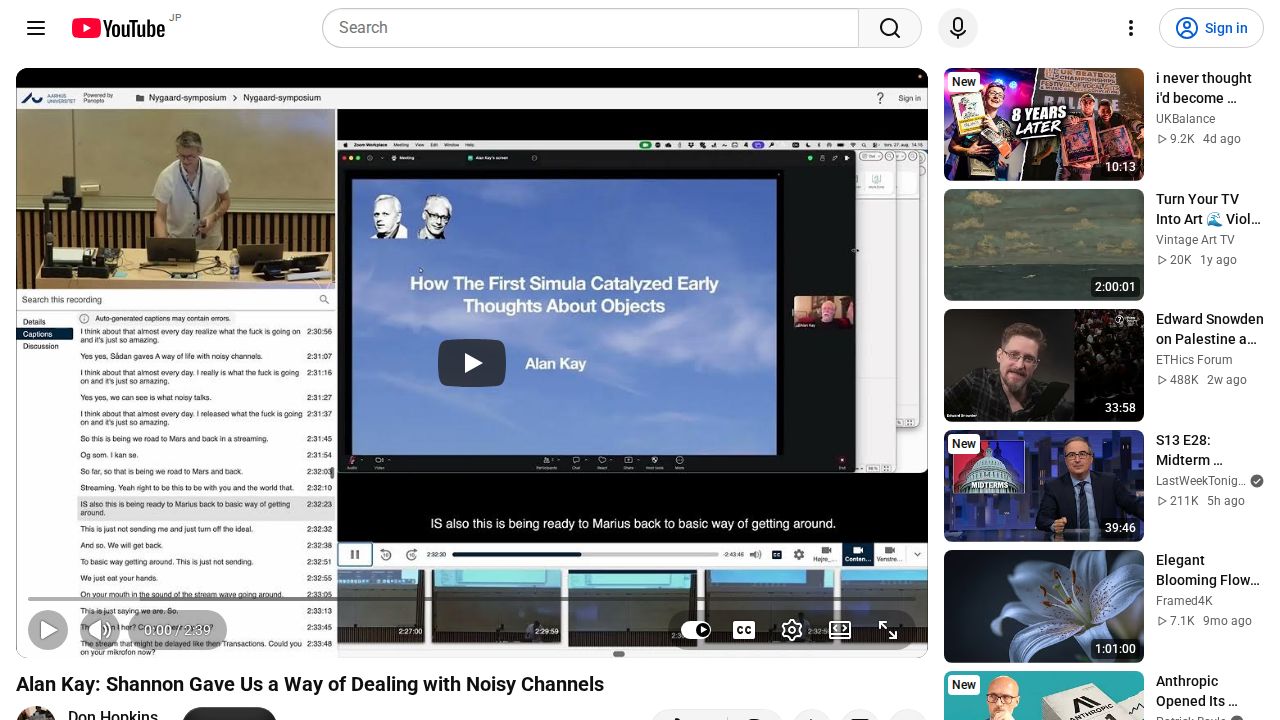
During a live online celebration of Kristen Nygaard's 100-year birthday, computer scientist Alan Kay was scheduled to discuss how the programming language Simula influenced his early conceptualization of objects. However, a technical setup error transformed his presentation into an improvisational performance. Because a live stream was playing out loud near an open Zoom microphone, Kay's own voice was fed back into his ears with a 21-second delay. This created a continuous audio feedback loop, effectively turning his speech into a real-time experiment in signal degradation.
Kay observed the phenomenon through the lens of Claude Shannon's noisy channel coding theorem, noting that Shannon provided the mathematical framework for dealing with exactly this kind of interference. While the theorem provides a way to quantify the maximum amount of information that can be transmitted over a noisy channel, the practical application is complex. Commenters on Hacker News clarified that Shannon's work does not provide a simple 'fix' for all noise; rather, it establishes the theoretical limit of what is possible. Approaching that limit in practice requires sophisticated error correction, as decoding truly random codes—which Shannon's original paper suggested as an optimal method—would require exponentially large amounts of memory and computation.
The experience also highlighted layers of 'interpretation noise' beyond the immediate audio loop. For instance, YouTube's automated speech-to-text transcription censored Kay's enthusiastic reaction to the glitch, replacing his words with bleeps. This added a secondary layer of data loss where the system's interpretation of the signal differed from the speaker's intent. The incident served as a meta-commentary on communication: while Shannon's theorem allows us to calculate the movement of the 'stars' (the theoretical limits of data), the 'madness' of real-world systems—including network compression, room acoustics, and automated transcription—remains a practical challenge to navigate perfectly.