Language learning platforms often use 'word coverage' as a primary metric for progress, calculating what percentage of a show's total spoken words a student knows. However, this metric can be misleading because it weights high-frequency grammar particles (like 'no' or 'wa') very heavily. In the anime 'Frieren,' the top 100 most common words alone account for 68.3% of the total word coverage. While these words appear constantly, knowing them does not guarantee that a viewer can follow a complete sentence if even a single less-common word remains unknown.
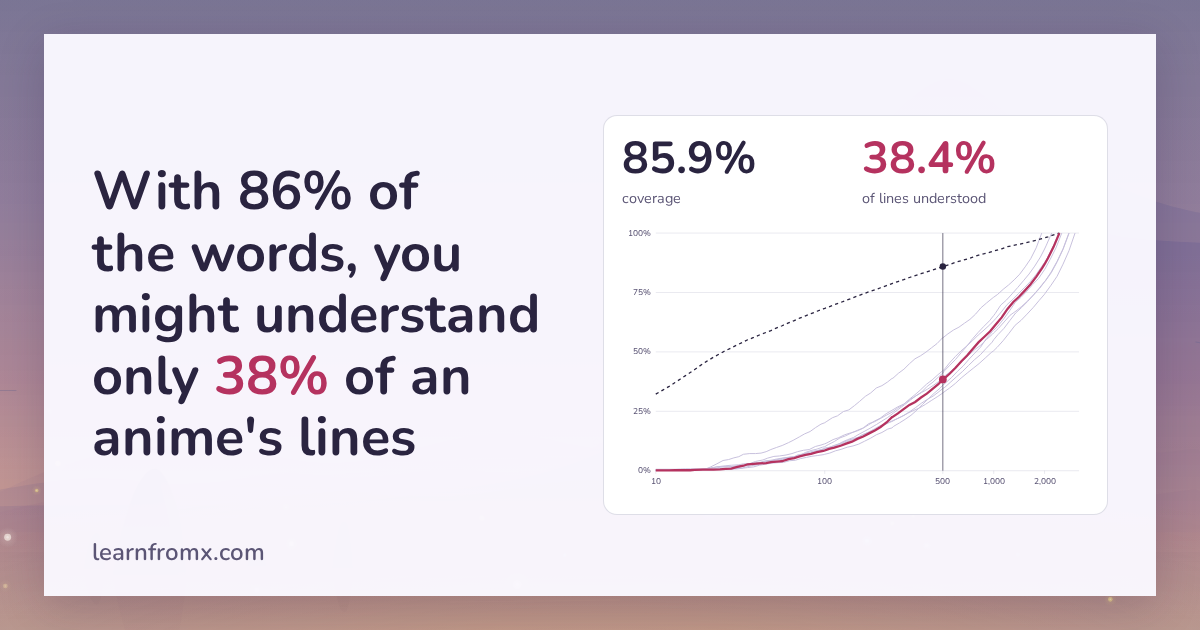
This chart visualizes the core finding of the study regarding the gap between knowing individual words and understanding full sentences.
The discrepancy between coverage and comprehension is primarily driven by average line length. In 'Frieren,' a typical line contains about seven words. To understand a line fully, a viewer must know all seven words; if just one is missing, the line remains 'ununderstood' in this specific metric. Mathematically, at 85.9% word coverage, the probability of knowing all seven words in a line is approximately 35% (0.859 raised to the seventh power), which closely aligns with the measured 38.4% comprehension rate. This gap persists across various titles, such as 'Death Note' and 'Jujutsu Kaisen,' where high coverage figures often mask a much lower percentage of fully understood lines.
Analysis of the data suggests that expanding a vocabulary from 500 to 1,000 words provides a much larger boost to line comprehension than to word coverage. While the coverage only increases by about 6.5 points in 'Frieren,' the percentage of understood lines jumps by 22.1 points. This occurs because many lines are only one word away from being fully understood. However, these 'one-word gaps' are often filled by a wide variety of different words, meaning that while a single new word might unlock several lines at once, a learner cannot rely on a small handful of words to bridge the gap to full fluency. Additionally, the study notes that polysemy—words with multiple meanings—can make these figures appear higher than they are in practice, as a learner might know a word's most common meaning but not the specific meaning used in a complex sentence context.
Ultimately, the research highlights that while word coverage is a useful starting point, it is an incomplete proxy for real-world comprehension. The effectiveness of a vocabulary list depends heavily on the specific show's lexicon; for instance, the 2,000 most common words in general Japanese provided significantly lower comprehension rates (23.4% to 37.6%) compared to the top 2,000 words specific to the shows analyzed (74.3% to 93.3%). This suggests that targeted vocabulary acquisition, focusing on the specific words used in a preferred series, is a more efficient path to understanding than general frequency lists alone.