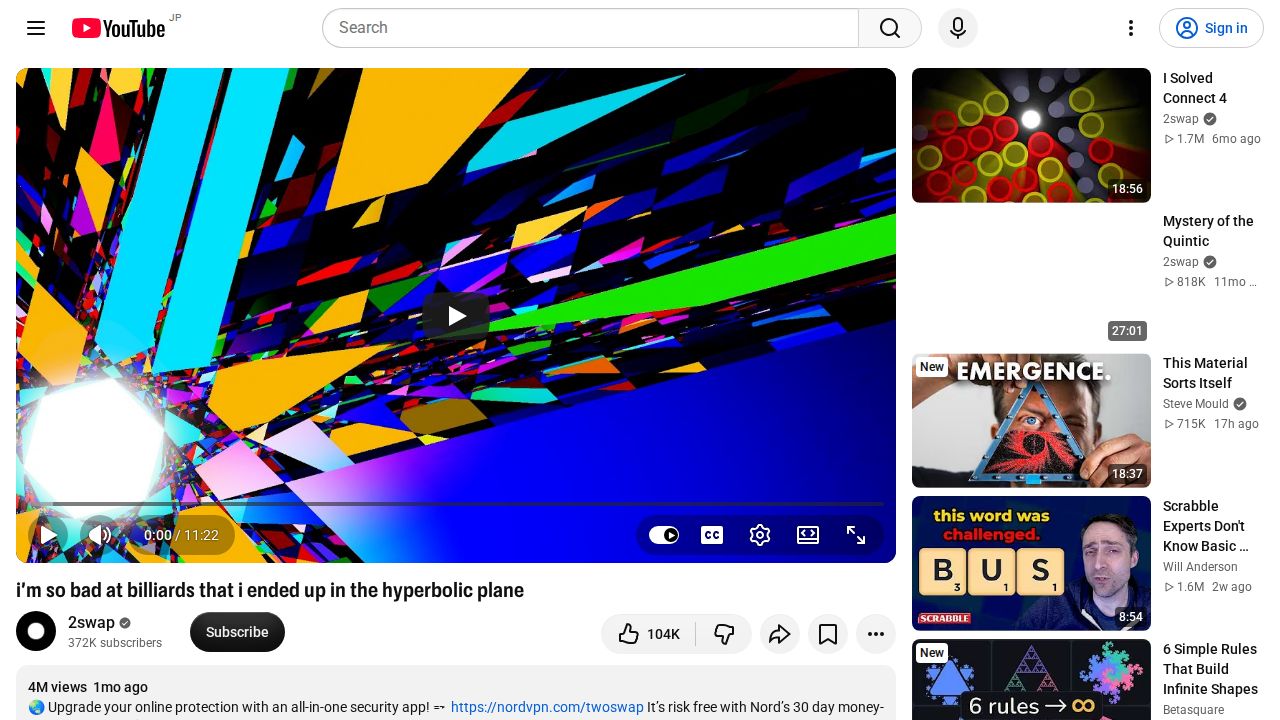
A recent mathematical animation explores the behavior of billiards in a hyperbolic plane, a non-Euclidean geometry where the rules of movement differ significantly from standard flat space. The video uses this metaphor to visualize complex geometric concepts, illustrating how a ball's trajectory behaves when the underlying space is curved rather than Euclidean. By contrasting these movements with traditional billiards, the animation provides a visual entry point into advanced mathematical theory.
In a hyperbolic plane, the geometry is characterized by a constant negative curvature. Unlike a flat surface where parallel lines remain equidistant, lines in hyperbolic space diverge from one another. This creates a unique environment for a game of billiards: as a ball travels, its path is dictated by the curvature of the space, leading to trajectories that would be impossible in a standard room. The animation serves as a thought experiment, showing how mathematical models can be used to explore these abstract environments through familiar physical actions.
The animation has garnered significant attention, reaching millions of views and sparking discussion regarding its aesthetic and technical execution. While many viewers praised the visual beauty and the unique perspective on math, the reception was mixed regarding the sensory experience. Some viewers found the audio mix and color palette uncomfortable or distracting, leading them to rely on closed captions. Additionally, the discussion highlighted the creator's broader work in computational concepts like lambda calculus, suggesting that the billiards animation is part of a larger effort to make complex mathematical structures accessible through high-quality visual media.