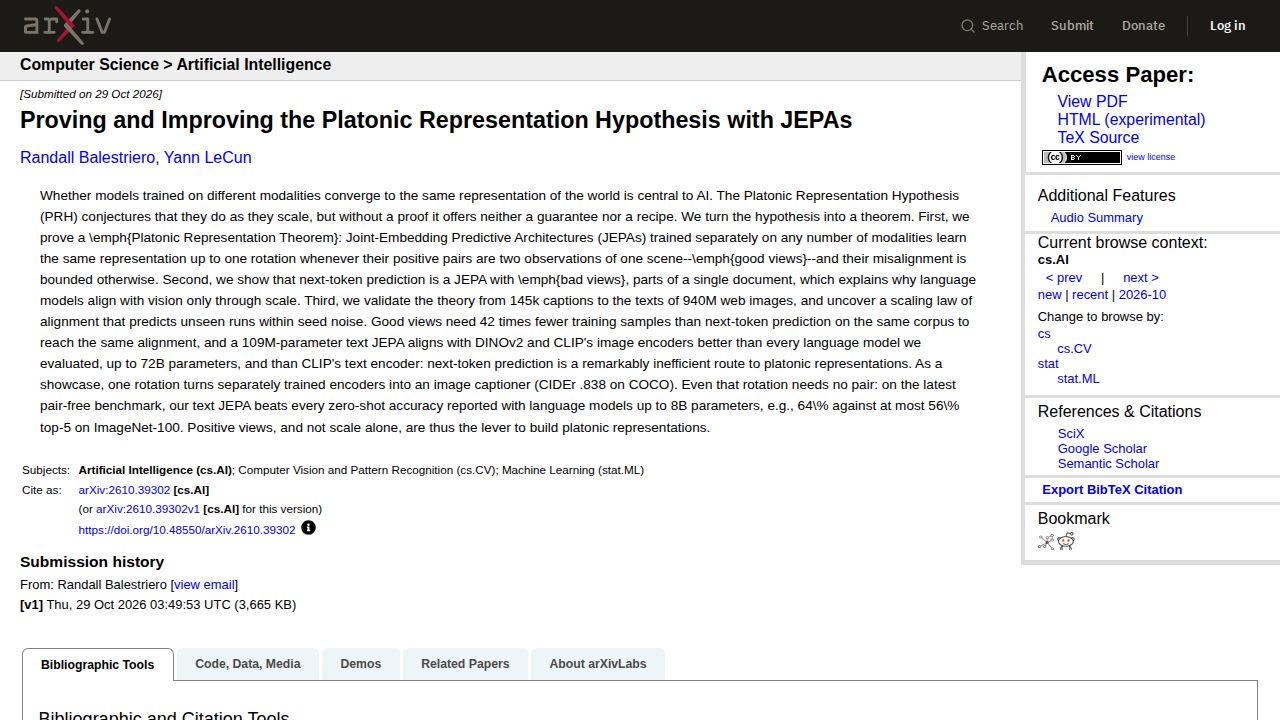
The Platonic Representation Hypothesis (PRH) posits that as artificial intelligence models scale, they will eventually converge on a shared, universal representation of the world, regardless of whether they were originally trained on text, images, or other modalities. While this has been a central conjecture in AI research, it lacked a formal proof. Recent research by Randall Balestriero and Yann LeCun addresses this by establishing a 'Platonic Representation Theorem.' This theorem proves that Joint-Embedding Predictive Architectures (JEPAs) trained on different modalities will learn the same representation—up to a single rotation—provided that their positive pairs consist of 'good views,' which are multiple observations of the same scene where the misalignment between views is bounded.
The authors contrast this with the standard 'next-token prediction' method used to train most modern language models. They categorize next-token prediction as a JEPA trained on 'bad views'—specifically, fragments of a single document. Because these fragments are less consistent than multiple views of a single scene, language models require massive scale to align their internal representations with those of vision models. The study uncovers a specific scaling law of alignment, showing that 'good views' are significantly more efficient: they require 42 times fewer training samples than next-token prediction to reach the same level of alignment between modalities.
In practical testing, the researchers demonstrated that a relatively small 109M-parameter text JEPA outperformed every language model they evaluated up to 72B parameters in its ability to align with image encoders like DINOv2 and CLIP. This suggests that the current reliance on massive scale to bridge the gap between text and vision is a byproduct of using inefficient data structures. While 'good views' offer a much faster route to a shared world model, they require specific data pairings—multiple observations of a single scene—rather than the ubiquitous sequential data that currently fuels the development of large language models. This finding shifts the focus from simply increasing model size to improving the quality and structure of the training views to achieve faster, more efficient alignment.