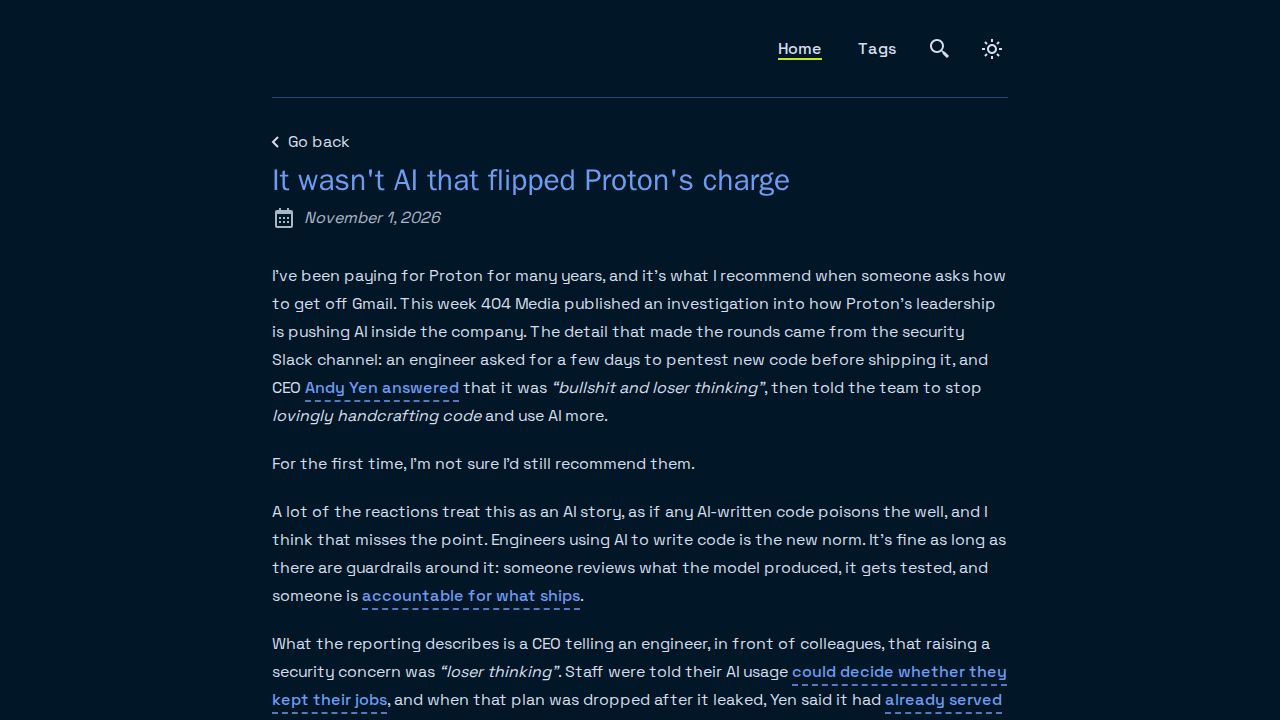
Proton, a provider known for secure email and encrypted services, is facing scrutiny following reports regarding its shift toward an AI-accelerated development model. The controversy centers on a reported incident where CEO Andy Yen dismissed an engineer's request for additional time to perform penetration testing—a standard procedure for identifying security flaws before shipping new code. According to reporting summarized by Raed Devin, Yen characterized such caution as "bullshit and loser thinking," urging teams to move away from what he described as "lovingly handcrafting" code in favor of increased AI integration.
The core tension lies in the trade-off between production speed and safety protocols. For most software companies, accelerating release cycles through AI coding agents is viewed as a reasonable efficiency gain. However, because Proton markets itself specifically as a high-security privacy firm, its value proposition depends on meticulous engineering. A bug that exposes user data could be catastrophic for a company whose primary product is trust. Critics argue that by treating these inherent security constraints as obstacles to velocity rather than essential requirements, the leadership may be undermining the very attributes that differentiate it from competitors like Gmail.
Internal tensions have also surfaced regarding how this transition is being managed among staff. Reports suggest that employees were initially told their continued employment might depend on their adoption of AI tools, a policy that was later reportedly dropped after leaking publicly. While some employees defended the company’s direction online, observers noted these defenses appeared more like corporate crisis management than genuine dissent over technical practices. The situation remains unresolved, with the central question being whether Proton can maintain its reputation for rigorous security while pursuing an aggressive, AI-driven development pipeline that prioritizes rapid deployment dates over manual verification.