OpenIDEA is a native desktop application designed to replicate the specific workflow and user interface of JetBrains' IntelliJ IDEA. It aims to provide a high-performance environment that includes an editor, code insight, debugger, Git integration, terminal, database, and HTTP clients for over 60 programming languages. By mirroring the 'IntelliJ IDEA way of working,' the project seeks to offer a familiar experience for developers who rely on specific keymaps, tool windows, and 'search-everywhere' habits but want a different underlying architecture.
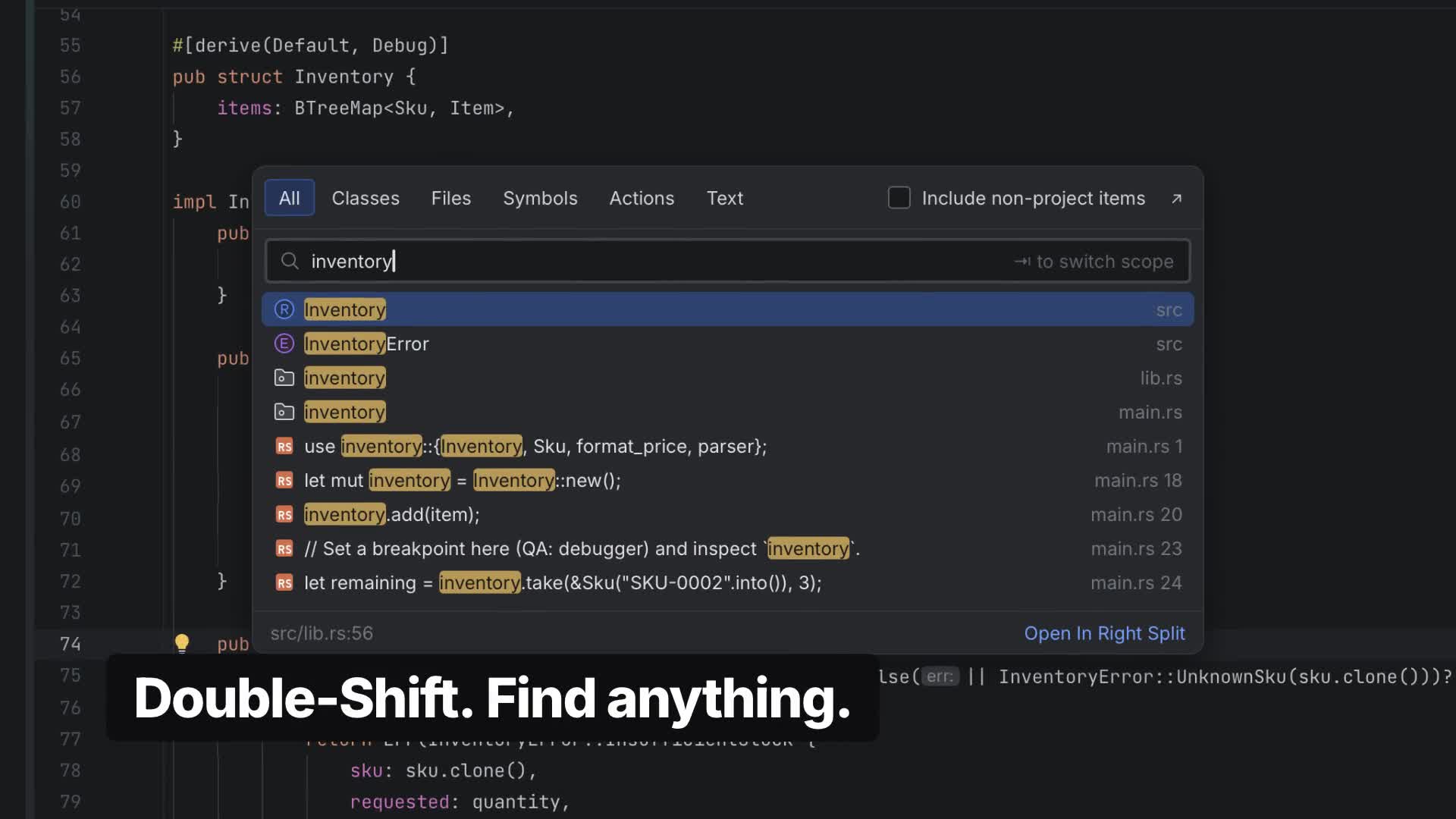
A frame from the project’s demonstration; the search panel is shown over a Rust source file.
The project aims to improve performance by using a Rust core and a Tauri-based architecture. The project distributes builds for macOS, Windows and Linux. The developers have provided benchmark data to illustrate this difference: in a test opening a Python project with approximately 770 files, OpenIDEA showed its project window in a median of 0.9 seconds, compared with 3.1 seconds for IntelliJ IDEA. The separate CPU-settled “ready” measurement was 1.1 seconds versus 13.2 seconds. Furthermore, OpenIDEA utilized 169 MB of memory (USS) during this process, while IntelliJ IDEA required 2,011 MB.
These developer-reported measurements have important limits: there are important nuances regarding the comparison and the project's scope. The developers note that because IntelliJ IDEA performs deeper analysis during startup, the 'ready' state in the benchmark may not represent an equivalent amount of work performed by both tools. Additionally, OpenIDEA is an independent project and is not affiliated with JetBrains. While it offers a faster, lower-memory alternative for those who prefer the IntelliJ workflow, it is separate from the official JetBrains products. The supplied project description does not establish the extent of plugin or settings compatibility.