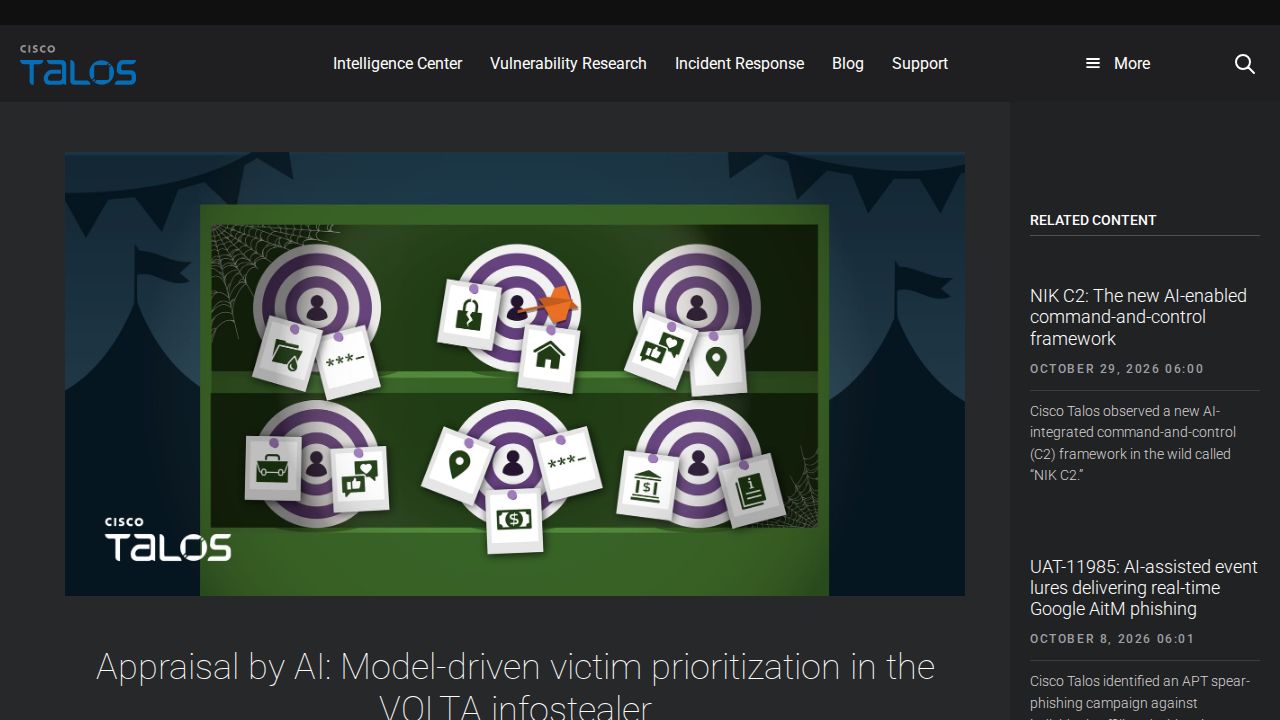
Security researchers at Talos Intelligence have identified a new piece of malware known as the Volta infostealer. Unlike traditional infostealers that may indiscriminately harvest data from any infected machine, Volta employs a sophisticated prioritization mechanism. It uses Large Language Models (LLMs) to analyze the data it collects from a victim's system, effectively 'appraising' the target to determine how much they are worth. This allows the malware to prioritize high-value targets, potentially optimizing the attackers' efforts by focusing on individuals or entities with more valuable assets.
The mechanism involves the malware exfiltrating initial data points to an AI model, which then ranks the victims. This represents a shift in malware development where attackers adopt professional software engineering practices—such as lead generation and pipeline optimization—to refine their operations. By using LLMs to filter and rank victims, the malware authors can ensure that their resources are spent on the most lucrative targets, mirroring how legitimate product managers might prioritize customer segments or lead generation pipelines.
Discussion among security observers highlights several concerns regarding the rapid evolution of these threats. Commenters on Hacker News noted that the speed of modern software development, where thousands of code changes are pushed monthly, creates a wider window of opportunity for compromised updates to introduce such sophisticated logic. Some participants suggested that the rise of AI agents and automated tools could lead to a new era of complex, automated 'virus storms.' To counter these threats, some users suggested moving toward more isolated environments, such as using hypervisors like QubesOS to separate sensitive activities like banking or development into distinct virtual machines.