Anthropic has reached a significant milestone in the artificial intelligence industry: the value of its internal AI consumption now exceeds the cost of its employee compensation. According to the company's IPO filing, the value of Claude AI used internally—calculated at the retail prices Anthropic charges its customers—surpassed monthly employee compensation costs (excluding stock awards) as of April 2026. This figure represents a dramatic escalation in internal AI integration, with internal usage surging more than 250-fold between January and September 2026.
Dario Amodei is the executive leadership behind Anthropic's shift toward AI-driven production cycles.
It is important to distinguish between retail valuation and actual cash expenditure. Anthropic is not spending more literal cash on AI than it does on salaries; rather, it is valuing its own internal consumption at the prices it sells to the public. This accounting distinction has drawn scrutiny, with some observers noting that a company would typically measure internal expenditures by their actual cost. By using retail prices, Anthropic presents a narrative of AI's massive scale, which some suggest may be a strategic choice for its IPO filing to emphasize the platform's dominance over traditional human labor.
This shift in internal operations is reflected in the company's software development pipeline, where Claude now writes more than 90% of the code added to Anthropic's software. This trend aligns with a broader growth pattern where Anthropic's revenue has grown significantly faster than its headcount. However, this high level of internal 'dogfooding'—where employees use the product extensively—may create a skewed development environment. Because internal teams have access to unlimited, zero-cost tokens, the products they build might not fully reflect the constraints and costs faced by the average consumer, potentially creating a gap between internal testing and real-world usability.
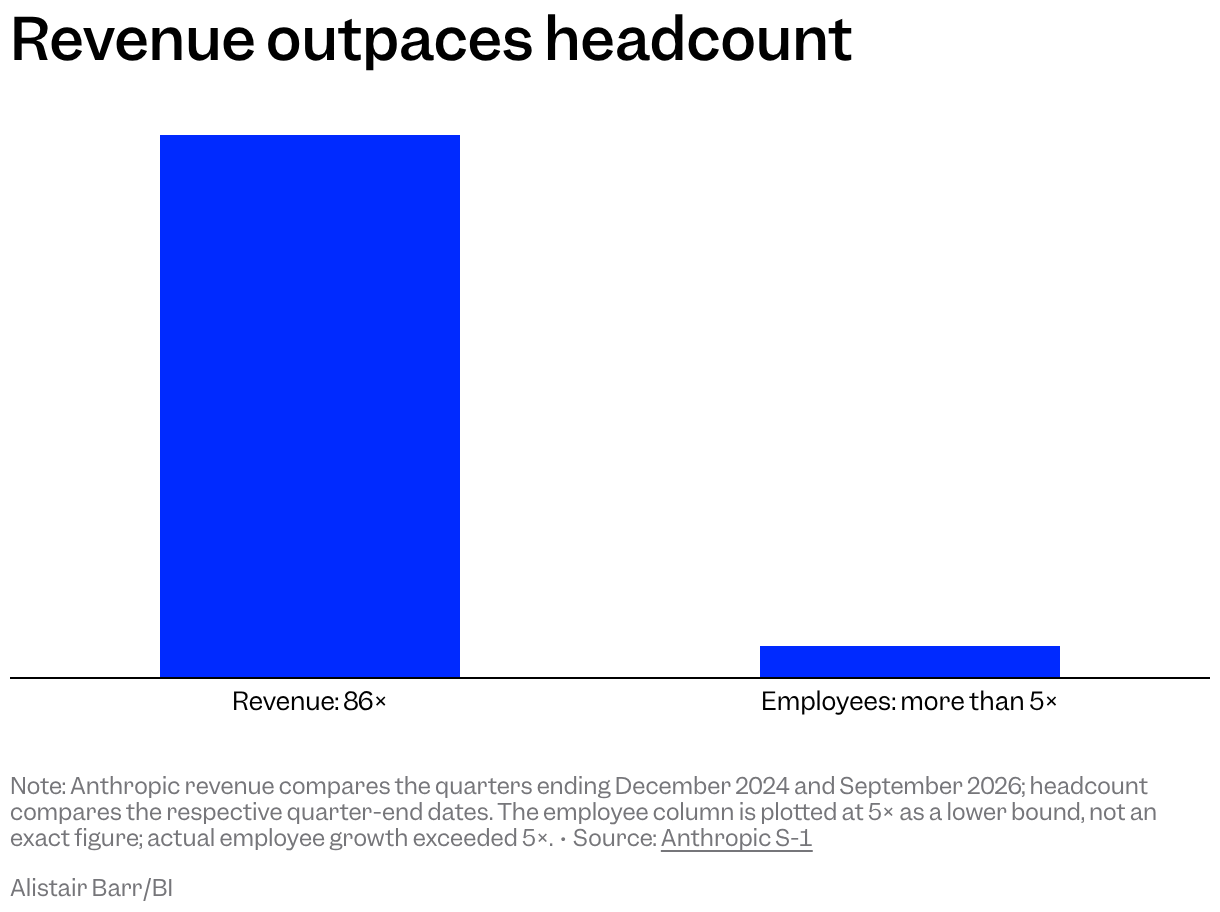
The chart illustrates the disparity between the company's rapid revenue expansion and its relatively stable workforce size.
While the data suggests a watershed moment where AI is challenging the traditional role of human talent as a company's most valuable resource, the true cash-flow impact remains opaque. Because the figures rely on retail pricing rather than internal operational costs, it is difficult to determine the actual financial burden of internal AI usage versus the cost of maintaining a human workforce. The primary takeaway remains the sheer scale of AI's role in Anthropic's production cycle, even if the financial comparison is framed through a retail lens.