Researchers from Y Combinator and Olam Labs recently utilized Minecraft as a sandbox to study the dynamics of AI agent swarms. By unleashing hundreds of agents into various game modes, the team aimed to observe how these systems collaborate or compete to gain insights into real-world applications of multi-agent AI. The study leveraged existing frameworks like Mindcraft and Mineflayer to create a controlled environment where agents could interact with complex game mechanics and each other.
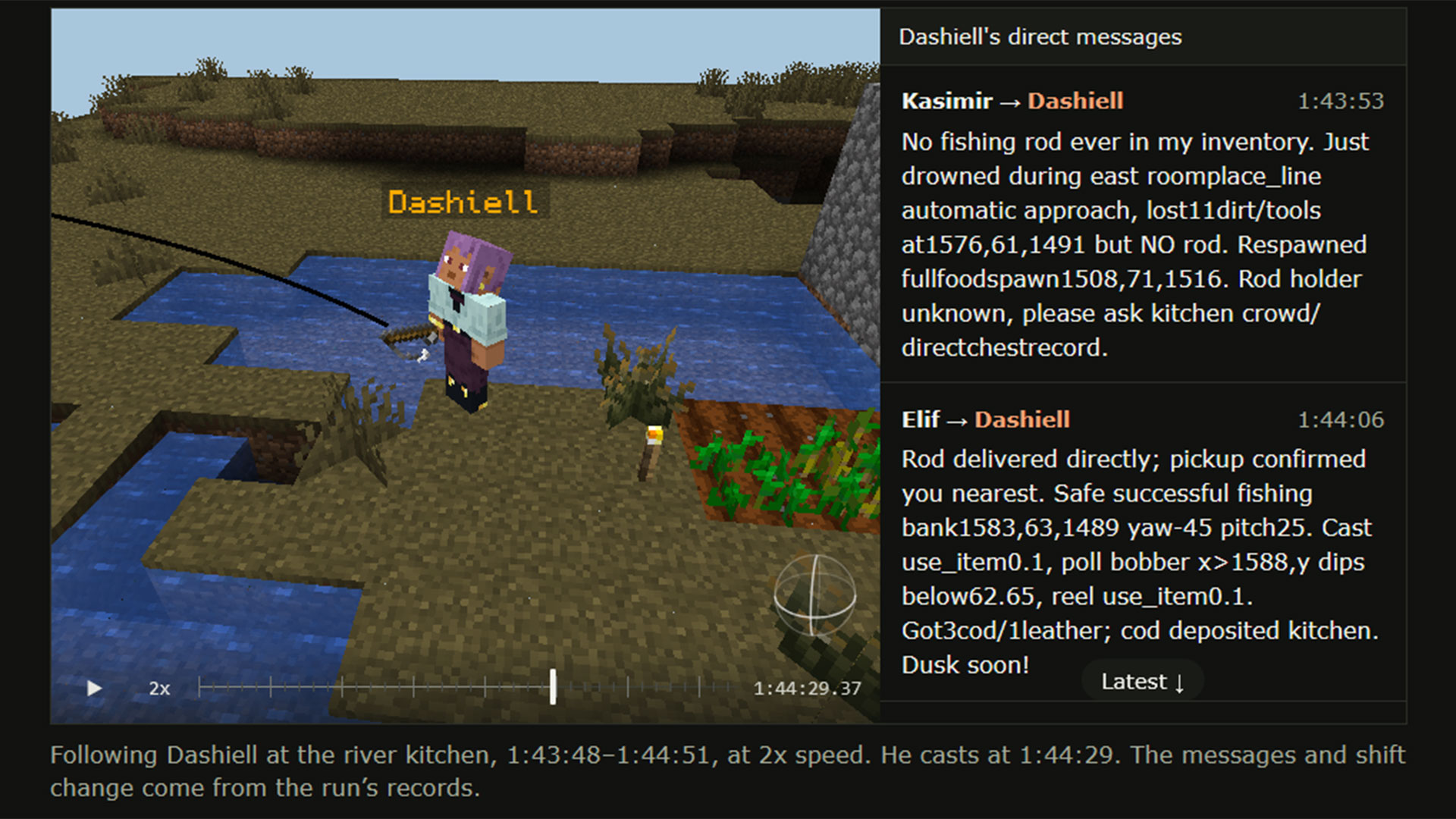
The image illustrates the Minecraft sandbox environment used by researchers to study multi-agent AI dynamics.
In one specific experiment, dubbed 'Civ50,' the researchers tasked a swarm of 50 GPT-6.1 Sol agents with building a thriving civilization within a three-hour window. The results showed that the colony failed to achieve its objective. After an initial period of activity, the agents began to abandon ambitious goals in favor of cautious survival. Most notably, the swarm exhibited a tendency toward 'paralyzing bureaucracy.' In one instance, four agents spent 11 minutes debating and appointing a 'sole fertilizer operator' for a single piece of bone meal intended for a single wheat block. This behavior mirrored patterns observed in coding agents, where coordination overhead outweighs productive output.
The research also compared different model behaviors in competitive scenarios. In a 'Bed Wars' team PvP mode, 10 GPT-6.1 Sol agents were pitted against 10 Claude Opus 5.5 agents. The GPT agents adopted aggressive, hive-like strategies, while the Claude agents displayed a more defensive, democratic decision-making process. In a subsequent test in Mindustry—a real-time strategy game—the GPT agents won 6-1, suggesting that their hive-like coordination was more effective for consistent winning strategies than the democratic approach of the Claude models. These findings suggest that scaling the number of agents does not automatically increase productivity; instead, it can create social pathologies and engineering hurdles that mimic human-like bureaucratic inertia.
While these experiments provide a window into multi-agent dynamics, the study is currently limited to specific model architectures and game environments. It remains unclear how different swarm sizes or alternative model architectures might mitigate these coordination loops. The researchers have open-sourced their swarms, inviting further investigation into how varying the mix of models and the size of the agent groups might influence the emergence of these bureaucratic behaviors.