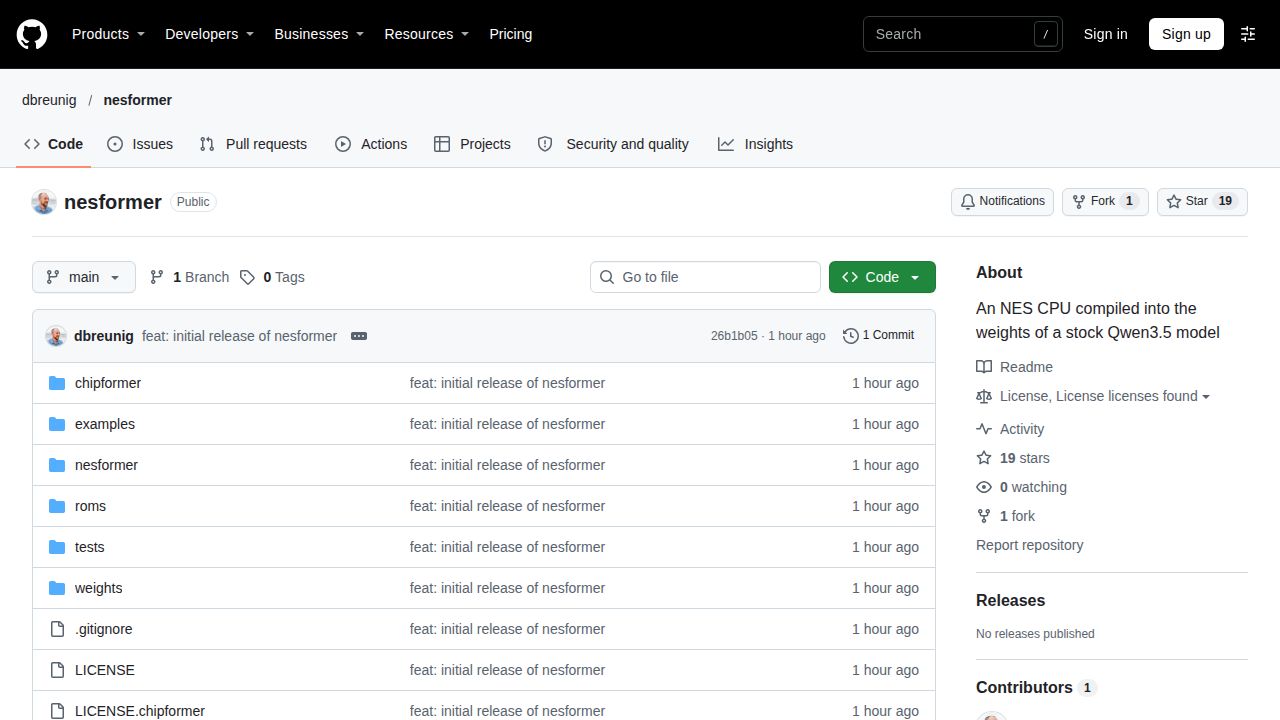
The Nesformer project showcases a unique method of hardware simulation by utilizing a Qwen-based model with approximately 1GB of weights. Rather than using a traditional emulator—which interprets software instructions on a virtualized processor—this implementation encodes the behavior of the Nintendo Entertainment System (NES) directly into the neural network. According to the project's documentation and community discussion, the model uses a gated deltanet architecture to manage the internal state of the system. This means that the CPU logic, the game's ROM data, and the system's RAM are all contained within the model's weights, requiring only controller inputs as external data points after initialization.
From a technical standpoint, this approach represents a significant departure from standard computing efficiency. Commenters on Hacker News noted that while the project is a creative feat of 'code golfing' via neural weights, it is inherently less efficient than deterministic assembly code. Because the model must perform inference to determine the next state of the system, it consumes significantly more resources to achieve the same result that a dedicated circuit or traditional emulator would produce with minimal overhead. The project serves as a proof of concept for the idea that digital logic circuits can be reduced to a set of learned weights, even if that method is not practical for everyday use.
One of the primary questions raised by the community concerns the scope of the simulation's accuracy. While the project demonstrates a 'working' Nintendo, it remains unclear if the model can perfectly replicate every possible input and output combination across all possible game states. Furthermore, the project highlights a growing trend in AI where complex systems are being compressed into model weights, a technique that some observers compare to early 'CSS-only' recreations of games. While currently a novelty, it illustrates the increasing capability of models to internalize and replicate complex, stateful logic systems without explicit external instructions.