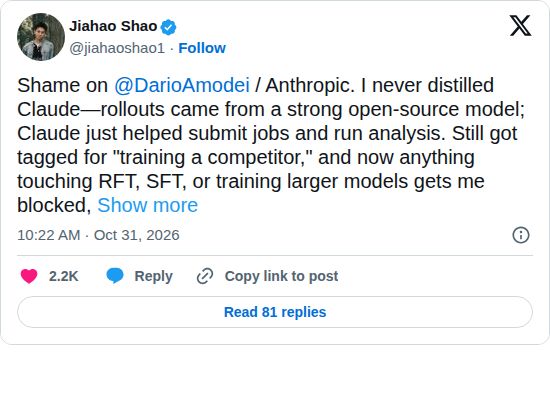
A researcher, Jiahao Shao, reported being blocked by Anthropic after using the company's Claude models to assist in research involving open-source models. Shao claimed that while he did not 'distill' Claude, he used the model to submit jobs and run analysis for a project involving a strong open-source model. According to Shao, Anthropic flagged his account for "training a competitor," subsequently blocking his access to specific features, downgrading his access to certain models, and killing active sessions. He argued that since Anthropic built its models on public data, it is contradictory to treat paying users who perform research automation as adversaries.
Discussion on Hacker News highlighted a perceived trend of Anthropic being highly opinionated and dogmatic regarding its user base. Some commenters suggested that the company may be making a pragmatic business decision to prioritize high-value enterprise users over individual researchers who engage in model training or weight modification. Others noted that the restrictions might not be purely based on the nature of the research, but could be triggered by technical signals. For instance, one commenter pointed out that the researcher is based in Hong Kong—a region where Claude is geo-blocked—and suggested that using a VPN to access the service while performing model training could trigger Anthropic's security classifiers.
Beyond the specific incident, the discussion touched on broader concerns regarding the 'moat' of AI companies and the increasing friction in using LLMs for complex developer tasks. Several users reported instances where Claude refused to perform tasks like extracting services from a monolith codebase or generating context files for multi-computer workflows, citing internal 'moral' or 'extraction' policies. These reports suggest a growing tension between the capabilities of these models and the safety guardrails imposed by their providers, which some users argue are becoming increasingly restrictive for professional and academic research purposes.
Ultimately, the incident underscores a developing boundary in the AI ecosystem: the distinction between using a model for general assistance and using it as a tool for the underlying mechanics of model development. While Anthropic maintains these policies to protect its intellectual property and competitive position, the friction created for researchers highlights a potential shift toward a more closed ecosystem for those working on the frontier of model training and optimization.
Evidence: - Jiahao Shao reported being blocked for "training a competitor" and losing access to Opus 5.5 after using Claude for research automation (primary). - Commenters on Hacker News discussed the possibility of VPN usage and geo-blocking triggers contributing to account flags (hn-50319358). - Users reported Claude refusing tasks like code extraction or context preservation due to internal safety/policy constraints (hn-50319358).