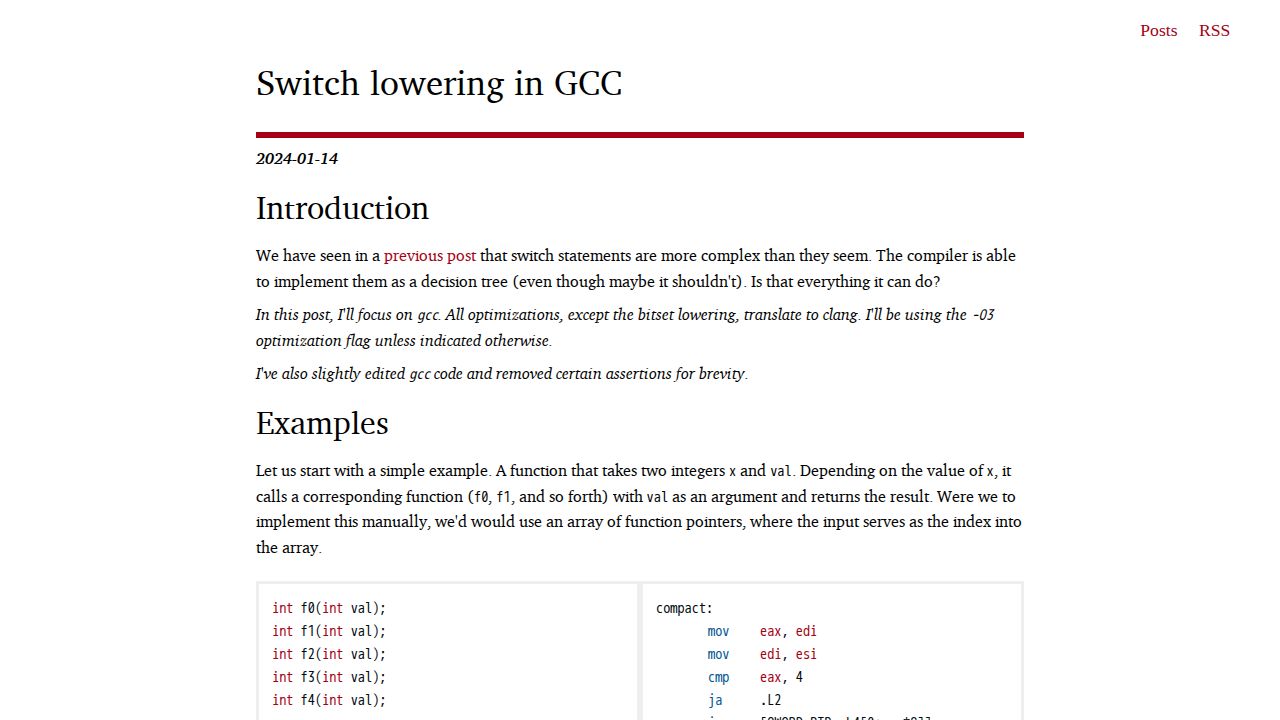
The technical analysis of switch statement lowering in the GNU Compiler Collection (GCC) centers on how the compiler translates high-level switch constructs into efficient machine code. When a switch statement contains a sparse set of values—meaning the cases are not contiguous integers—the compiler must decide between a series of conditional branches or a jump table. A jump table provides O(1) constant-time access but requires a contiguous range of memory. For sparse inputs, the compiler often generates complex logic to map specific values to the correct jump table index, a process known as 'lowering.'
Commenters on Hacker News discussed the limitations of current compiler implementations, specifically noting that neither GCC nor Clang appears to implement perfect hashing for large, sparse switch tables. One commenter, writing as rurban, noted that implementing perfect hashes for such tables could be a significant optimization, particularly for Unicode-related work. They pointed out that while such a patch was rejected in LLVM a decade ago, it remains a viable area for improvement. Another commenter, Andi, shared a contrasting experience in JavaScript engines, where perfect hashing for immutable Maps and Sets showed negligible gains, though it did provide a 2x speedup for complex Unicode range regular expressions.
Technical nuances of the lowering process were also highlighted, including the trade-offs between jump table indirection and hardware branch prediction. One commenter, LarsKrimi, observed that GCC sometimes fails to simplify certain switch patterns (such as those in 'sparse_8') because a mathematical simplification might incorrectly map multiple values to the same default case. Others discussed the impact of hardware Branch Target Buffers (BTB), noting that large switches are prone to branch mispredictions and that compiler lowering must be carefully tuned to accommodate hardware speculation. The discussion also touched on implementation details, such as whether perfect hashes should map to a contiguous range for a jump table or directly to relative offsets for basic blocks.