Modern electrical grids are transitioning into 'cyber-physical' infrastructures, where physical power flow is increasingly dictated by digital control software. This shift has revealed a mysterious, universal phenomenon: a persistent 1-minute oscillation in grid frequency observed across five continents. This pattern is not a result of traditional mechanical resonance, but rather a form of 'unintended synchronization.' It occurs when millions of independently operated but digitally controlled devices—such as electric vehicle chargers, heat pumps, and battery energy storage systems—execute software routines at the exact same time, creating a coherent, periodic peak in power demand that propagates across voltage levels to the transmission interface.
Researchers identified the root cause by performing Fourier analysis on grid-frequency time series from diverse systems, ranging from the massive Continental European synchronous area to small island systems like Iceland and Mallorca. The analysis revealed a remarkably narrow spectral peak at exactly one minute, indicating a precisely timed and phase-coherent process that remains stable over multiple years. The study specifically highlights clock-synchronized control software in battery-based uninterruptible power supplies (UPSs) as a primary driver. These devices generate periodic power-demand peaks that, when synchronized across a large number of units, create a systemic oscillation. This effect is particularly relevant as grids move toward lower 'inertia'—a measure of a grid's resistance to frequency changes—making them more sensitive to these coherent power imbalances.
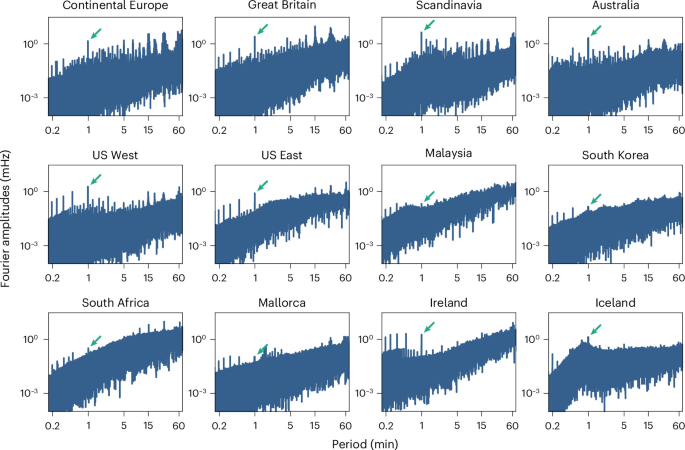
The analysis revealed a remarkably narrow spectral peak at exactly one minute, indicating a precisely timed and phase-coherent process.
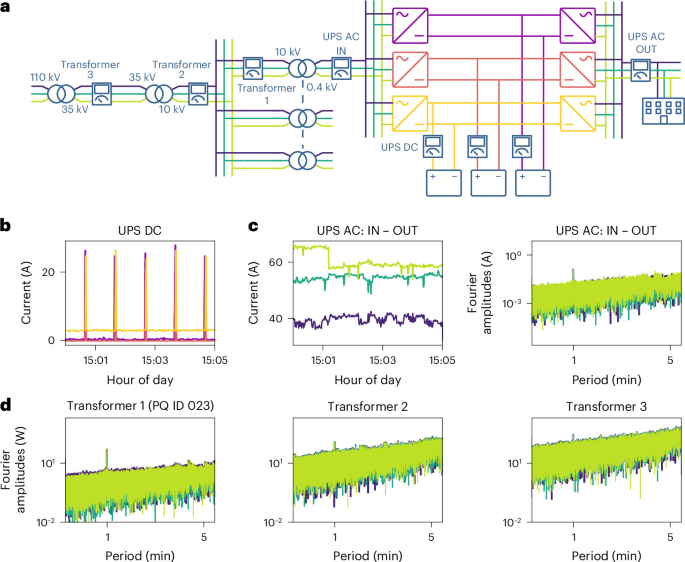
The study specifically highlights clock-synchronized control software in battery-based uninterruptible power supplies (UPSs) as a primary driver.
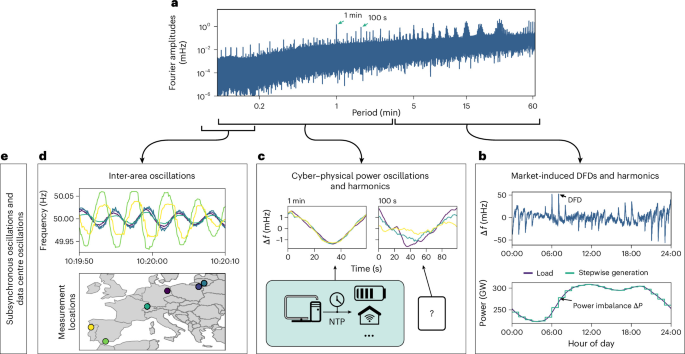
The analysis revealed a remarkably narrow spectral peak at exactly one minute, indicating a precisely timed and phase-coherent process that remains stable over multiple years.
While these oscillations are often benign, they have tangible physical consequences. The 1-minute pattern has been shown to contribute to mechanical wear and tear on infrastructure, particularly in hydropower turbines. In several grids, the amplitude of this pattern has increased substantially in recent years, prompting the implementation of stricter load-frequency control requirements. The study suggests that as the number of Internet-of-Things (IoT) devices and data centers grows, these cyber-physical oscillations may amplify. To mitigate these risks, the researchers suggest that the issue can be addressed directly at the source through improved control design, such as introducing intentional timing variations to prevent large groups of devices from acting in perfect unison.