A significant portion of the shiny coating on classic Halloween treats like candy corn, jelly beans, and Milk Duds is derived from insects. This coating, often listed on packaging as "confectioner's glaze," is actually shellac—a moisture-blocking resin produced by the lac bug. The process begins when a female lac bug pierces a tree to feed on sap; she secretes a gooey substance from an abdominal gland that hardens into a protective cocoon. This resinous home allows her to live, feed, and lay eggs while shielded from predators.

This image serves as a visual metaphor for the article's central theme: the biological origin of candy corn's coating.
While the amount of resin produced by a single insect is microscopic, the industrial scale of candy production requires massive quantities. It takes the secretions of approximately 100,000 insects to produce one pound of finished shellac. Once harvested from tree bark, the resin is melted, purified of wood and insect fragments, and broken into shards for use in food production. According to candy scientist Michelle Frame, roughly a quarter of 1 percent of a shiny candy is composed of this bug by-product. Shellac remains a preferred ingredient because it is food-safe, tasteless, and provides a high-gloss finish that many synthetic alternatives, such as corn-derived zein, cannot match in strength or moisture resistance.
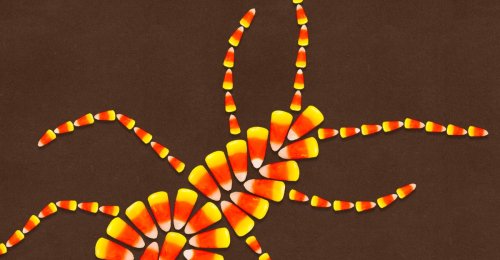
This image provides a clear visual of the specific candy mentioned throughout the text.
Beyond candy, shellac's versatility allows it to be used in furniture polish, nail polish, hair spray, and even as a coating for pills to mask bitter tastes or slow absorption. Its presence in the food supply is part of a broader industrial reliance on animal and insect products. For instance, many gummy candies and candy corn use gelatin derived from animal collagen, while some red dyes are made from crushed cochineal bugs. Even in highly industrialized systems, the FDA permits certain levels of unavoidable insect fragments and rodent hairs in products like chocolate, highlighting the pervasive role of animal and insect by-products in modern food manufacturing.