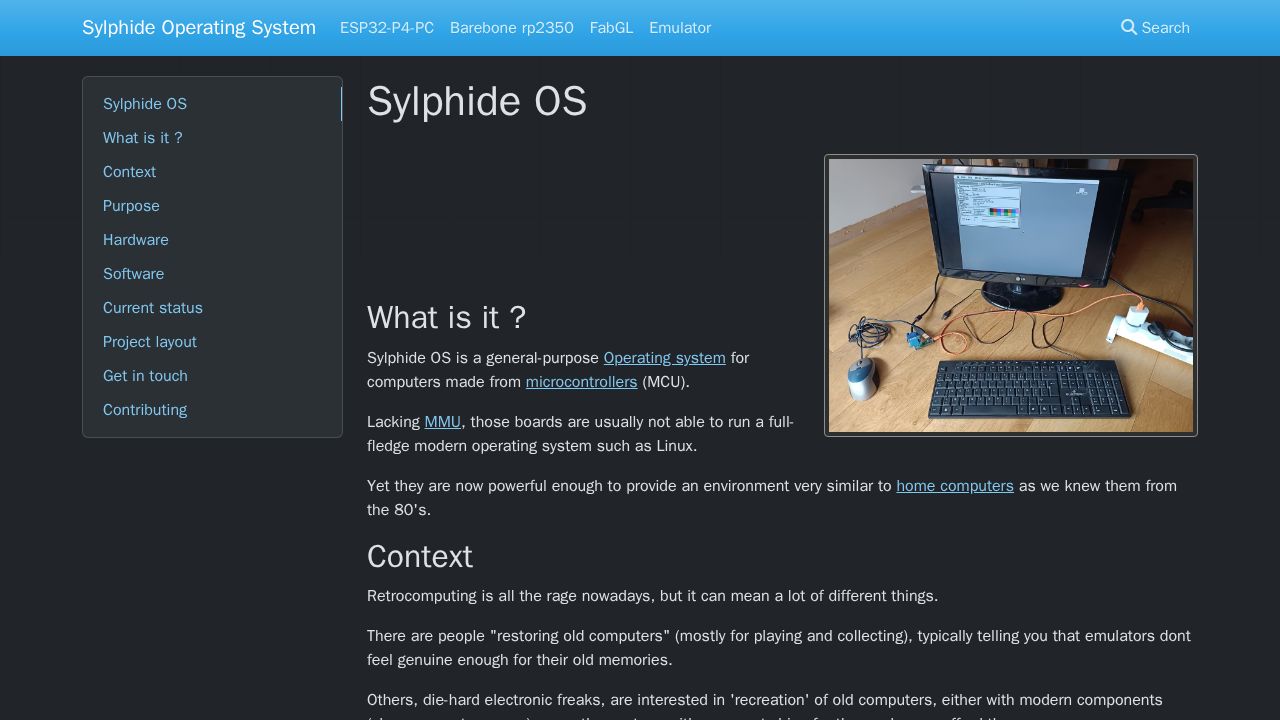
Sylphide OS is a project designed to provide a general-purpose operating system for microcontroller-based computers. Unlike many embedded systems that run a single dedicated application, Sylphide OS aims to support a multi-program environment with a graphical user interface (GUI). The project is built on top of FreeRTOS, a widely used real-time operating system (RTOS) kernel, which provides the underlying scheduling and task management necessary to support its goals.
The project targets hardware such as the Olimex ESP32-P4-PC, a powerful microcontroller board. While the project lists support for various peripherals—including mouse, keyboard, display, storage, and network—some of these features, specifically storage (microSD, USB) and network (Ethernet, Wi-Fi) drivers, are currently listed as planned rather than fully implemented. The choice of hardware highlights a growing trend where high-performance microcontrollers are beginning to rival the capabilities of older personal computers in specific use cases.
Technical discussions regarding the OS have centered on how it manages memory and program execution on systems without a Memory Management Unit (MMU). Because it lacks an MMU, the system must handle how multiple programs are loaded into memory. Commenters on Hacker News discussed whether the OS requires relocatable binaries to function without static task configurations and how this might interact with Execute-in-Place (XIP) capabilities. While some participants noted that these implementations are relatively straightforward on a FreeRTOS base, others pointed out that hardware without an MMU may have inherent limitations regarding XIP support regardless of the software architecture.