Fujifilm has announced a significant investment of approximately 10 billion yen (roughly $63 million) to expand its production capacity for magnetic tape by five times. This expansion, centered at the company's Kanagawa Factory in Odawara, represents its largest investment to date in dedicated LTO (Linear Tape-Open) facilities. The project is scheduled to run from fiscal years 2026 through 2028, focusing on manufacturing the latest-generation FUJIFILM LTO Ultrium10 tape. This move is a direct response to the "exponential growth" in global data needs fueled by the rapid spread of generative AI.
While magnetic tape may seem like a legacy technology, it remains a cornerstone of enterprise and cloud infrastructure due to its unique economic and security advantages. Cloud service and data center operators favor tape because it allows for the storage of massive data volumes at a relatively low cost per gigabyte. Beyond cost, tape offers a critical security feature known as "air-gapping." Because tape cartridges can be physically disconnected and stored in vaults or separate facilities, they provide a final line of defense against sophisticated cyberattacks and ransomware that target connected systems.
The technical evolution of the medium continues to keep pace with modern demands. The LTO Ultrium10, which is the focus of this expansion, utilizes "fine hybrid magnetic particles"—a combination of barium ferrite and strontium ferrite technology—to achieve higher storage limits. While the tape cartridges themselves are cost-effective, the infrastructure required to manage them remains a high-end enterprise solution; for example, standalone LTO-10 drives can cost approximately $25,000. This creates a landscape where tape serves as a high-capacity, secure archive for the massive datasets required to train and maintain AI models, even as the hardware to access those archives remains specialized and expensive.
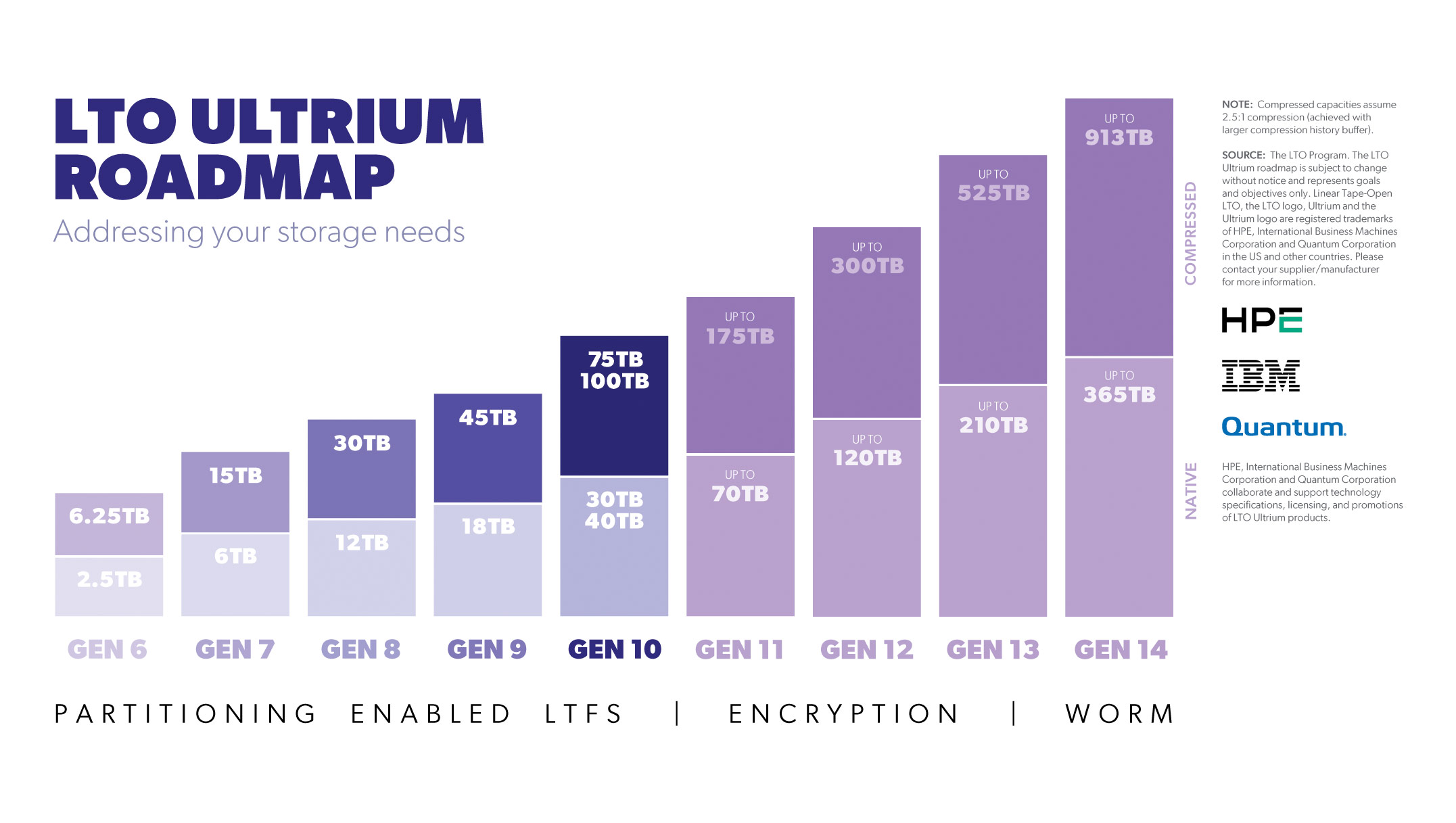
This graph visualizes the technical evolution and capacity growth of the LTO tape medium discussed in the article.