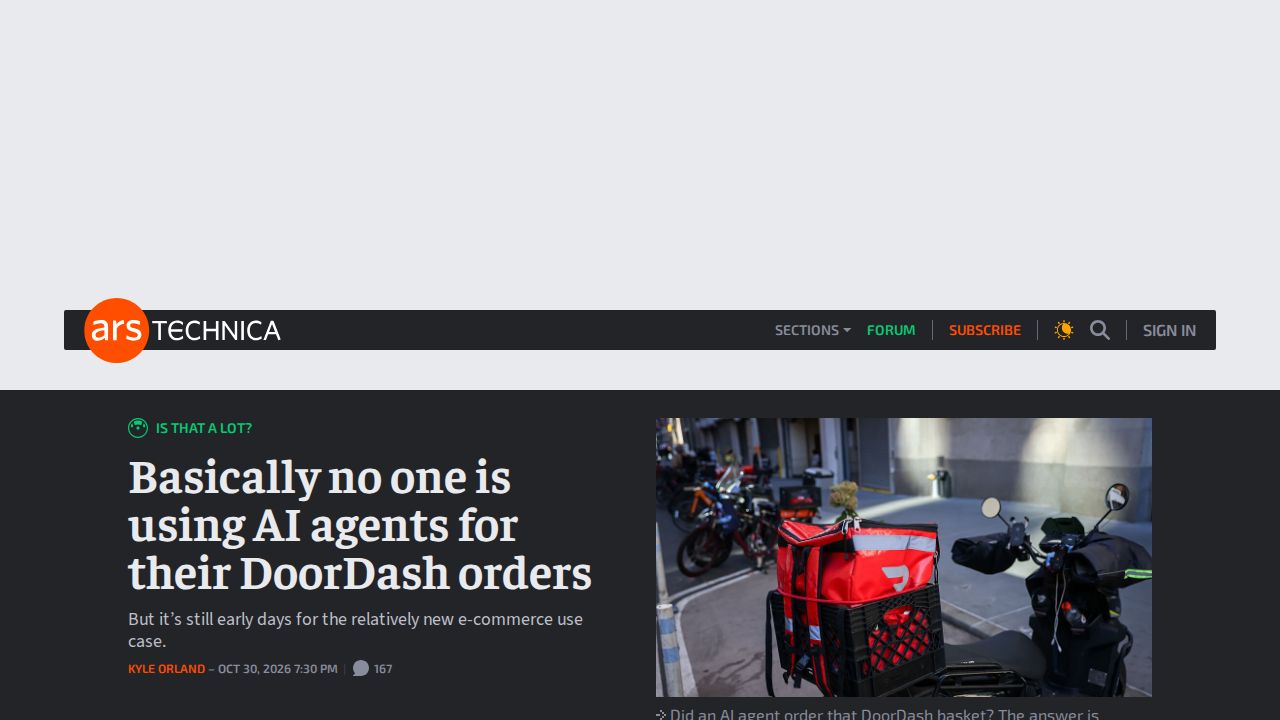
DoorDash has observed a significant gap between the potential of AI agents and their actual usage for food delivery. During a third-quarter earnings call in 2026, DoorDash co-founder and CEO Tony Xu revealed that outside AI agents have generated only several hundred orders to date. This figure stands in stark contrast to the company's total volume, which reached nearly 1 billion orders in the same quarter. Xu characterized this as a "very low use case," suggesting that while AI agents may excel at "long consideration purchases" or proactive background tasks, the simple act of ordering food currently remains a direct, manual interaction for most consumers.
One primary reason for this low adoption is the lack of accessible infrastructure for third-party tools. DoorDash recently introduced a Model Context Protocol (MCP) connector, which provides a standardized way for outside AI tools to interact with the platform. However, this connector was released less than a month prior to the report and is currently restricted to a small number of "early beta partners," primarily used for streamlining corporate lunch orders. Without this direct link, AI agents must attempt to navigate the web interface, a process that is less efficient than using a dedicated API or connector.
DoorDash distinguishes these outside agents from its own internal AI features, such as "Ask DoorDash." This internal tool, which allows users to build shopping carts from recipe photos or vague descriptions, has shown more significant engagement. The company reported that "Ask DoorDash" baskets are built five times faster than traditional methods and result in nearly 50% higher average basket values. Despite these internal successes, the company remains cautious about the broader adoption of third-party agents, comparing the current state to the early days of online ordering in the 1990s. While the technology is evolving, the current friction of using an agent for a simple visual task like food selection remains a significant hurdle for mainstream adoption.
Several factors contribute to this friction, including the inherent design of food delivery apps. Because these platforms are highly visual, users can quickly see their food and the associated costs, making a text-based chat interface feel like a downgrade rather than an upgrade. Furthermore, some users express concerns regarding the reliability of AI in interpreting menu data, particularly when descriptions are poorly labeled or AI-generated. There is also a practical trade-off: for many, the effort of prompting an AI agent—and the associated costs of "burning tokens"—outweighs the convenience of simply clicking through a well-designed mobile interface.
While the current numbers are low, DoorDash leadership views this as a nascent stage of development. The company's stance is that while they do not want to "fight gravity" against the current reality of user behavior, they also avoid being "delusional" about the long-term trajectory of the technology. The transition to agentic commerce may take years to reach a point where it becomes a standard way to interact with everyday services like food delivery.
It remains uncertain how many users will eventually transition to third-party agents as the MCP connector becomes more widely available. Additionally, while DoorDash provided data on the basket values and speed of its internal "Ask DoorDash" tool, it has not yet shared specific usage statistics or conversion rates for that feature, leaving the full scale of internal AI adoption unclear.
Evidence: - DoorDash CEO Tony Xu reported that outside AI agents generated only several hundred orders in Q3 2026 (primary). - DoorDash reported that "Ask DoorDash" baskets are built five times faster and have nearly 50% higher basket values than traditional orders (primary). - The Model Context Protocol (MCP) connector is currently limited to a small number of early beta partners (primary). - Commenters noted that using AI agents for simple tasks can be slower than manual navigation and may involve unnecessary token costs (hn-50338474). - Users expressed concerns about AI's ability to accurately interpret menu data and personal dietary restrictions (hn-50338474). - Commenters argued that the visual nature of food apps makes chat interfaces less intuitive for this specific use case (hn-50338474).
Editorial: - evidence_sufficient: true - story_id: 50338474 - primary_source_id: primary - discussion_digest: false - source_limited: true - submission_only: false - reader_orientation_audit: - Named thing: DoorDash (food delivery app) and AI agents (software that performs tasks on behalf of users). - Change/Claim: Very low adoption of third-party AI agents for ordering food. - Mechanism: MCP connector (standardized way for agents to talk to DoorDash) vs. internal "Ask DoorDash" tool. - Key terms: "Model Context Protocol (MCP)" (standardized interface for AI tools), "tokens" (computational units used by AI models). - Affected parties: DoorDash, third-party AI developers, and consumers. - Uncertainties: Total volume of internal AI tool usage and long-term adoption rates of third-party agents.