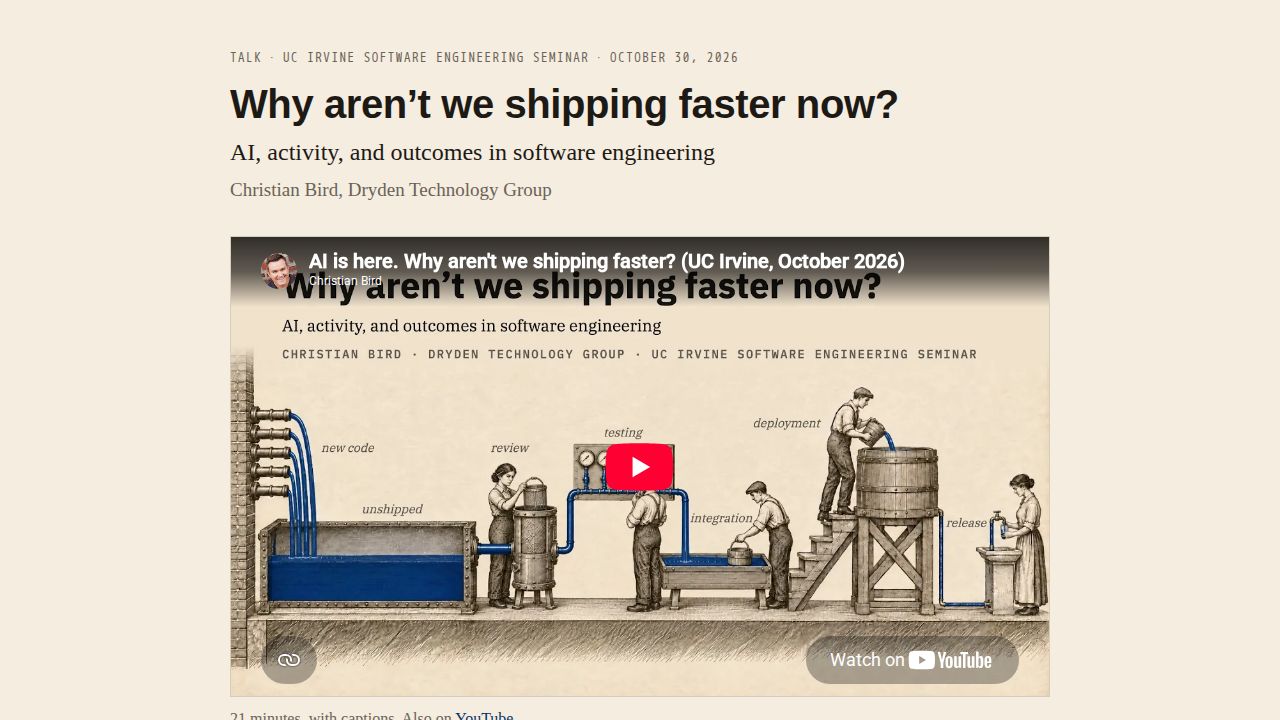
Software engineering is experiencing a widening 'Activity-Outcome Gap' where the rapid generation of code by AI does not automatically translate into faster product releases. Christian Bird of Dryden Technology Group argues that while AI excels at the 'writing' phase of development, the 'shipping' phase remains governed by systemic bottlenecks that AI has yet to bypass.
The Distinction Between Writing and Shipping
Christian Bird's presentation highlights that the primary challenge in modern software engineering is the gap between activity and outcomes. While AI can generate code at unprecedented speeds, the process of turning that code into a 'truly useful object' involves complex requirements that go beyond the editor.
The core issue is that many organizations turn on the 'firehose' of AI-generated code without first building the 'highway' of infrastructure needed to support it. This creates a situation where developers may feel they are moving faster, but the final product's delivery remains stalled by external factors.
“The Activity-Outcome Gap: Why AI Does Not Solve Software Engineering.”
— Why aren't we shipping faster now?
Accelerated Debt Resolution and Migrations
Commenters on Hacker News noted that AI is already providing tangible benefits in specific areas, such as performing full migrations in a single day that previously took weeks of multi-team coordination. One commenter, writing as intrasight, reported using LLMs to address massive technical debt in about one-fifth of the time it would have taken without them.
Another commenter, 9cb14c1ec0, observed that while customers might not see a change in new features, the underlying project is improving faster because security patches and total rewrites are being completed more efficiently. This suggests that AI's greatest immediate impact may be in 'invisible' improvements to project health.
Systemic and Organizational Bottlenecks
Despite the speed of code generation, many developers report that 'shipping' is still delayed by non-technical hurdles. One commenter, mystifyingpoi, described a scenario where code is written 5-10x faster, but the process is still stalled by IT hardware installations, corporate firewall changes, and business-side indecision.
Other participants in the discussion argued that the bottleneck has shifted to CI/CD pipelines and product alignment. One commenter, MisterPea, suggested that the most arduous parts of development—experimentation and aligning with business goals—remain the primary hurdles for modern engineering teams.
Trade-offs in Quality and Scale
The rapid influx of AI-assisted code also introduces risks regarding software quality. One commenter, smy20011, noted that this speed can result in more broken features that are eventually removed, suggesting that the rate of bugs may rise alongside the rate of behavior changes.
Conversely, some developers argue that AI allows for 'deeper' code, enabling the inclusion of full test coverage and edge-case mocks that might have been skipped in a manual workflow. The consensus among commenters is that the impact of AI depends heavily on whether an organization can scale its review and QA processes to match the new speed of production.
Unresolved Questions on Software Improvement
A central question raised in the discussion is whether faster shipping actually leads to better software. One commenter, ferguess_k, noted that while shipping may be faster, it does not necessarily result in a better product.
The discussion also touched on the 'Activity-Outcome Gap' described in Bird's research, questioning why software isn't improving at the same rate as the tools used to build it. This suggests that the next frontier for software engineering may be optimizing the 'non-coding' parts of the lifecycle rather than the coding itself.