Microsoft has begun rolling out a preview update for Windows 11 designed to address a persistent point of friction for power users: the redesigned right-click context menu. Since the launch of Windows 11, many users complained that the new interface moved familiar commands—such as 'Send To' or 'Create Shortcut'—behind a 'Show more options' submenu, disrupting years of established muscle memory. The new update, identified as KB5127936, introduces a 'customize menu' button. This feature allows users to toggle built-in commands on or off, rearrange the order of items in the main menu, and manage which third-party extensions appear in the primary or secondary menus.
Beyond menu customization, the preview update introduces a recovery feature called 'Cloud Rebuild.' This tool allows users to reinstall Windows 11 directly from the cloud if the operating system fails to boot, pulling the necessary image and system drivers directly from Windows Update. This removes the need for external recovery media or custom images. However, Microsoft clarifies that Cloud Rebuild functions more like a fresh installation than a repair; it does not preserve existing applications or files, though it allows users to sanitize system drives before initiating the process.
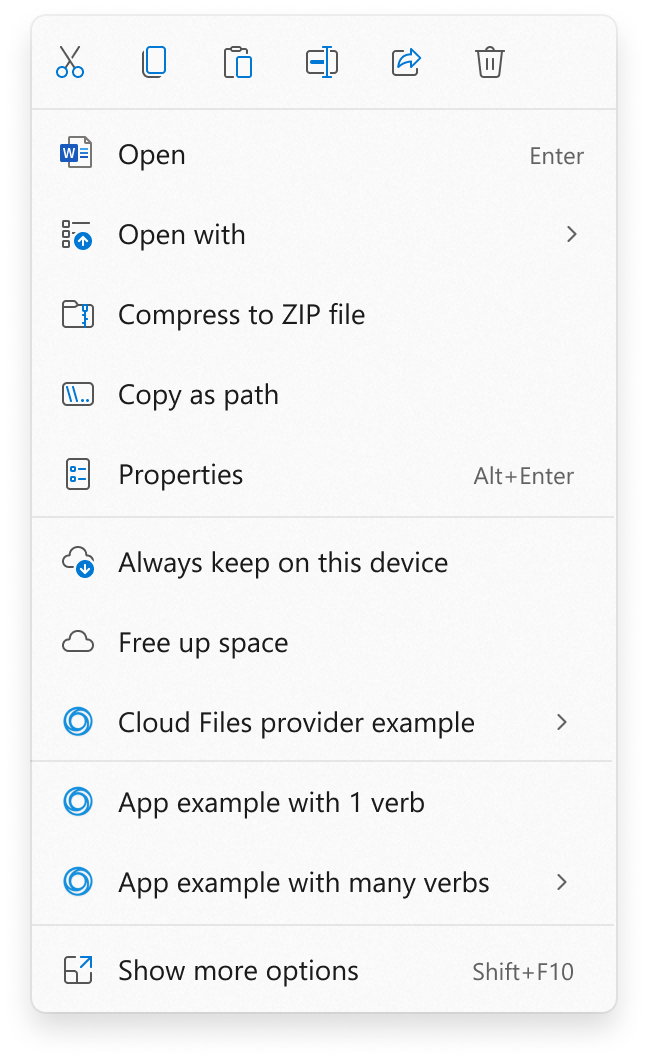
This image illustrates the current Windows 11 right-click interface that the KB5127936 update aims to improve by allowing for more direct customization.
These software refinements coincide with a challenging period for Microsoft's traditional PC business. In its latest quarterly report, the company revealed that Windows OEM revenue—the sale of licenses for new PCs—decreased by 27% to 28% in constant currency. This decline is attributed to a combination of weaker PC market demand, inventory drawdowns by partners, and the conclusion of the Windows 10 end-of-support demand cycle. While the PC segment is struggling, Microsoft's pivot toward cloud services is yielding significant results. Azure and other cloud revenues saw jumps of 48% and 30% respectively, now accounting for approximately 70% of the company's $92.3 billion total quarterly revenue.