Valles Marineris is a massive canyon system on Mars that dwarfs Earth's Grand Canyon, stretching nearly 3,900 kilometers across the planet. It reaches widths of up to 600 kilometers and depths of over nine kilometers, making it the largest canyon system in the solar system. While it was formed billions of years ago, new research from scientists at Columbia University and Imperial College London suggests that the canyon is not a 'dead' fossil landscape. Instead, the geological structures that created it remain active today, continuing to shape the Martian surface.
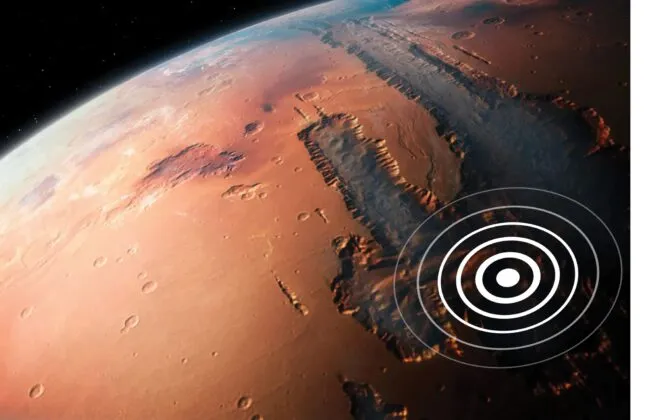
This image provides a visual reference for the massive scale of the Valles Marineris canyon system described in the opening paragraph.
The discovery centers on a specific seismic event, designated S0976a, which was recorded by NASA’s InSight lander on August 25, 2021. This event was unique because it was the only marsquake detected during the mission that could be located in the planet’s western hemisphere. By analyzing the amplitudes and directions of the seismic waves, researchers determined that the event was a 'strike-slip' marsquake. This means blocks of the Martian crust moved horizontally past one another along a steep, deeply rooted fault located roughly 20 to 40 kilometers beneath the surface. The team ruled out other possibilities, such as meteoroid impacts or landslides, by testing various models and confirming that no new impact craters or large landslides were visible in satellite imagery of the region.
This activity highlights a significant difference between Martian and terrestrial geology. Unlike Earth, Mars lacks a system of moving tectonic plates; its outer shell behaves more like a single, slowly cooling lid. Because of this, structures created during the planet's early evolution can remain structurally weak. These ancient faults can still rupture today due to a combination of the planet's long-term cooling, stresses from the nearby Tharsis volcanic region, and local effects associated with the canyon itself. These findings suggest that even seemingly inactive planetary bodies may harbor ongoing seismic evolution, providing a new way to study how planets like Mars continue to change over billions of years.