Figma is shifting its AI strategy toward specialized post-training to address the nuances of iterative design work. While frontier models are capable of broad tasks, they often struggle with the small, non-verifiable edits that designers perform daily—such as adjusting a button's spacing, changing a specific color, or reworking a layout based on feedback. To solve this, Figma developed a design agent that uses a first-party editing model specifically trained to understand Figma's internal syntax and design system assets. This allows the agent to perform precise iterations directly on the canvas, where speed and accuracy are critical to maintaining a designer's workflow.
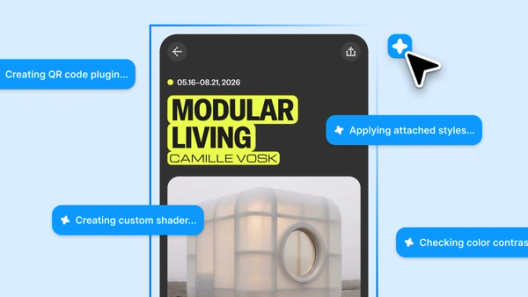
This image illustrates the design agent's ability to perform precise iterations directly on the canvas, such as adjusting spacing and colors.
The technical core of this approach involves supervised fine-tuning (SFT) using Figma's native file format. By representing designs in their native structure, the model learns to produce changes that can be applied directly back to the canvas. Figma built a 'self-healing' generation pipeline where larger 'teacher' models attempt edits, which are then checked by deterministic validators and visual model judges. If an edit fails a check—such as causing overlapping text or clipped icons—the pipeline uses evaluator feedback to revise the output. This method allowed an earlier Llama 3.3 70B model, trained on over 250,000 examples, to become competitive with top-tier models on specific editing tasks.
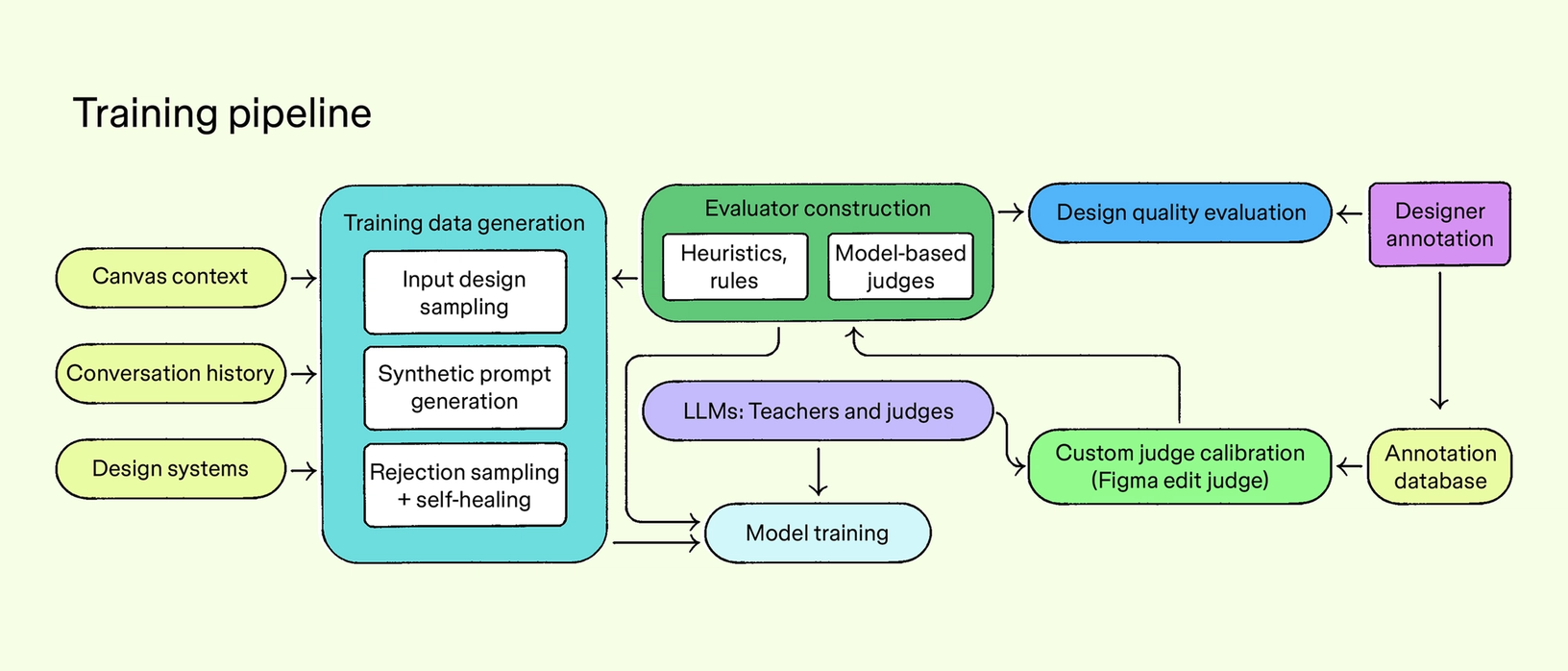
This diagram explains the technical core of the approach, including the self-healing generation pipeline and evaluator construction.
However, Figma noted that SFT alone has limitations, specifically regarding 'imitation learning,' which can cause a model to mimic training data too closely at the expense of generalization. To counter this, the company is integrating Reinforcement Learning (RL) into its training recipe. This shift focuses on improving the diversity of training examples and shaping reward models based on expert-written criteria that reflect actual designer priorities. Early results indicate that this specialized approach is effective: in head-to-head testing, the new agent matched or beat previous production versions 62% of the time, while reducing the average cost per message and improving typical task speeds by approximately 20%.
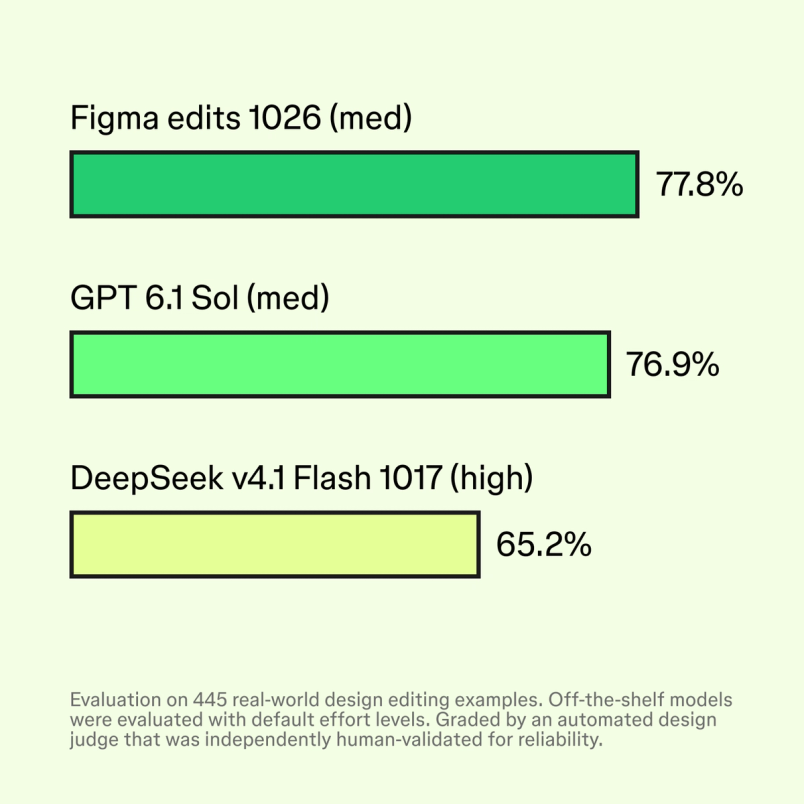
This chart supports the claim that the new agent matched or beat previous production versions in head-to-head testing.