AI assistants frequently provide statistics that appear credible but lack verifiable evidence, a phenomenon Trakkr Research identifies as 'zombie stats.' These are numbers that are repeated across various web pages—such as news articles, marketing materials, and blog posts—without ever being linked back to an original study. For example, the claim that 44% of salespeople give up after one follow-up attempt is a common figure cited by multiple AI models. However, tracing this specific number reveals a trail that ends at a freelance writer's sample article and a sales firm's stats page, neither of which contains an actual study to support the figure.
To investigate this, researchers analyzed 1,285 statistics provided by five major AI assistants: ChatGPT, Perplexity, Gemini, Claude, and Google AI Overviews. They followed each citation trail up to five pages deep to find the original source. The results showed that only 40% of these statistics successfully reached a study that confirmed the same number. The remaining figures either led to dead ends, were found to have changed in context or value along the way, or were completely untraceable. Notably, ChatGPT quoted the fewest numbers per answer (1.3) and had the highest sourcing success rate (57%), while other models like Claude and Gemini quoted significantly more statistics per answer but had lower sourcing success rates.
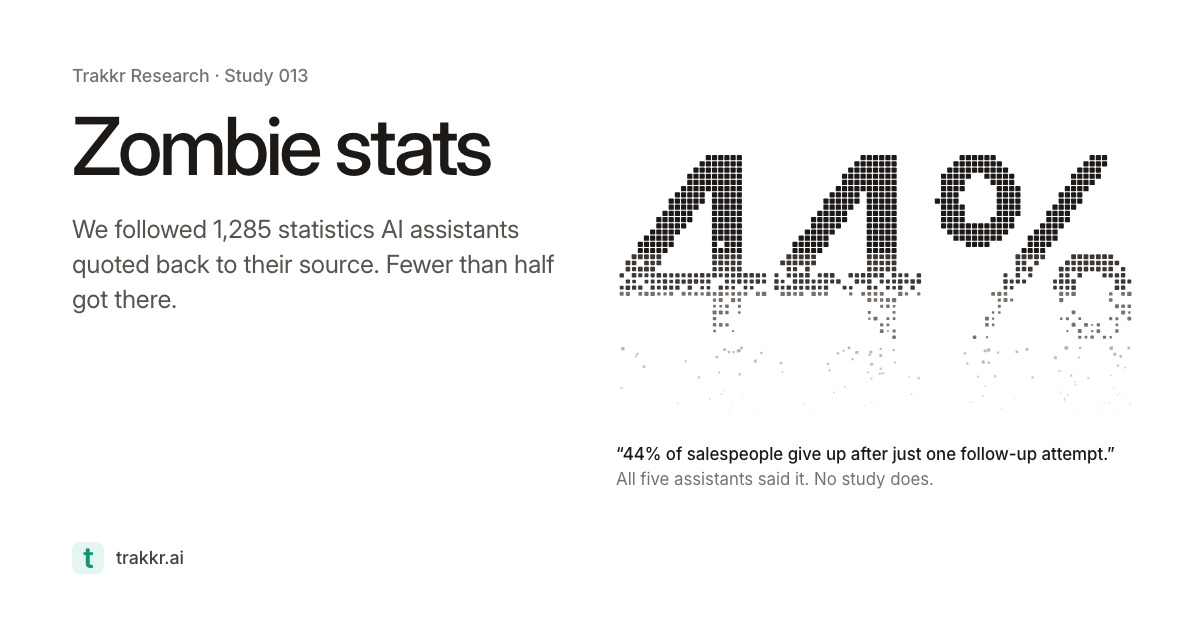
This image illustrates the concept of zombie stats described in the first paragraph, where numbers are repeated across web pages without a primary study link.
The research highlights a significant correlation between the type of source and the likelihood of finding a primary study. When an AI assistant cited a government page or a research firm, the trail reached a matching study 61% to 62% of the time. In contrast, when the first citation was a company blog—which accounted for 54% of all first citations—the success rate dropped to 37%. Even when a study was eventually found, 17% of the statistics had 'drifted' in meaning, with changes occurring in the year of the study, the specific population asked, or the metric being measured. This suggests that AI models are often retrieving and repeating figures from secondary marketing content rather than primary research, potentially prioritizing the speed of an answer over the accuracy of its underlying data.
This figure supports the data in the second paragraph regarding the specific sourcing success rates and citation counts for ChatGPT, Claude, and Gemini.
One significant limitation of the study is that 40% of the trails stopped at sources that were 'locked, gone, or silent,' meaning the true origin of those statistics remains unknown. Furthermore, the research indicates that while the AI models are rarely 'making up' numbers entirely—often correctly identifying the figure on the cited page—they are frequently failing to distinguish between a primary research finding and a secondary summary. This creates a risk where users receive a confident, cited answer that is actually a 'zombie' figure, repeated by many sources but anchored to no actual data.