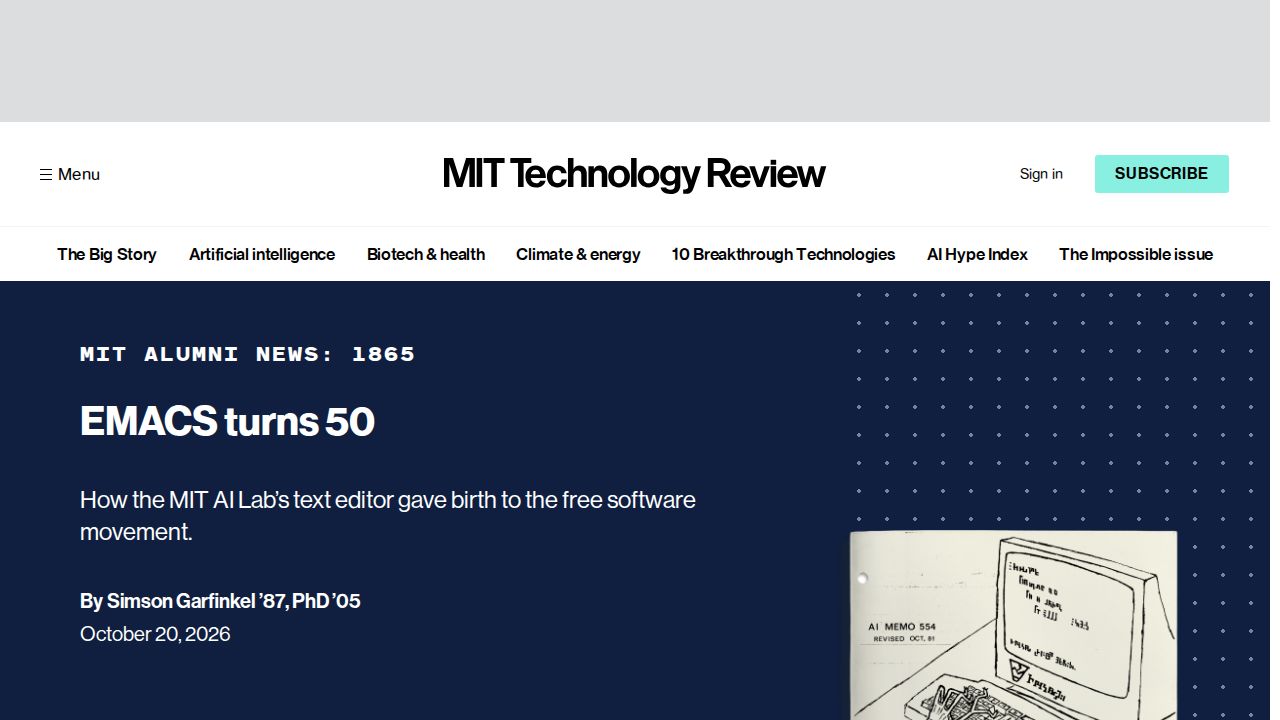
EMACS first appeared in 1976 at the MIT Artificial Intelligence Laboratory, emerging from a need to standardize the user experience for researchers. Before its inception, programmers used tools like TECO (Tape Editor and Corrector), which eventually evolved into a full programming language capable of creating macros. While early iterations like Control-R introduced video displays, they lacked a unified interface. The creation of EMACS was driven by a desire to broker consensus; by assigning a standard set of commands to the 'Meta' key—such as Meta-F to move forward a word—the developers aimed to solve the social problem of inconsistent workflows among lab members. This focus on a shared, predictable interface allowed users to learn the editor quickly while providing 'sophisticated users' with a powerful, customizable environment.
The editor's technical architecture was defined by its macro system, where every keypress could trigger a specific command. This design choice effectively turned the editor into a programmable environment where the code itself served as the API. This extensibility became a defining characteristic, allowing the software to be rewritten for various operating systems and eventually distributed as part of the GNU Project. Richard M. Stallman’s commitment to the 'software-sharing commune'—where users were required to return any improvements they made—laid the groundwork for the modern free software movement. This ethos eventually led to the creation of GNU Emacs, which remains a primary application of the GNU Project and was even included in early versions of Apple's Mac OS X.
Despite the rise of modern integrated development environments (IDEs), EMACS maintains a significant presence due to its longevity and the 'muscle memory' of its long-term user base. Its enduring relevance is supported by its ability to integrate with modern technologies, such as AI-assisted configuration and advanced package managers like Magit. However, the editor's history also highlights a complex relationship with commercial interests; while Stallman pushed for free software, other versions of EMACS were commercialized by companies like Honeywell and even by James Arthur Gosling, the creator of Java. Today, EMACS remains a unique 'hackable' environment that continues to serve as a primary development tool for those who value a self-documenting, infinitely customizable workspace over the standardized features of contemporary competitors.