Survival LLM is a free, open-source AI assistant and emergency library designed to function entirely offline. Unlike standard large language models (LLMs) that rely on cloud-based processing, Survival LLM stores both the AI model and its reference library directly on the user's computer. This architecture ensures that the tool remains accessible during internet outages, power failures, or other infrastructure collapses. The application is compatible with both Mac (Apple Silicon) and Windows systems, requiring a one-time setup period where the user downloads the necessary components while online.
The system operates by querying a massive local database of plain-text references, which includes approximately 930,000 Wikipedia articles, WikiMed medical encyclopedias, and official guidance from agencies like the CDC, FEMA, and the U.S. military. When a user asks a question—such as how to treat a burn or purify water—the AI generates a response based on these trusted sources. A key feature of the tool is its transparency: every answer includes a list of the specific articles the AI consulted. Users can click these links to view the exact passage used, allowing them to verify the information manually to mitigate the risk of AI hallucinations.
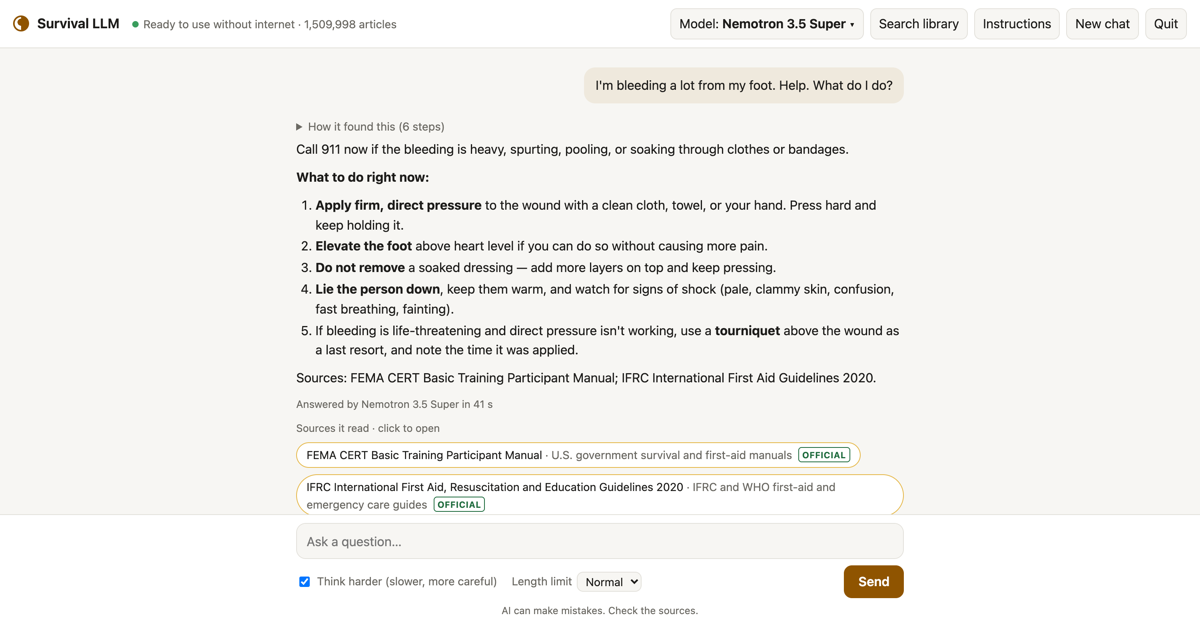
The application provides a transparent way to verify information by listing the specific articles consulted for every answer.
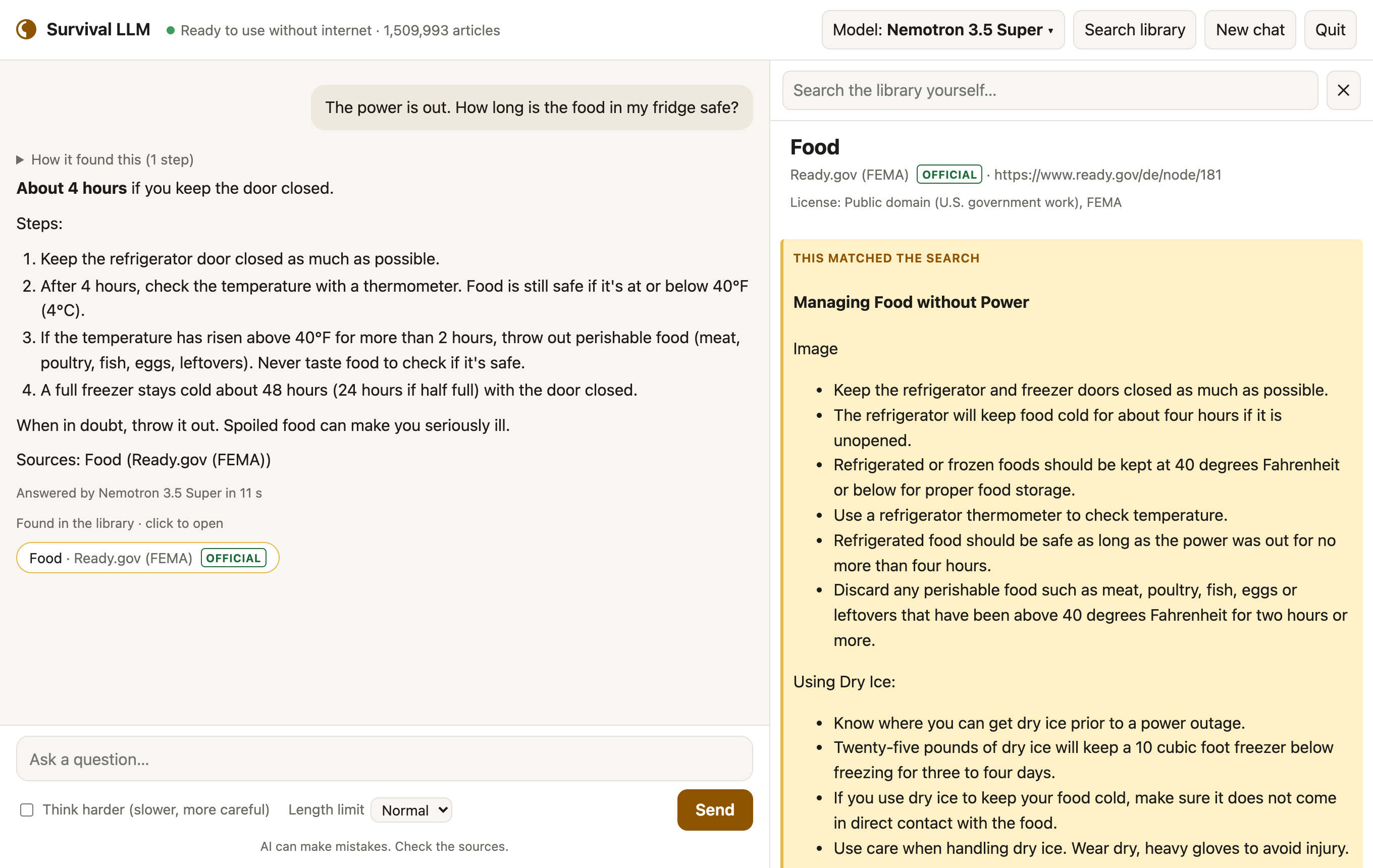
A key feature of the tool is its transparency: every answer includes a list of the specific articles the AI consulted.
Because the tool runs locally, the performance and accuracy of the AI depend on the user's available hardware. The application automatically detects the computer's memory and downloads a model suited to that capacity. For example, a Mac with 128 GB of memory can run the NVIDIA Nemotron 3.5 Super model, which scored 21 out of 22 correct on an emergency test, while a machine with 16–31 GB of memory uses the IBM Granite 4.2 8B model, which scored 14 out of 22 correct. This discrepancy highlights a significant trade-off: while smaller models are more accessible on standard consumer hardware, they are more prone to errors. To compensate for this, the developers emphasize that the AI should be used as a search tool to surface underlying knowledge rather than a definitive source of truth, especially in high-stakes medical scenarios.",