As artificial intelligence models grow in complexity, the infrastructure required to train them faces a significant bottleneck: the speed and efficiency of moving data between massive pools of compute resources. Traditional networking methods are increasingly struggling to keep pace with the demands of these high-scale systems. To address this, the computing industry is turning toward optics—using light rather than electricity to transmit data—to provide more scalable and efficient connectivity for AI data centers.
PsiQuantum has introduced an Optical Circuit Switching (OCS) technology to meet these demands. The company's first publicly disclosed OCS is an 8x8-radix demonstration vehicle built on a silicon photonics platform that the company spent nearly a decade developing for utility-scale quantum computing. Silicon photonics allows for the integration of optical components onto semiconductor chips, enabling high-speed data routing. In lab testing, this demonstration vehicle achieved a typical insertion loss of 1.2 dB and 40 dB of crosstalk, with a reconfiguration time of less than 3 ms. These results exceeded the initial performance targets for the devices and were achieved without the need for signal amplification.
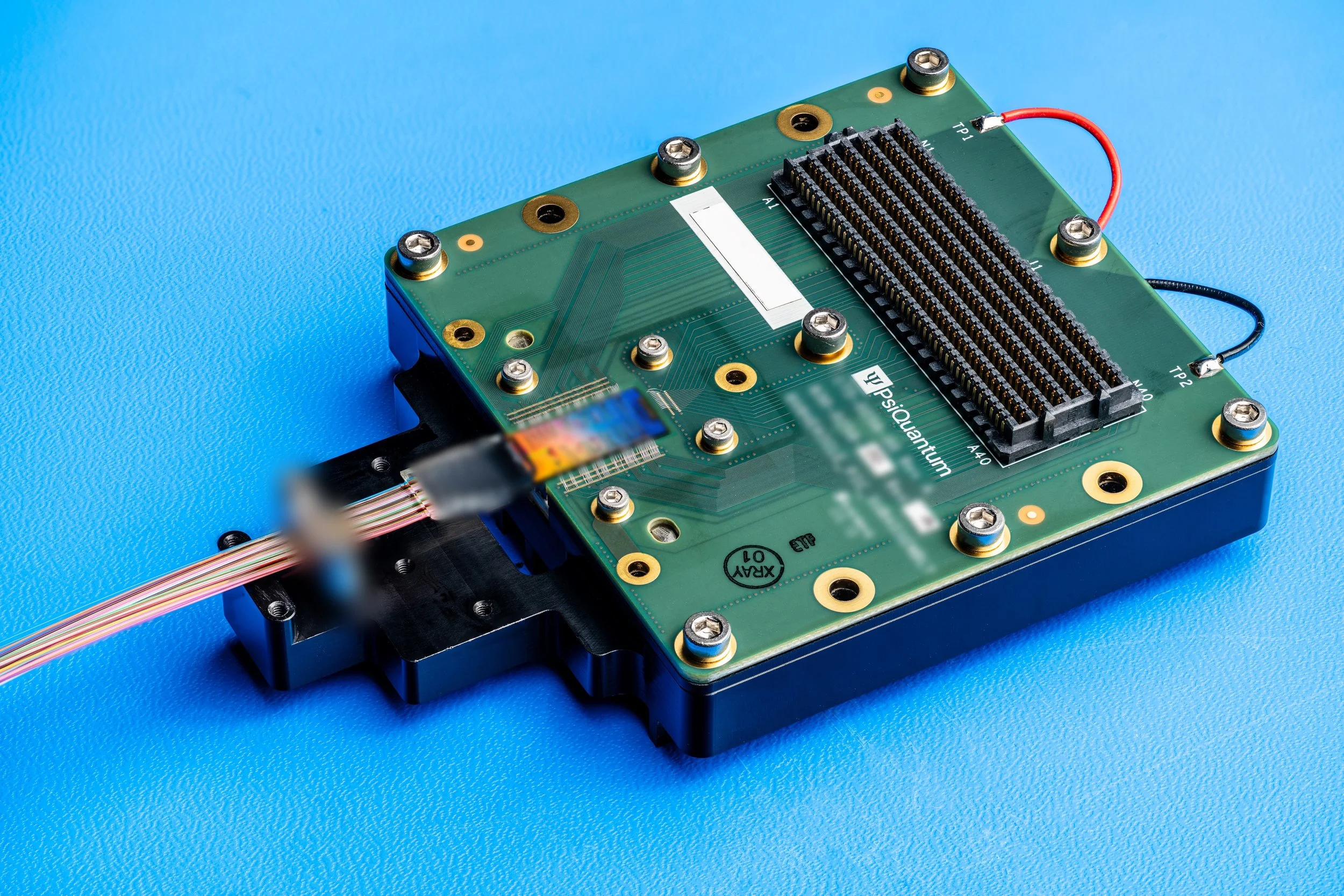
The image serves as a visual representation of the OCS technology built on the silicon photonics platform described in the article.
This technology is effectively a byproduct of the extreme requirements of fault-tolerant quantum computing. Because PsiQuantum designed its platform to handle the most demanding scaling problems imaginable for quantum systems, the resulting hardware is highly capable of meeting the requirements for AI data centers. While the current demonstration vehicle does not utilize barium titanate (BTO) integration, the underlying platform supports it for future, more advanced products. By repurposing this high-precision hardware, PsiQuantum aims to remove bottlenecks in AI infrastructure while continuing its primary mission of building the world's first useful, fault-tolerant quantum computers.