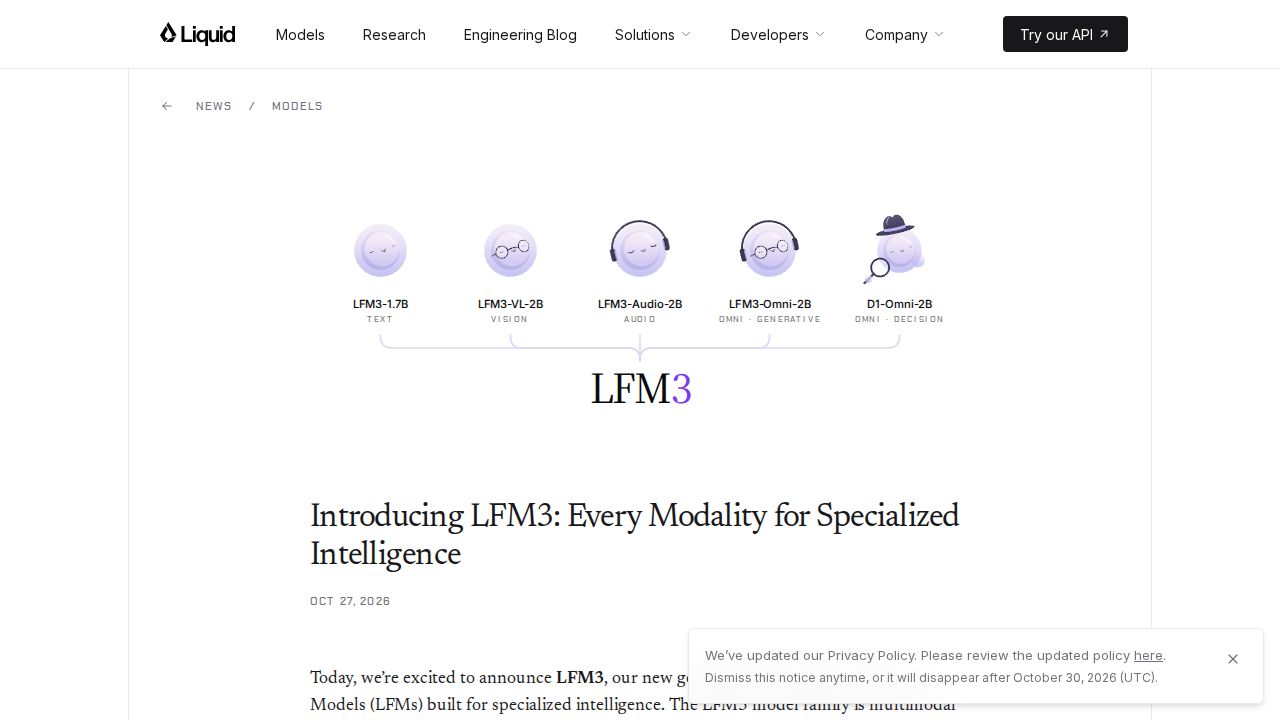
Liquid AI has introduced LFM3, a new series of models designed to provide specialized intelligence across multiple modalities. The release focuses on balancing high-performance capabilities with efficiency, aiming to support a range of use cases from general knowledge tasks to complex agentic coding. The models are positioned as a step up from the previous LFM 2.6 generation, with a focus on maintaining speed while improving accuracy and reasoning capabilities.
The LFM3 lineup includes several variations, such as the 1.7B parameter model and a Vision-Language (VL) version. Early user feedback highlights varying performance across these models; for instance, some users observed that the LFM3-VL-2B model occasionally outperformed the LFM3-1.7B model on text-only prompts in specific testing environments. Additionally, the 1.7B model has been noted for its performance in agentic coding tasks, with some comparisons suggesting its capabilities are on par with significantly larger models, such as the Qwen3.5-4B and Qwen3.5-9B models.
Practical applications for LFM3 include local AI deployment, where users are exploring its integration into home assistants and mobile devices. Some users have reported using the models for metadata enrichment and triaging personal data streams, such as emails and text messages. However, early adoption has faced some technical hurdles, with some users reporting issues loading the models in specific local environments. The models are intended to facilitate 'mini-agent' capabilities on hardware with limited resources, such as mobile NPUs and consumer-grade GPUs, by providing a balance between model size and intelligence.