Naval blockades—the act of restricting an enemy's maritime trade or confining their fleet—are as old as maritime warfare itself. While modern technology like satellites and unmanned systems has transformed the scale of these operations, the underlying strategic problems remain consistent with those faced in the ancient Mediterranean. By examining four specific historical cases, naval historians can identify the enduring challenges of maintaining control over a contested sea space to achieve a political or military objective.
Historical precedents illustrate the fragility and logistical demands of maintaining a blockade. For example, during the Athenian campaign against Samos (440–439 BCE), the blockade was temporarily broken because a portion of the Athenian fleet was diverted to meet a secondary threat. This demonstrated that even a brief weakening of forces on station can provide a defender with a window to restore maritime access. Conversely, the siege of Rhodes (305–304 BCE) showed the limits of a blockade; despite a formidable fleet and siege machinery, the attackers could not make the waters completely impermeable. Because Rhodes maintained enough access to receive grain and supplies from outside powers like Ptolemy of Egypt, the blockade failed to achieve its coercive purpose, eventually forcing a settlement.
Furthermore, the dynamics of a blockade can be reversed or rendered unsustainable by the costs of the operation itself. At Syracuse in 413 BCE, the Athenians transitioned from the aggressors attempting to isolate the city to the besieged, as Syracusan forces seized key positions and used merchant vessels to physically block the harbor entrance. Similarly, the Roman effort to blockade Lilybaeum during the First Punic War (250–249 BCE) highlights the attrition of such operations. The Romans faced significant manpower depletion and disease, and their eventual attempt to strike a nearby Carthaginian base resulted in a devastating defeat. These cases collectively suggest that a blockade is a contest of endurance where the success of the operation depends on the ability to sustain pressure while managing the mounting costs of the blockade force itself.
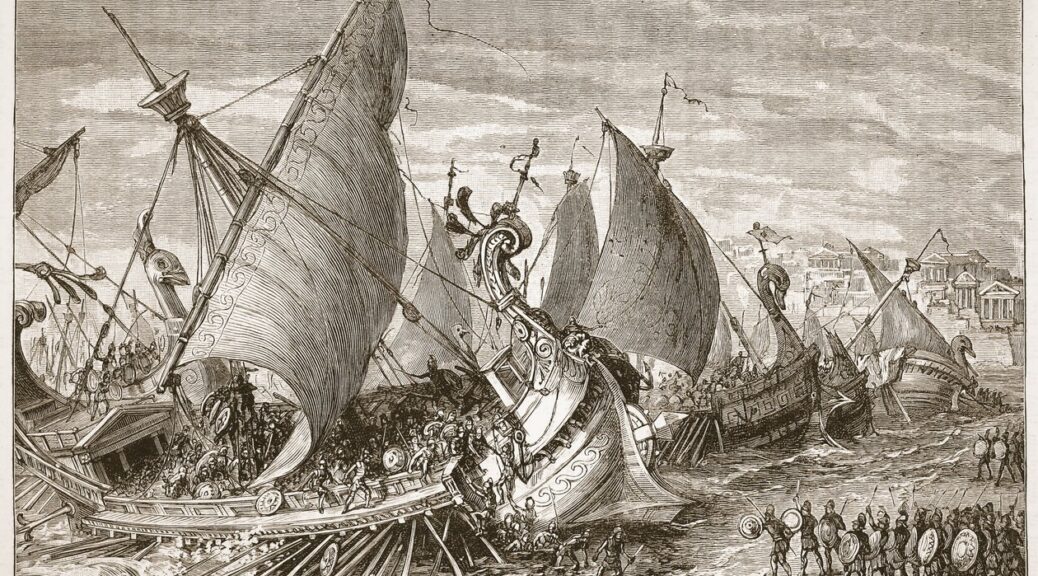
This image provides a visual representation of the naval engagements and harbor blockades discussed in the historical analysis.